Trump Presses Taoiseach on LNG as Coalition Navigates Diplomatic Tightrope Between Washington and Climate Commitments
The political fallout from Donald Trump's visit to Ireland is already reshaping the domestic debate about the country's relationship with the United States, as the coalition government faces pressure from opposition parties and environmental groups over its handling of the LNG question — a dispute that cuts to the heart of the tension between Ireland's economic dependence on US corporate investment and its legally binding climate commitments under the Climate Action Plan.
Background
Ireland's relationship with the United States is unlike that of any other European country. The presence of more than 800 US multinational companies — including Apple, Google, Meta, Pfizer, and Johnson and Johnson — makes the US the single most important source of foreign direct investment in the Irish economy, accounting for the majority of Ireland's corporation tax receipts and a substantial proportion of its export earnings. This economic reality gives the US government a degree of leverage over Irish policy that is qualitatively different from its relationship with larger European economies.
The LNG question has been building since Trump raised it during the St Patrick's Day meeting in Washington earlier in 2026. The US has become the world's largest LNG exporter, and the Trump administration has been pressing European countries to purchase American gas as a way of reducing their dependence on other suppliers and simultaneously reducing the US trade deficit with Europe. Ireland's trade surplus with the United States — driven by the pharmaceutical and technology sectors — has made it a particular focus of this pressure.
The Irish government's position on LNG has been complicated by its climate commitments. The Climate Action Plan sets legally binding targets for the reduction of greenhouse gas emissions, and the development of a new LNG terminal — which would lock Ireland into fossil fuel infrastructure for decades — sits uneasily with those commitments. Environmental groups have argued that any LNG terminal would be incompatible with Ireland's climate obligations and would undermine the credibility of the government's climate policy.
Key Developments
At the Farmleigh meeting, Trump pressed the case for Irish LNG imports with characteristic directness, framing the purchase as a straightforward mechanism to reduce the trade imbalance and strengthen the bilateral relationship. Taoiseach Martin is understood to have indicated Ireland's openness to the Shannon LNG terminal project while emphasising the need for any development to be consistent with Ireland's climate commitments — a formulation that satisfies neither the American president nor the environmental lobby.
In the Dáil, opposition parties have been quick to exploit the political tensions created by the visit. People Before Profit and the Social Democrats have called on the government to reject the LNG proposal outright, arguing that it would be a betrayal of Ireland's climate commitments. Sinn Féin has taken a more nuanced position, acknowledging the importance of the US relationship while questioning whether LNG imports are the appropriate mechanism for managing the trade imbalance. Fine Gael and Fianna Fáil have defended the government's approach as pragmatic and consistent with Ireland's national interests.
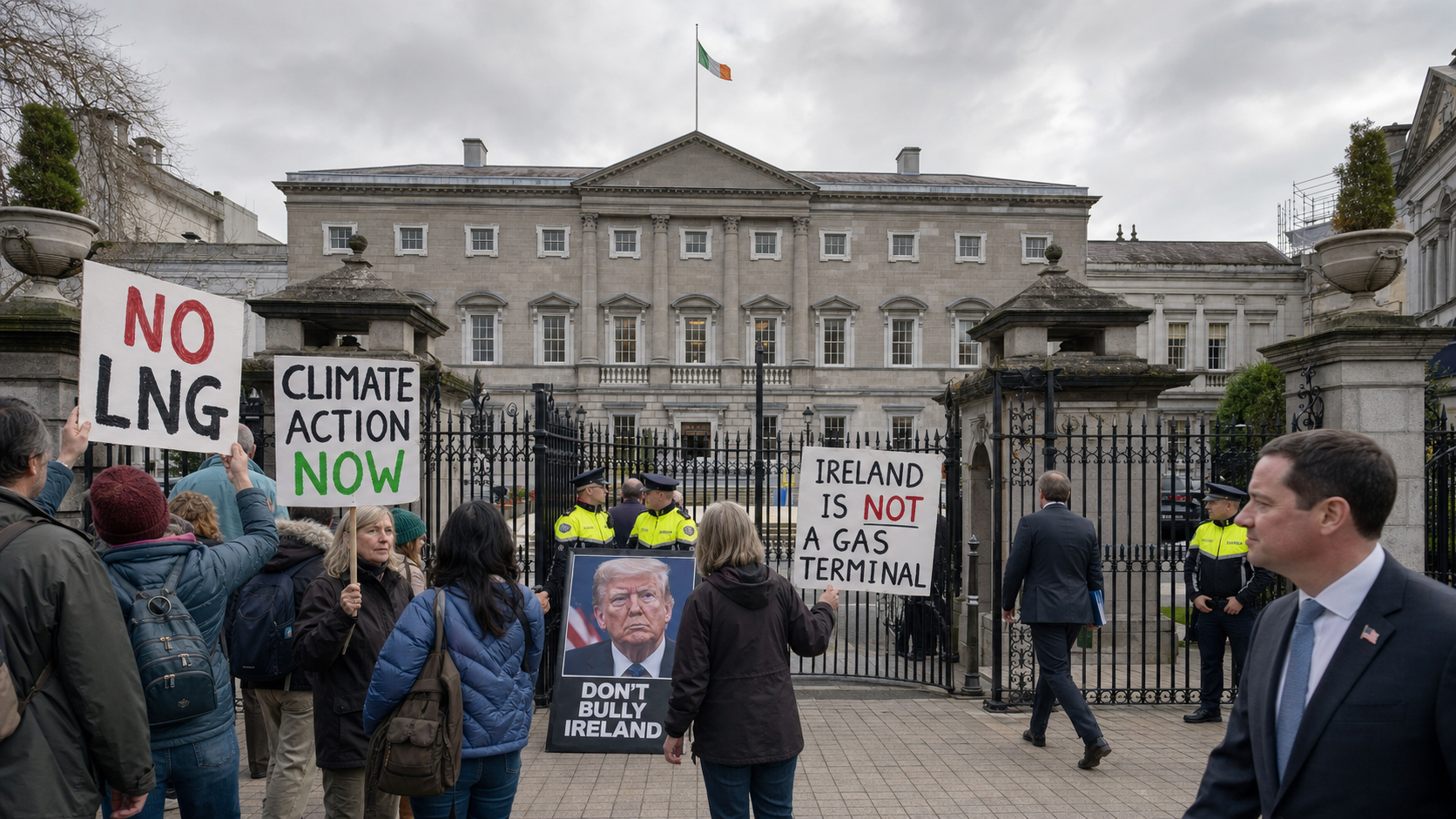
The protests that accompanied the visit — in Dublin and Doonbeg — were smaller than some had anticipated, reflecting perhaps the complexity of the public's feelings about a visit that is simultaneously diplomatically important and politically uncomfortable. The Irish Neutrality League, which organised the Dublin protest, has called for a more assertive Irish foreign policy that is less deferential to American pressure.
Why It Matters
The LNG dispute is a microcosm of a broader challenge facing small, open economies in an era of great power competition: how to maintain the economic relationships that underpin prosperity while preserving the policy autonomy to make decisions in the national interest. Ireland's dependence on US corporate investment is a source of enormous economic strength, but it also creates vulnerabilities that are exposed whenever the US government decides to use its economic leverage for political purposes.
The climate dimension adds a further layer of complexity. Ireland has made legally binding commitments to reduce its greenhouse gas emissions, and those commitments are not merely aspirational — they carry legal force under the Climate Action and Low Carbon Development Act. A decision to develop an LNG terminal that locks Ireland into fossil fuel infrastructure for thirty or forty years would be difficult to reconcile with those commitments, and would expose the government to legal challenge from environmental groups.
Local Impact
In Shannon, where the proposed LNG terminal would be located, the project has divided opinion. Supporters argue that it would bring significant investment and employment to the Shannon estuary region, which has been seeking to diversify its economic base since the decline of traditional industries. Opponents argue that the environmental risks — including the risk of methane leaks during LNG production and transportation — outweigh the economic benefits. Shannon Group, which manages Shannon Airport and the Shannon Free Zone, has been cautious in its public statements about the project, reflecting the complexity of the local political landscape.
What's Next
The government is expected to commission a detailed feasibility study on the Shannon LNG terminal in the coming weeks, providing a basis for a more informed decision about whether to proceed with the project. The study will need to address the climate compatibility question, the economic case for the terminal, and the regulatory and planning requirements. Environmental groups have indicated that they will challenge any decision to proceed with the terminal through the courts if necessary. The outcome of the feasibility study is likely to be a major political issue in the run-up to the 2027 Assembly election and any subsequent general election.