Trump Arrives in Ireland for Doonbeg Irish Open Visit in Diplomatic High-Wire Act for Coalition Government
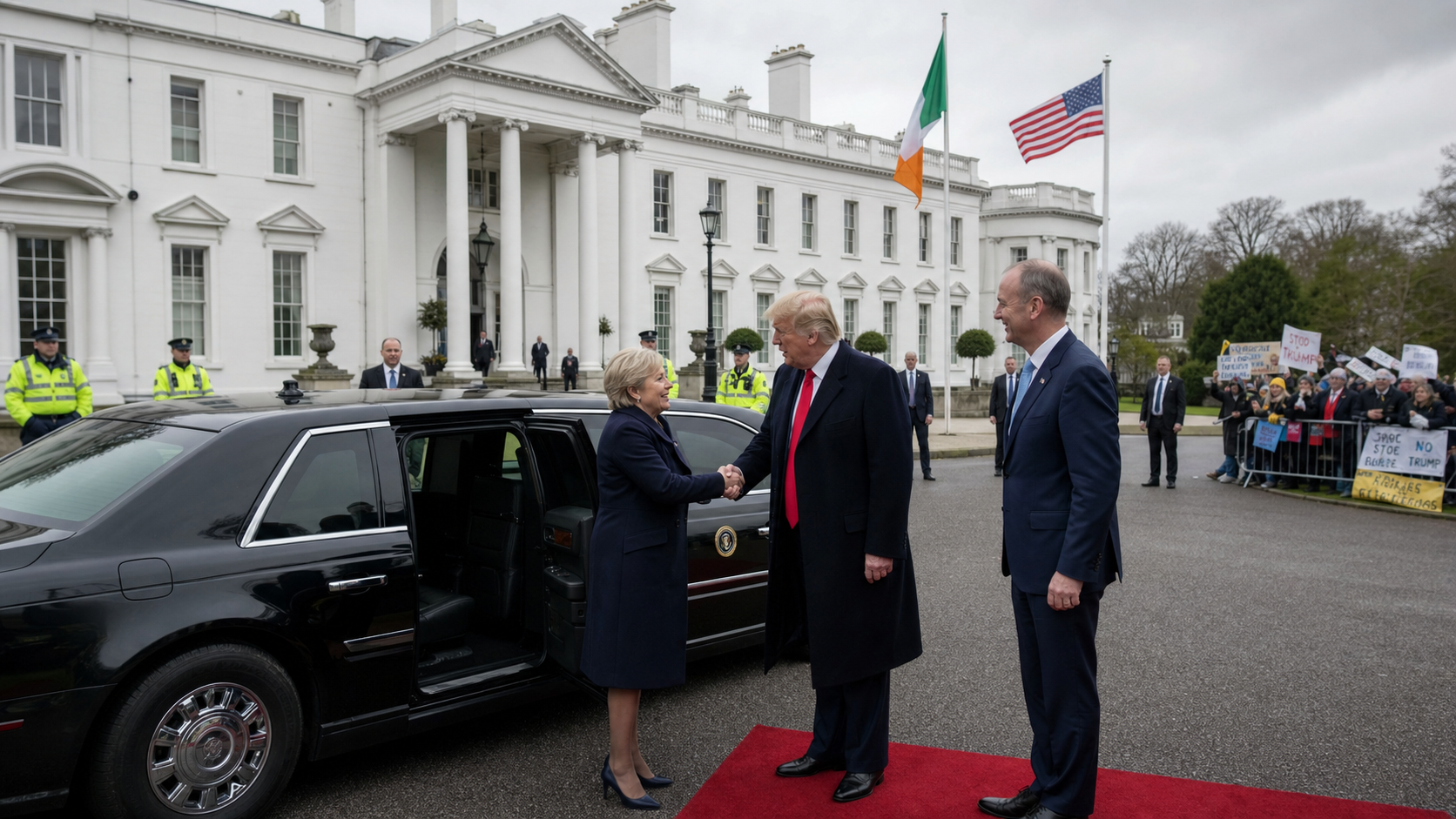
US President Donald Trump arrived in Ireland on Thursday morning, touching down at Dublin Airport where he was greeted by Tánaiste Simon Harris before proceeding to a series of high-level diplomatic engagements in the capital, including meetings with President Catherine Connolly at Áras an Uachtaráin and Taoiseach Micheál Martin at Farmleigh House, ahead of his departure by Marine One helicopter to his Doonbeg resort in County Clare for the Irish Open golf tournament.
Background
The Trump visit to Ireland has been in preparation for several months, with the Irish government navigating the considerable diplomatic and political sensitivities involved in hosting a US president whose policies on trade, immigration, and international relations have generated significant controversy in Ireland and across Europe. An opinion poll conducted in February 2026 found that 61% of the Irish public opposed the invitation, reflecting the depth of public ambivalence about the visit.
The government's decision to extend the invitation was driven primarily by the importance of the US-Ireland economic relationship. American companies employ approximately 300,000 people in Ireland, and the country's status as a preferred European base for US technology and pharmaceutical multinationals is central to its economic model. Maintaining a functional relationship with the US administration — regardless of its political complexion — is a strategic imperative for Irish governments of all persuasions.
The Irish Open at Doonbeg provided a convenient pretext for the visit, allowing Trump to combine a diplomatic engagement with a personal interest in his County Clare resort. The tournament, which carries a prize purse of €5.17 million and features a field including Rory McIlroy, Jon Rahm, and Shane Lowry, has been the subject of significant media attention in the days leading up to Trump's arrival.
Key Developments
Trump's Dublin itinerary was focused on the Phoenix Park area, where he met President Connolly at Áras an Uachtaráin and held a bilateral meeting with Taoiseach Martin at Farmleigh House. He also delivered a speech at the residence of US Ambassador Ed Walsh, attended by hundreds of invited guests from the Irish business, political, and cultural communities.
The security operation for the visit was designated an "extraordinary event" by Garda Commissioner Justin Kelly, allowing for the cancellation of garda leave and the deployment of personnel from across the country to secure locations in Dublin, Shannon, and Doonbeg. A large US Secret Service contingent, White House staff, and support personnel accompanied the president, with heavy-lift Chinook helicopters arriving in Dublin days in advance to manage the logistics of the visit.
Protests were organised in both Dublin and Clare by groups including People Before Profit, whose representatives criticised the visit and the government's alignment with US foreign policy. The protests were peaceful, with demonstrators gathering near the Phoenix Park and in Ennis, County Clare. Taoiseach Martin acknowledged the right of citizens to protest respectfully while emphasising the importance of the US-Ireland relationship.
In his bilateral meeting with Trump, Martin was expected to raise issues including the impact of US tariff policy on Irish exports, the importance of the US corporate tax framework for Irish-based multinationals, and the situation in Gaza, where Ireland has been among the most vocal EU member states in calling for a ceasefire.
Why It Matters
The Trump visit crystallises the fundamental tension in Irish foreign policy between the country's values-based approach to international affairs and its economic dependence on the United States. Ireland has been among the most outspoken EU member states on issues including Gaza, climate change, and multilateralism — positions that place it at odds with the current US administration on multiple fronts. Managing that tension while maintaining the economic relationship requires considerable diplomatic skill.
The visit also has domestic political implications. The government's decision to host Trump has been criticised by Sinn Féin, the Social Democrats, and People Before Profit, who argue that it legitimises an administration whose policies are antithetical to Irish values. The government's response — that engagement is preferable to isolation — reflects a pragmatic calculation about the limits of Irish influence and the costs of alienating a major economic partner.
For context, this is the third visit by a sitting US president to Ireland in the past decade, following Barack Obama's 2011 visit and Joe Biden's 2023 trip. Each visit has generated significant media attention and public debate, but the Trump visit is the most politically charged of the three given the depth of public opposition to his administration's policies.
Local Impact
In County Clare, the Trump visit has generated a mixture of economic opportunity and political controversy. The Irish Open at Doonbeg is expected to bring significant revenue to the local hospitality and tourism sector, with hotels, restaurants, and accommodation providers in Ennis, Kilrush, and the surrounding area reporting strong bookings. The security operation, however, has disrupted normal life in the area, with road closures and access restrictions affecting residents and businesses.
In Dublin, the security operation has affected traffic and public transport across the city, with diversions in place around the Phoenix Park and the US Ambassador's residence. The Garda deployment has drawn resources from other parts of the country, with implications for policing in areas outside the capital.
What's Next
Trump is expected to remain at Doonbeg for two nights, attending the Irish Open on Thursday and Friday before departing Ireland on Saturday. The Taoiseach's office will publish a readout of the bilateral meeting in the coming days. The diplomatic outcomes of the visit — including any commitments on trade, investment, or political issues — will be assessed in the weeks that follow.