Troubles History to Become Mandatory in All Northern Ireland Schools Under Landmark Curriculum Reform
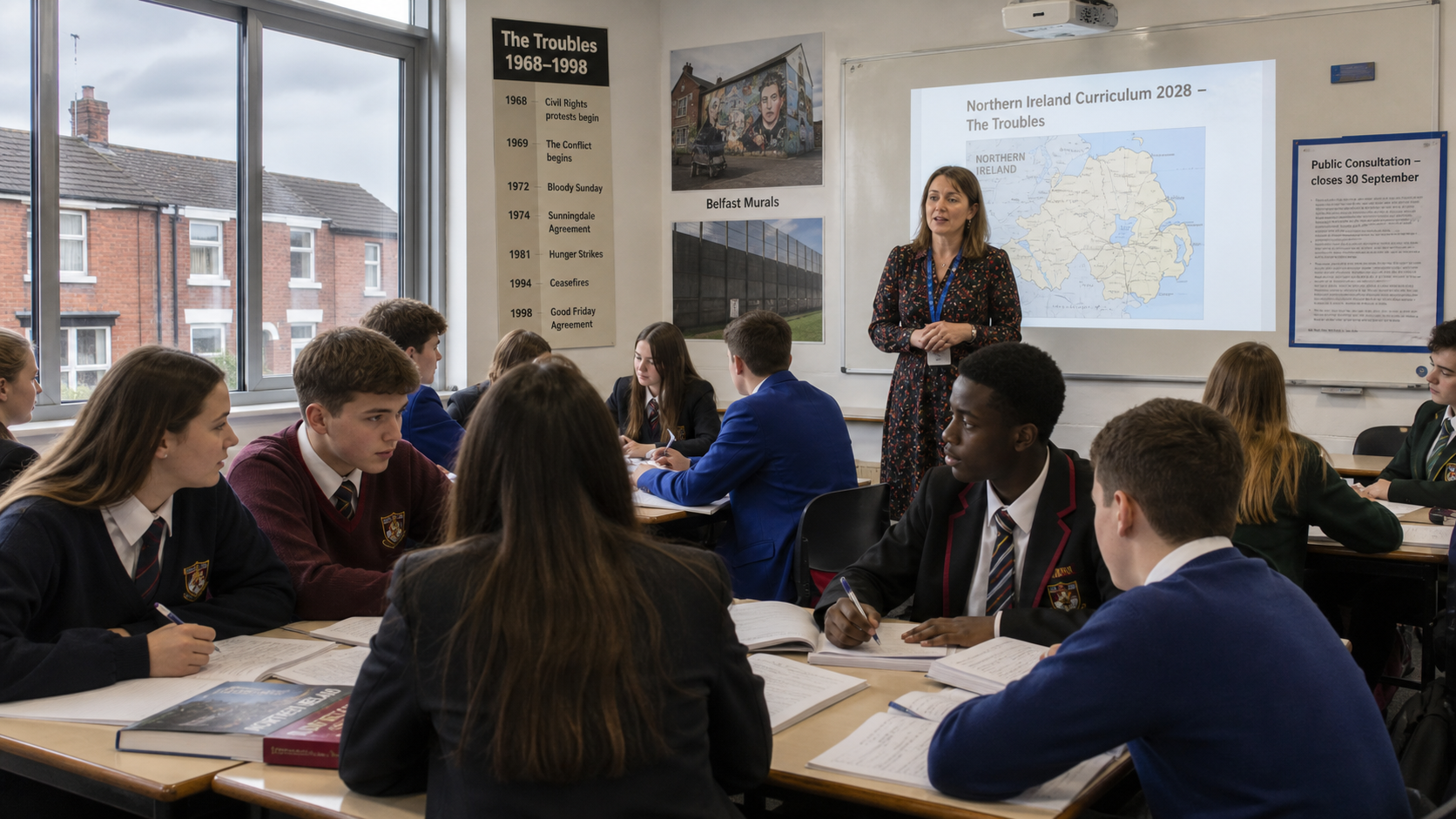
The history of the Troubles is to become a mandatory subject for all Key Stage 3 pupils in Northern Ireland's publicly-funded schools under the most significant overhaul of the education curriculum since 2007, with the Department of Education's proposed Northern Ireland Curriculum 2028 currently open for public consultation until September 30 and implementation in schools scheduled for September 2028.
Background
The question of how — and whether — Northern Ireland's schools should teach the history of the Troubles has been one of the most contested issues in education policy since the Good Friday Agreement. For decades, the subject was largely absent from formal curricula, left to individual teachers and schools to address as they saw fit, with the result that many young people in Northern Ireland reached adulthood with only a fragmentary understanding of the conflict that shaped the society they were born into. The consequences of that gap — in terms of community relations, historical literacy, and the capacity for informed civic engagement — have been widely documented by researchers and community organisations.
The current Northern Ireland curriculum, introduced in 2007, was designed to be flexible and skills-based, giving schools considerable latitude in how they approached content. A strategic review led by educationalist Lucy Crehan, published in June 2025, found that this approach had produced significant weaknesses: curriculum overload, a lack of subject-specific knowledge, and insufficient coherence across key stages. The review recommended a shift toward a more knowledge-rich, purpose-led framework — one that specified content rather than leaving it entirely to individual schools to determine.
The Department of Education, under Minister Paul Givan, established a Curriculum Taskforce chaired by Christine Counsell to design the new framework. The result is the proposed Northern Ireland Curriculum 2028, which introduces mandatory content requirements across a range of subjects and represents a fundamental rethinking of what Northern Ireland's schools should teach and why.
Key Developments
The most significant and symbolically charged element of the proposed curriculum is the mandatory inclusion of the Troubles at Key Stage 3 — covering pupils aged 11 to 14. For the first time, all publicly-funded schools in Northern Ireland, excluding special schools, will be required to teach the origins and course of the conflict, the peace processes that brought it to an end, and the legacies that continue to shape Northern Irish society. The requirement applies to all schools regardless of their religious or cultural ethos, meaning that both Catholic maintained schools and state-controlled schools will be expected to deliver this content.
The curriculum reform also introduces digital technology as a new standalone subject, with lessons on identity, privacy, and cybersecurity beginning at primary school level. At primary level, the existing "World Around Us" area of learning is to be replaced by distinct subjects — Science and Technology, and Environment and Society, the latter incorporating history and geography. A new strand titled Employability and Wellbeing will incorporate Home Economics and a new citizenship and personal development programme.
The public consultation on the proposed curriculum is open until September 30, 2026, and the Department of Education has indicated that it will consider all responses before finalising the framework. Bespoke curriculum strands are being developed for Irish-medium education and special schools, with dedicated working groups ensuring the new framework responds to the specific needs of those sectors.
Why It Matters
The mandatory inclusion of Troubles history in the curriculum is a decision with implications that extend well beyond the classroom. Northern Ireland is a society still processing the trauma of a conflict that claimed more than 3,500 lives and left tens of thousands more physically and psychologically injured. The argument for mandatory teaching is straightforward: young people cannot engage meaningfully with the society they inhabit, or contribute to its continued healing, without understanding how it came to be the way it is. The counter-argument — that mandatory teaching risks reopening wounds or imposing particular narratives — has been addressed in the curriculum design by emphasising the origins, course, and legacies of the conflict rather than assigning blame or privileging any single community's experience. Whether that balance can be maintained in practice, across schools with very different cultural and political contexts, will be the real test of the reform's success.
Local Impact
Schools across Northern Ireland — from grammar schools in Belfast's south suburbs to rural primaries in Fermanagh and Tyrone — will need to invest in teacher training and curriculum development to implement the new requirements by September 2028. The Education Authority has indicated that a programme of professional development will be made available to teachers in the period between the finalisation of the curriculum and its implementation. Schools in areas most directly affected by the Troubles — north and west Belfast, Derry/Londonderry, south Armagh — may face particular challenges in navigating the emotional complexity of the material, and additional pastoral support resources are expected to be made available. The Council for the Curriculum, Examinations and Assessment (CCEA) will develop assessment frameworks aligned with the new content requirements.
What's Next
The public consultation closes on September 30, 2026. Following analysis of the responses, the Department of Education will publish a revised curriculum framework and initiate the legislative changes required to give it statutory force. Implementation in schools is scheduled for September 2028, giving schools approximately two years to prepare. A parallel review of the Religious Education Core Syllabus — prompted by a 2025 UK Supreme Court judgment — is proceeding on a separate but related timeline, with a new syllabus expected to be published before the main curriculum reform takes effect.