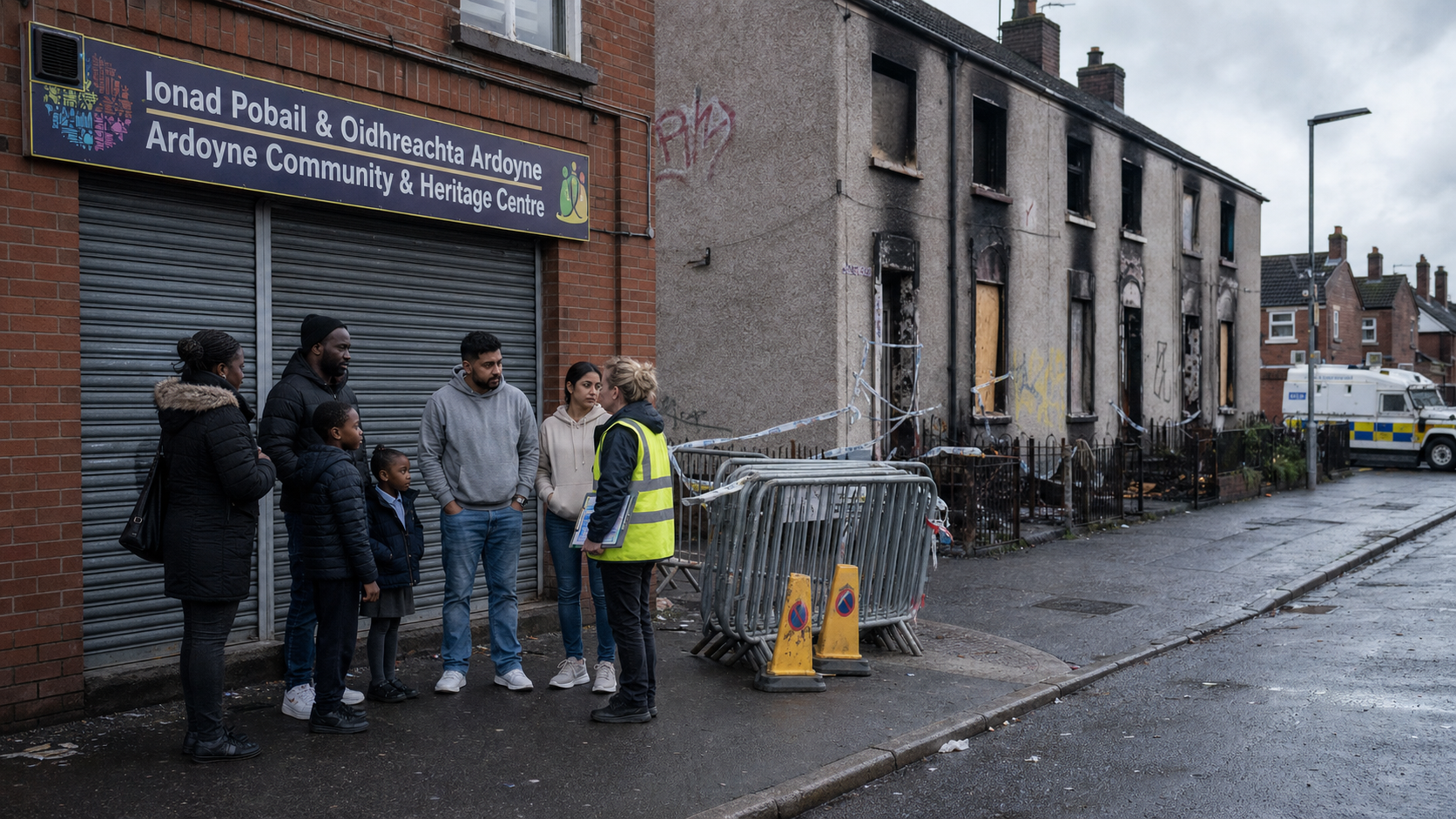
Three Months On: Northern Ireland's Race Riot Victims Still Living in Fear as Recovery Proves Slow
Three months after consecutive nights of racially motivated violence engulfed Northern Ireland in June 2026, the communities targeted by the riots remain deeply scarred, with dozens of families still displaced, many too frightened to return to their homes, and community workers warning that the true scale of the human damage has been systematically underestimated by official figures.
Background
The violence that erupted on 9 June 2026 was triggered by a knife attack in north Belfast the previous evening, in which a 44-year-old local man, Stephen Ogilvie, was severely injured. The suspect, a 30-year-old Sudanese national, was quickly apprehended by police, who clarified that the attack was not being treated as terrorism. However, footage of the incident spread rapidly across social media platforms, where far-right agitators and online influencers — including figures with large international followings — used it to incite anti-immigration sentiment and coordinate protests that rapidly descended into widespread rioting.
The disorder, which lasted until 11 June, was characterised by arson, vandalism, and the systematic targeting of homes, businesses, and vehicles associated with immigrants and people of colour. Rioters were observed going door-to-door in loyalist areas of Belfast and other towns, identifying and attacking the homes of refugees, asylum seekers, and migrant workers. The Northern Ireland Housing Executive reported that 76 households presented as homeless in the immediate aftermath, though community workers have consistently maintained that the actual number of displaced individuals was significantly higher, as many fled to stay with friends or relatives or left Northern Ireland entirely without registering with any official body.
The PSNI deployed water cannons and plastic bullets during the worst of the disorder and requested the deployment of 200 additional officers from Great Britain to support local policing. Race-hate incidents in Northern Ireland had already reached record highs in the 12 months leading to March 2026, providing a deeply troubling backdrop to the summer's events.
Key Developments
As of late August 2026, the PSNI has made dozens of arrests in connection with the June violence, with prosecutions ongoing. However, community organisations working with affected families report that the legal process has provided little comfort to those whose lives were upended by the riots. Many families from Sudanese, Ukrainian, Romanian, and Polish backgrounds who were targeted during the disorder have not returned to their homes, either because the properties were too badly damaged or because they remain too frightened to do so.
The Anaka Women's Collective and other community groups that worked under dangerous conditions during the riots to evacuate those at risk have continued to provide support to displaced families, but they report that their resources are stretched to breaking point. Funding for community integration and support services in Northern Ireland has not been increased in response to the crisis, leaving voluntary organisations to fill a gap that statutory services have been unable to address.
A BBC NI investigation published this week has documented the ongoing fear experienced by migrant communities across Belfast and other affected areas. Residents describe a persistent sense of vulnerability, with many reporting that they no longer feel safe in neighbourhoods where they had previously lived without incident for years. Some families have made the decision to leave Northern Ireland permanently, relocating to the Republic of Ireland or returning to their countries of origin.
Why It Matters
The June 2026 riots were not an isolated event but the most extreme manifestation of a pattern of race-hate incidents that had been escalating in Northern Ireland for several years. The PSNI's own data showed record levels of race-hate crime in the period leading up to the riots, and community leaders had been warning for months that the situation was deteriorating. The failure to address those warnings before the violence erupted raises serious questions about the adequacy of Northern Ireland's approach to community relations and integration.
The riots also exposed the extent to which social media platforms can be weaponised to organise and amplify racial violence. WhatsApp groups and other channels were used to circulate lists of specific home addresses of immigrants — a direct incitement to violence that the PSNI condemned as a severe risk to life. The role of high-profile online figures in amplifying the disorder has prompted calls for stronger regulation of social media platforms in the context of public order, a debate that is likely to continue in the Stormont Assembly in the autumn.
Local Impact
In north Belfast, where much of the worst violence occurred, community relations workers describe a neighbourhood landscape that has been fundamentally altered by the riots. Areas that had been gradually becoming more diverse over the previous decade have seen significant outflows of migrant residents, with some streets now noticeably less mixed than they were before June. In east Belfast, Newtownabbey, and parts of Derry/Londonderry, similar patterns have been observed. The long-term consequences for Northern Ireland's ability to attract and retain migrant workers — who are essential to sectors including healthcare, hospitality, and agriculture — are a source of serious concern for business leaders and public service managers alike.
What's Next
The Stormont Executive is expected to publish a community relations action plan in the autumn, addressing the specific challenges exposed by the June riots. The PSNI has committed to continuing its investigation and prosecution of those involved in the disorder. Community organisations are calling for a significant increase in funding for integration and support services, and for a formal independent review of the events of June 2026 and the systemic failures that allowed them to occur. The Assembly's justice committee is expected to hold hearings on the matter in September.