Thousands of Northern Ireland Pupils Collect GCSE Results as England Diverges with New Digital App
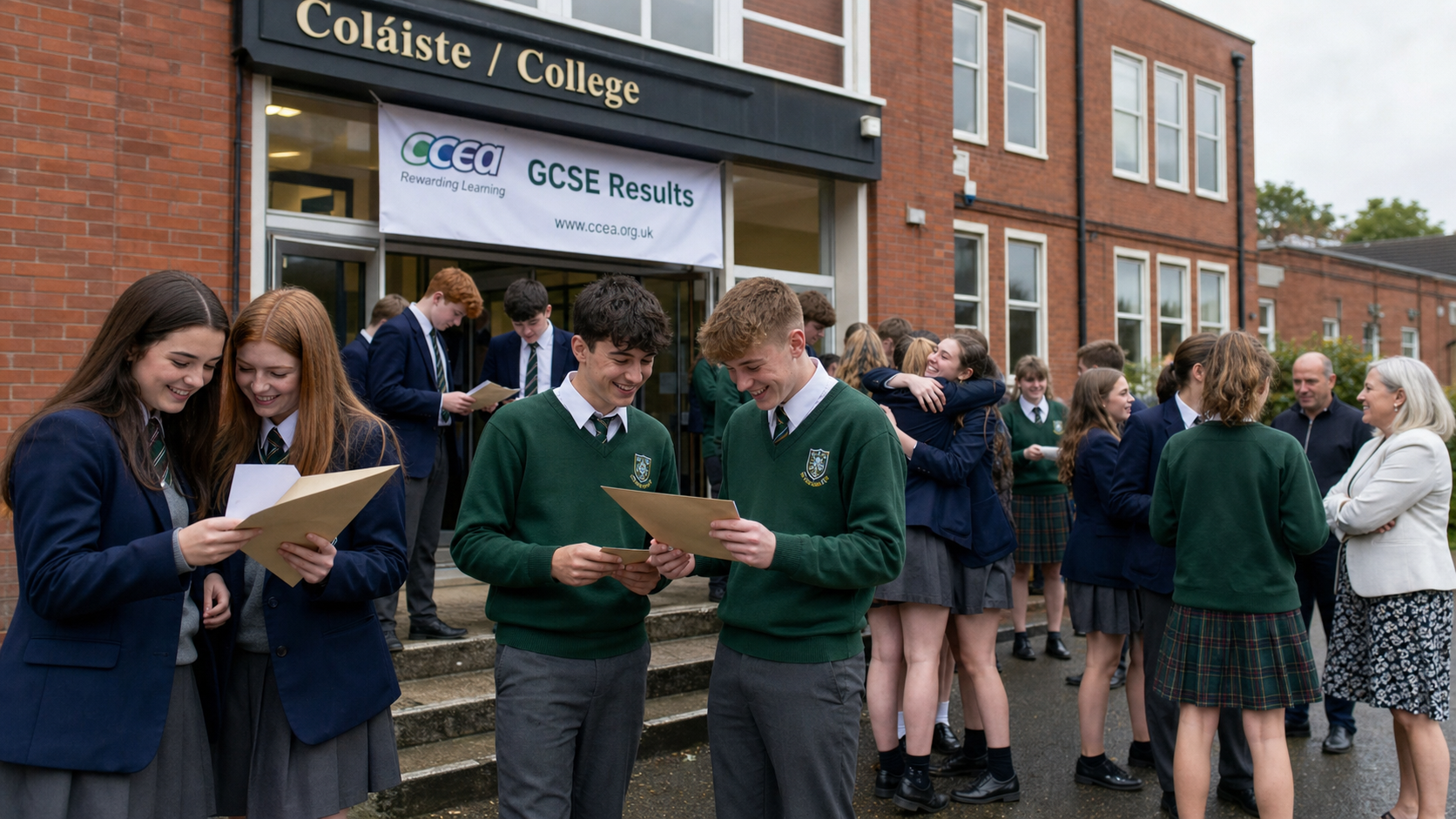
Thousands of Northern Ireland pupils collected their GCSE results on Thursday morning, with schools across Belfast, Derry, Antrim, Armagh, Down, Fermanagh, and Tyrone opening their doors from 8am in scenes that have defined the mid-August calendar for a generation of young people — even as a significant policy divergence with England emerged over how results are accessed.
Background
GCSE results day is one of the most emotionally charged days in the school calendar — a morning of relief, disappointment, celebration, and recalibration that plays out simultaneously in school corridors across the United Kingdom and Ireland. In Northern Ireland, the day has a particular character: the Council for the Curriculum, Examinations and Assessment (CCEA), which administers qualifications in the six counties, operates a distinct grading system that includes the C* grade introduced in 2019, rather than the 9-1 numerical system used in England. This means that Northern Ireland pupils are assessed on a different scale, with different grade boundaries, reflecting a curriculum that has evolved independently of the English system since devolution.
The CCEA made results data available to schools for download on Wednesday, August 19, allowing teachers and guidance counsellors to prepare for the conversations they would have with students the following morning. Schools typically begin releasing results from approximately 8am, though individual arrangements — designated arrival times, pastoral support structures, and in some cases alternative digital methods provided by the school itself — vary considerably across the province.
Results day in Northern Ireland has traditionally been a social occasion as much as an administrative one. The value of collecting results in person — surrounded by friends, with teachers available to offer immediate guidance on next steps, appeals, and clearing options — has been consistently emphasised by educators across the province. That tradition remained intact in 2026, even as England moved in a different direction.
Key Developments
The most significant development on this year's results day was not the grades themselves but the divergence in how they were accessed. For the first time, pupils in England were able to receive their GCSE results via a government-provided "Education Record" app, accessible from 11am on Thursday. The app, developed by the Department for Education in Westminster, allows students to view their grades digitally without attending school in person.
The CCEA confirmed that there are no plans to introduce a similar system in Northern Ireland. A spokesperson for the body noted that the traditional in-person collection model remains the preferred approach for the vast majority of schools and students in the province, and that the social and pastoral dimensions of results day are considered an important part of the experience. The CCEA also operates a results helpline from August 13 through August 26 to assist students with queries about their grades.
Across Belfast, scenes of celebration and consolation played out in school car parks and corridors throughout the morning. At schools in south Belfast, east Belfast, and the Shankill and Falls areas, pupils arrived in groups, many accompanied by parents who had taken the morning off work. Teachers reported a broadly positive atmosphere, with the overall pass rate in line with recent years.
Why It Matters
The divergence between Northern Ireland and England on digital results access is a small but telling illustration of the broader policy differences that have accumulated since devolution. Northern Ireland's education system has consistently prioritised in-person pastoral support on results day, a position that reflects both the social importance of the occasion and a degree of institutional caution about the risks of students receiving difficult news in isolation, without immediate access to guidance.
The England model — digital, immediate, accessible from home — has its own logic: it removes the logistical burden of travelling to school and allows students who may be anxious about the social dynamics of results day to receive their grades privately. But critics of the approach have argued that it risks stripping away the human dimension of a moment that, for many young people, is one of the most significant of their lives to date.
Northern Ireland's GCSE cohort is also navigating a system in transition. The decision, announced earlier this week, to scrap the German GCSE and overhaul the A-level structure represents the most significant reform of the qualifications landscape in a generation. For pupils collecting results today, that reform will not affect their own grades, but it will shape the choices available to younger siblings and future cohorts.
Local Impact
In practical terms, results day triggers a cascade of activity across Northern Ireland's further and higher education institutions. The Northern Regional College, South Eastern Regional College, Belfast Metropolitan College, and the other further education colleges open their clearing lines from early morning, fielding calls from students whose results have opened or closed particular pathways. Queen's University Belfast and Ulster University — with campuses in Belfast, Jordanstown, Coleraine, and Magee — also operate clearing processes, though the majority of university places in Northern Ireland are filled through the standard UCAS cycle.
For students in rural areas — in Fermanagh, Tyrone, and south Armagh — results day carries additional logistical weight, as the distance to further education colleges and universities means that decisions made today have significant practical consequences for travel, accommodation, and family finances.
What's Next
Students who are dissatisfied with their results have until the end of August to submit appeals through their schools. The CCEA will process appeals on a rolling basis, with outcomes typically communicated within four to six weeks. Students who need to resit subjects can do so in November, with results available in January 2027. The CCEA has also confirmed that the results helpline will remain operational through August 26 to assist students and parents with queries about the appeals process and resit options.