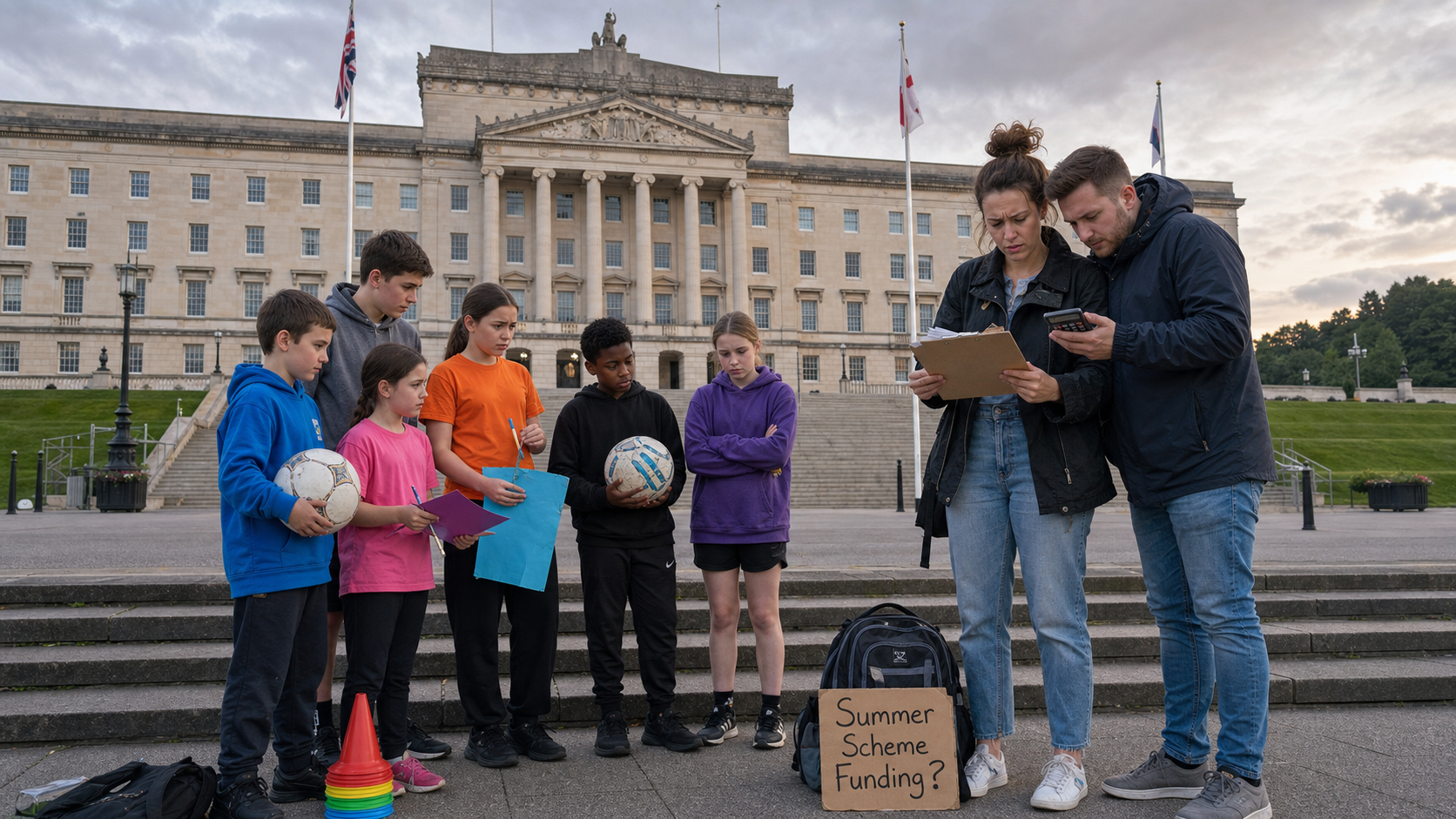
Summer Schemes at Risk Across Northern Ireland as Stormont Budget Impasse Leaves Youth Centres Counting the Cost
Summer schemes serving thousands of children across Northern Ireland are operating under severe financial strain as the Stormont Executive's ongoing failure to agree a comprehensive budget forces youth organisations to self-fund activities they would normally receive upfront support to deliver — with the Ógras Youth Centre in Coalisland, County Tyrone, facing a projected loss of up to £24,000 and warning that its very viability is under threat.
Background
Summer schemes have long been a cornerstone of community life in Northern Ireland, providing structured activities for children during the school holidays while offering working parents affordable childcare options. In areas with high levels of social deprivation, these programmes serve an additional function: keeping young people engaged, active, and connected to their communities during a period when the risk of antisocial behaviour and paramilitary recruitment is historically elevated.
The funding model for these schemes typically involves upfront payments from the Education Authority and the Department for Communities, which allow organisations to plan staffing, activities, and facilities in advance. Without that upfront certainty, centres are forced to operate on credit, drawing on reserves or borrowing from other budgets to cover costs they expect — but cannot guarantee — will be reimbursed.
The Northern Ireland Executive has been unable to agree a formal budget for 2026, a situation that has created cascading uncertainty across public services. While the UK Treasury provided a £400 million reserve claim in February 2026 to help departments balance their books, that funding is structured as a repayable loan, and its distribution across departments has been uneven and contested.
Key Developments
The Ógras Youth Centre in Coalisland, which runs junior, senior, and special educational needs schemes for approximately 450 children, has been forced to cover its own operating costs — estimated at roughly £20,000 — without the confirmed upfront support it would normally receive. The centre's management has described the situation as "begging and borrowing" to keep services running, and projects a potential loss of between £20,000 and £24,000 if funding is not secured before the end of the summer.
The problem extends well beyond Coalisland. Across Northern Ireland, more than 3,500 young people have been left in limbo regarding participation in anti-paramilitary summer camps administered by the Education Authority and funded by the Executive Office. While the Executive Office allocated £400,000 in June 2026 to support the Planned Intervention Programme, 19 of the 90 approved community organisations remained without funding at that point.
The Education Authority has stated that it recognises the importance of these services and has agreed to maintain local area funding for youth provision throughout 2026-27, despite the wider financial pressures. However, that commitment has not translated into the upfront payments that organisations need to operate with confidence.
Why It Matters
The impact of the budget impasse on summer schemes is a microcosm of a broader dysfunction at Stormont that has real consequences for real people. Northern Ireland's youth sector has been chronically underfunded for years, and the organisations that deliver summer programmes are typically small, community-based, and operating with minimal financial reserves. A loss of £20,000 to £24,000 is not an inconvenience for a centre like Ógras in Coalisland — it is potentially existential. For context, the Executive's failure to agree a budget is not a new phenomenon: Northern Ireland has operated without a formal multi-year budget for most of the past decade, a situation that has been described by the Fiscal Council as fundamentally incompatible with effective public service delivery. The summer schemes crisis is the human face of that structural failure.
Local Impact
In Coalisland, a town in County Tyrone with a strong community ethos and a history of civic activism, the threat to the Ógras summer scheme is felt acutely. The centre serves children from across the mid-Ulster area, including families from Dungannon, Stewartstown, and the surrounding rural hinterland. For many of these families, the summer scheme is not a luxury but a necessity — providing affordable, structured childcare during the six-week school holiday period. Special educational needs provision, which is among the most difficult and expensive to replace, is particularly at risk. Across the wider mid-Ulster district council area, similar pressures are being felt by youth organisations in Dungannon, Magherafelt, and Cookstown.
What's Next
The Education Authority has been urged by community organisations and political representatives to provide written confirmation of funding commitments before the end of August, to allow centres to plan for the remainder of the summer and for the autumn programme. The Department for Communities is expected to publish a revised allocation schedule for youth funding in the coming weeks. At Stormont, the Finance Minister faces mounting pressure from all parties to bring forward a draft budget before the Assembly returns from recess in September. If no budget is agreed by October, Northern Ireland faces the prospect of operating under emergency spending controls for the remainder of the financial year — a scenario that would further constrain the already-stretched youth sector.