NI Student Teachers Left Behind by £20,000 Bursary as Department Holds Firm on Eligibility
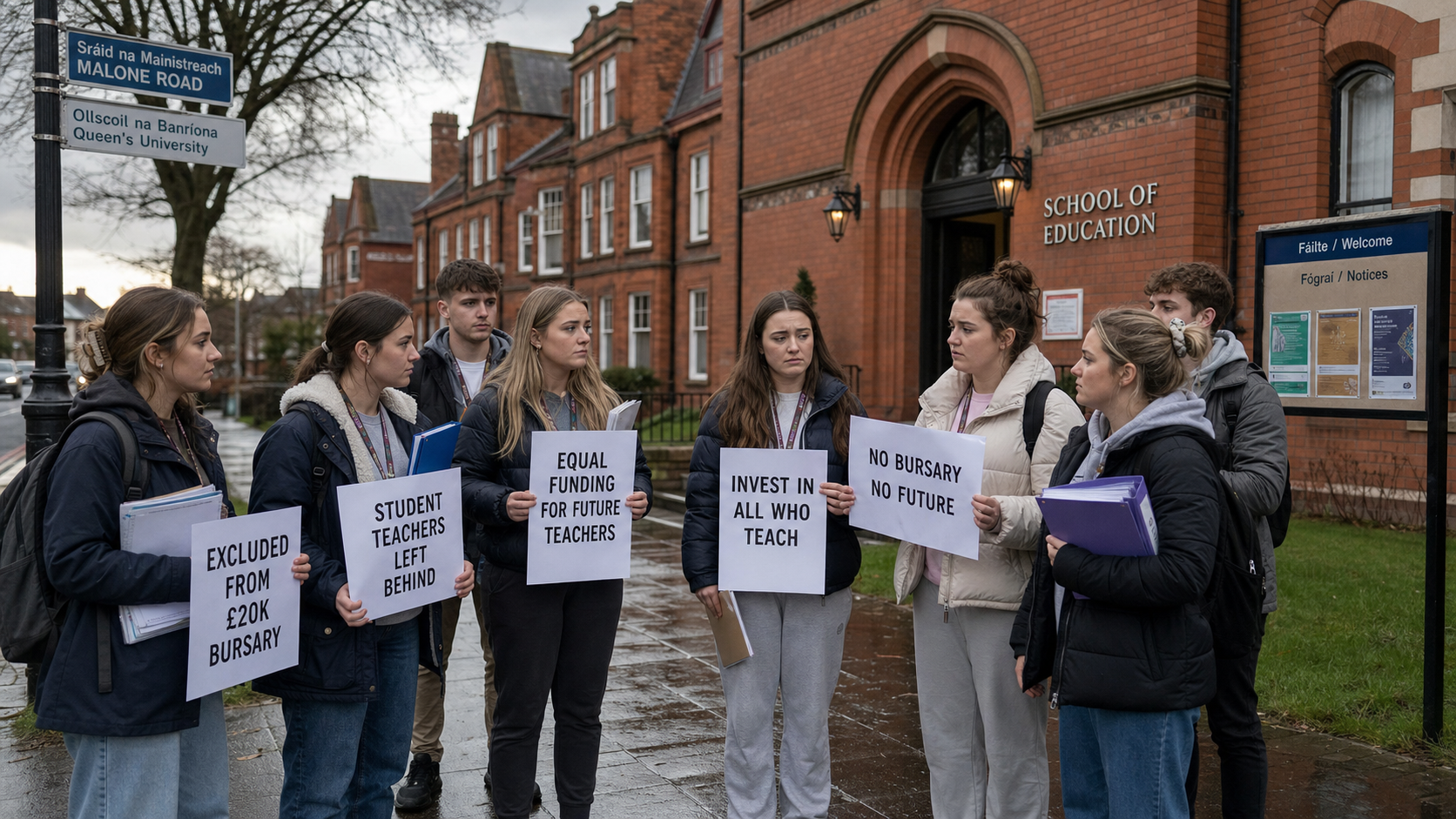
Approximately 120 undergraduate student teachers in Northern Ireland who enrolled in teacher training courses before September 2026 have been excluded from a new bursary scheme worth up to £20,000, despite studying the same shortage subjects — mathematics, science, technology, and Irish — that the scheme is designed to incentivise. The students, who face accumulated debts of between £40,000 and £50,000 by the time they graduate, have described the exclusion as "disheartening" and "disrespectful," and have submitted a formal proposal to the Department of Education for a tapered alternative that would cost an estimated £1.2 million in total.
Background
Northern Ireland has faced a persistent shortage of qualified teachers in STEM subjects and the Irish language for more than a decade. The problem is structural: teacher training in these disciplines has consistently failed to attract sufficient numbers of high-quality candidates, partly because the salary and career progression available in teaching compares unfavourably with the private sector for graduates with strong science and mathematics qualifications. The Irish language shortage carries an additional dimension, reflecting both the growth in Irish-medium education and the limited pool of fluent speakers with the academic qualifications required for teacher training.
The Department of Education, led by Minister Paul Givan, introduced the Initial Teacher Education Bursary Scheme in response to these shortages. Under the scheme, students who commence teacher training in the designated shortage subjects from September 2026 onwards are eligible for support valued at up to £20,000, delivered primarily through the waiving of tuition fees. Recipients are required to commit to teaching in Northern Ireland for a minimum of two years following qualification — a condition designed to ensure that the investment translates into classroom capacity rather than simply subsidising individuals who subsequently move to other jurisdictions.
The scheme was broadly welcomed by teacher training institutions and subject associations, who had long argued that financial incentives were necessary to make teaching competitive with other graduate career options. However, the decision to apply the scheme only to new entrants from September 2026 — rather than extending it to students already enrolled — created an immediate sense of grievance among those who had committed to the same courses without the benefit of financial support.
Key Developments
The approximately 120 affected students are at various stages of their undergraduate teacher training programmes, with some due to graduate in 2027 and others not until 2029. All are studying subjects designated as shortage areas under the new scheme. Their situation is, in practical terms, identical to that of students who will begin in September 2026 — they are training to teach the same subjects, in the same institutions, with the same commitment to working in Northern Ireland — but they will graduate with significantly higher debt and without the financial support their successors will receive.
The students have proposed a tapered alternative that would provide partial tuition fee coverage to those graduating in 2027, 2028, and 2029, with the level of support declining for each subsequent cohort. The total cost of this proposal, they estimate, would be approximately £1.2 million — a relatively modest sum in the context of the Department of Education's overall budget. The proposal has been submitted formally to the Department, but officials have maintained that the scheme cannot be extended retroactively, citing financial constraints and the argument that the bursary's primary purpose is to attract new entrants rather than to provide retrospective support.
One affected student, speaking to BBC NI, described the situation as "a slap in the face." "We chose to train as teachers in shortage subjects because we wanted to make a difference," she said. "Now we're being told that the students who come after us are worth £20,000 more than we are. That's a very difficult message to receive."
Why It Matters
The controversy highlights a recurring tension in public policy between the desire to incentivise future behaviour and the perceived fairness of treating existing participants differently. In this case, the Department's position is legally and financially defensible — the scheme was designed prospectively, and extending it retroactively would set a precedent with potentially significant cost implications. However, the optics of excluding students who are already committed to teaching shortage subjects, and who will graduate into the same classrooms as their better-supported successors, are difficult to manage.
The broader context is one of a teaching profession under pressure across Northern Ireland. Recruitment difficulties are not confined to shortage subjects — there are growing concerns about the attractiveness of teaching as a career more generally, with workload, pay, and the emotional demands of the role all cited as factors in declining applications to teacher training programmes. The bursary scheme addresses one dimension of this problem, but the exclusion of existing students risks undermining the goodwill that the initiative was designed to generate.
Local Impact
The affected students are enrolled at Queen's University Belfast, Ulster University's campuses in Coleraine and Jordanstown, and Stranmillis University College. Their placements take them into schools across Northern Ireland, from Belfast city schools to rural primaries in Fermanagh and Tyrone. The quality of their training and their commitment to the profession is not in question — what is at issue is whether the state's financial support for that commitment is equitable.
What's Next
The Department of Education is expected to respond formally to the students' tapered proposal within the next four weeks. Education Minister Paul Givan has indicated that he is aware of the concerns raised and that the Department will consider the proposal carefully, though he has not committed to any change in the scheme's eligibility criteria. The matter is also expected to be raised at the Stormont Education Committee, where members from across the political spectrum have expressed sympathy for the affected students' position. A decision is anticipated before the start of the new academic year in September.