Stormont Divided Over Alliance Push to Reform Power-Sharing as DUP Warns Against 'Majority Rule'
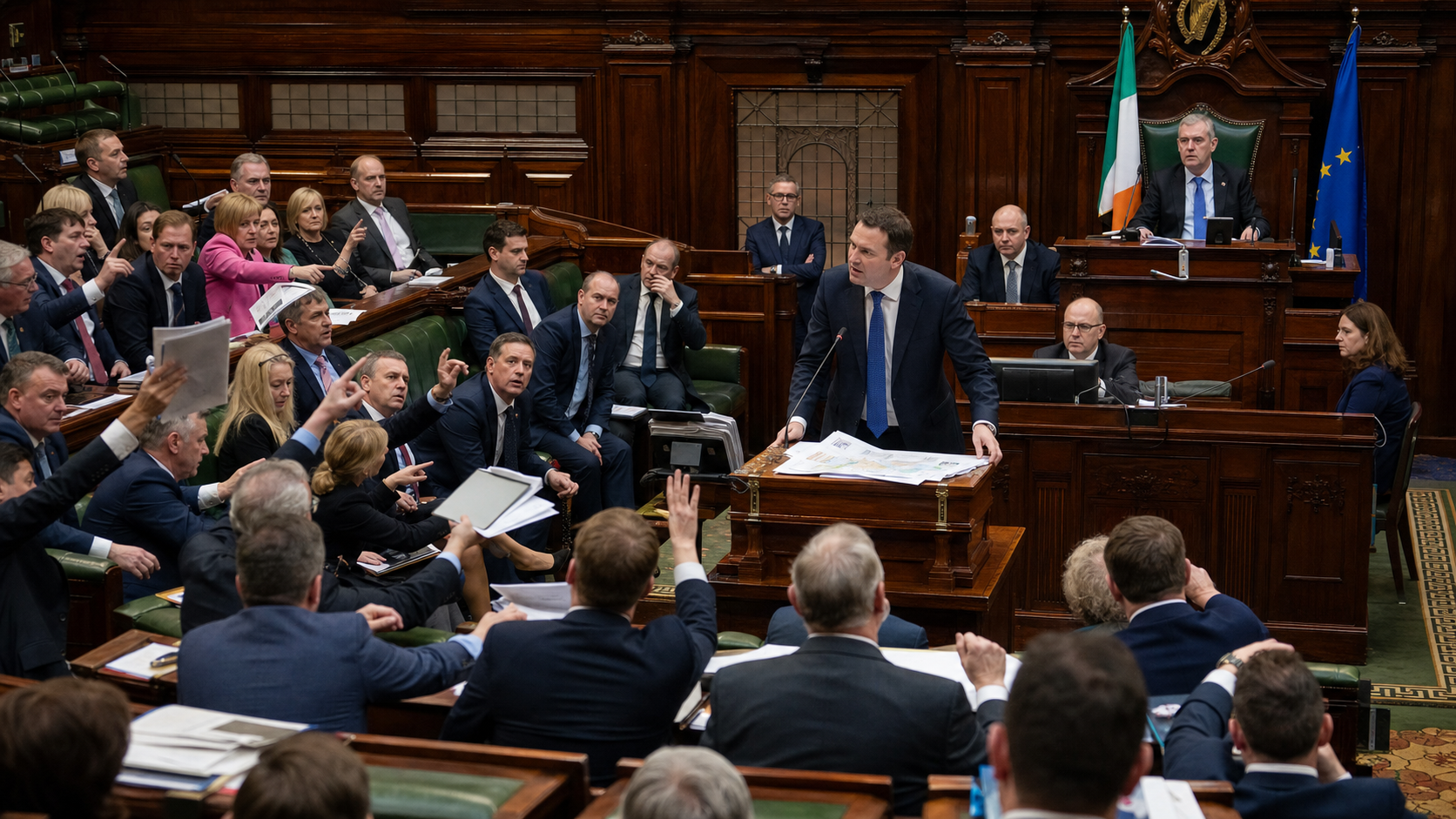
The Northern Ireland Assembly has been sharply divided over Alliance Party leader Naomi Long's sustained push to reform the Stormont power-sharing mechanisms, with DUP leader Gavin Robinson delivering a firm rejection of the proposals, describing them as a "dangerous step towards majority rule" that would fundamentally undermine the cross-community consent principles at the heart of the Good Friday Agreement. The debate, which has intensified in the wake of the Donaldson conviction and the ongoing budgetary crisis, goes to the heart of how Northern Ireland is governed and whether the current institutional architecture is fit for purpose in 2026.
Background
The Stormont power-sharing institutions, established under the Good Friday Agreement of 1998 and subsequently modified by the St Andrews Agreement of 2006, are built on the principle of cross-community consent. Key decisions require the support of both designated unionists and designated nationalists in the Assembly, and the Executive operates on a mandatory coalition basis, with ministerial positions allocated to parties in proportion to their Assembly seats. This architecture was designed to ensure that neither community could be outvoted on matters of fundamental importance, and it has been credited with providing the framework within which the peace process has been sustained.
However, the system has also been criticised for creating structural incentives for political deadlock. The ability of any party to collapse the institutions by withdrawing from the Executive — a mechanism that has been used by both the DUP and Sinn Féin at various points — has resulted in Northern Ireland being without a functioning government for a total of over five years since the institutions were established. The most recent collapse, triggered by the DUP's boycott over post-Brexit trading arrangements, lasted nearly two years and left Northern Ireland without an Executive during a period of acute economic and social pressure.
Alliance, which designates as "other" rather than unionist or nationalist, has long argued that the designation system is outdated and that it effectively excludes the growing proportion of the Northern Ireland electorate that does not identify with either community. The party has proposed a range of reforms, including the replacement of the designation system with a weighted majority voting mechanism that would require broad cross-community support for key decisions without mandating that support be expressed through the binary unionist/nationalist designation.
Key Developments
The debate over institutional reform has been given fresh impetus by the events of the past week. The Donaldson conviction has raised questions about the accountability mechanisms within the Stormont system, and the ongoing budgetary crisis has highlighted the limitations of a mandatory coalition in which parties with fundamentally different economic philosophies are required to govern together. Alliance has used both developments to argue that the current institutional architecture is not delivering effective government for the people of Northern Ireland.
Naomi Long, speaking in the Assembly on Tuesday, argued that the power-sharing system as currently constituted gives individual parties an effective veto over progress on issues of broad public concern, and that this veto power has been used repeatedly to block reforms that command majority support in the Assembly. She cited the DUP's opposition to the Justice Minister's proposal to raise the age of criminal responsibility from 10 to 14 as a recent example of a reform being blocked by a minority of Assembly members despite having the support of a majority.
Gavin Robinson's response was unequivocal. He described Alliance's proposals as a "fundamental attack on the cross-community consent principle" and warned that any move to replace the designation system with a simple weighted majority would remove the protections that the unionist community relies on to ensure that its interests cannot be overridden by a nationalist majority. He argued that the Good Friday Agreement's genius lay precisely in its insistence on cross-community consent, and that weakening this principle would undermine the foundations of the peace settlement.
Why It Matters
The debate over Stormont reform is not merely an internal political argument — it goes to the heart of how Northern Ireland is governed and whether the current institutional architecture can deliver effective government in the decades ahead. The mandatory coalition system has produced periods of genuine cross-community cooperation, but it has also produced prolonged periods of deadlock that have left Northern Ireland without effective government at critical moments. The question of whether the system can be reformed to reduce the risk of deadlock without undermining the cross-community consent principles that are essential to the peace settlement is one of the most important constitutional questions facing Northern Ireland. Alliance's proposals have the support of Sinn Féin and the SDLP, which means that a majority of Assembly members are in favour of some form of reform. However, the opposition of the DUP and UUP means that any reform would require either a change in the law at Westminster or a negotiated agreement between the parties — neither of which appears imminent.
Local Impact
For ordinary people in Northern Ireland, the debate over institutional reform can seem remote from the immediate pressures of daily life — the waiting lists, the school transport cuts, the cost of living. But the connection between institutional effectiveness and service delivery is direct: a government that is paralysed by internal disagreement cannot make the decisions needed to address the housing crisis, reform the health service, or invest in infrastructure. In Belfast, where the impact of political dysfunction is most visible — in the derelict sites, the underfunded community services, and the persistent deprivation in areas like north and west Belfast — the case for institutional reform has a particular resonance. In rural areas of Tyrone and Fermanagh, where public services are already stretched thin, the prospect of further cuts driven by political deadlock is a source of genuine anxiety.
What's Next
The debate over Stormont reform is expected to continue through the summer, with Alliance planning to bring a formal motion on institutional reform to the Assembly in September. The UK government has indicated that it is monitoring the debate but has stopped short of endorsing any specific reform proposals. The Irish government, which has a formal role in the governance of Northern Ireland under the Good Friday Agreement, has expressed support for the principle of institutional reform but has been careful not to be seen as interfering in what it regards as primarily a matter for the parties in Northern Ireland to resolve. A formal review of the Stormont institutions, as provided for under the Good Friday Agreement, has been called for by Alliance and Sinn Féin but has been resisted by the DUP.