Stormont Budget Deadlock Exposed as NI Health Minister Admits He Cannot Fund Doctors' Pay Deal
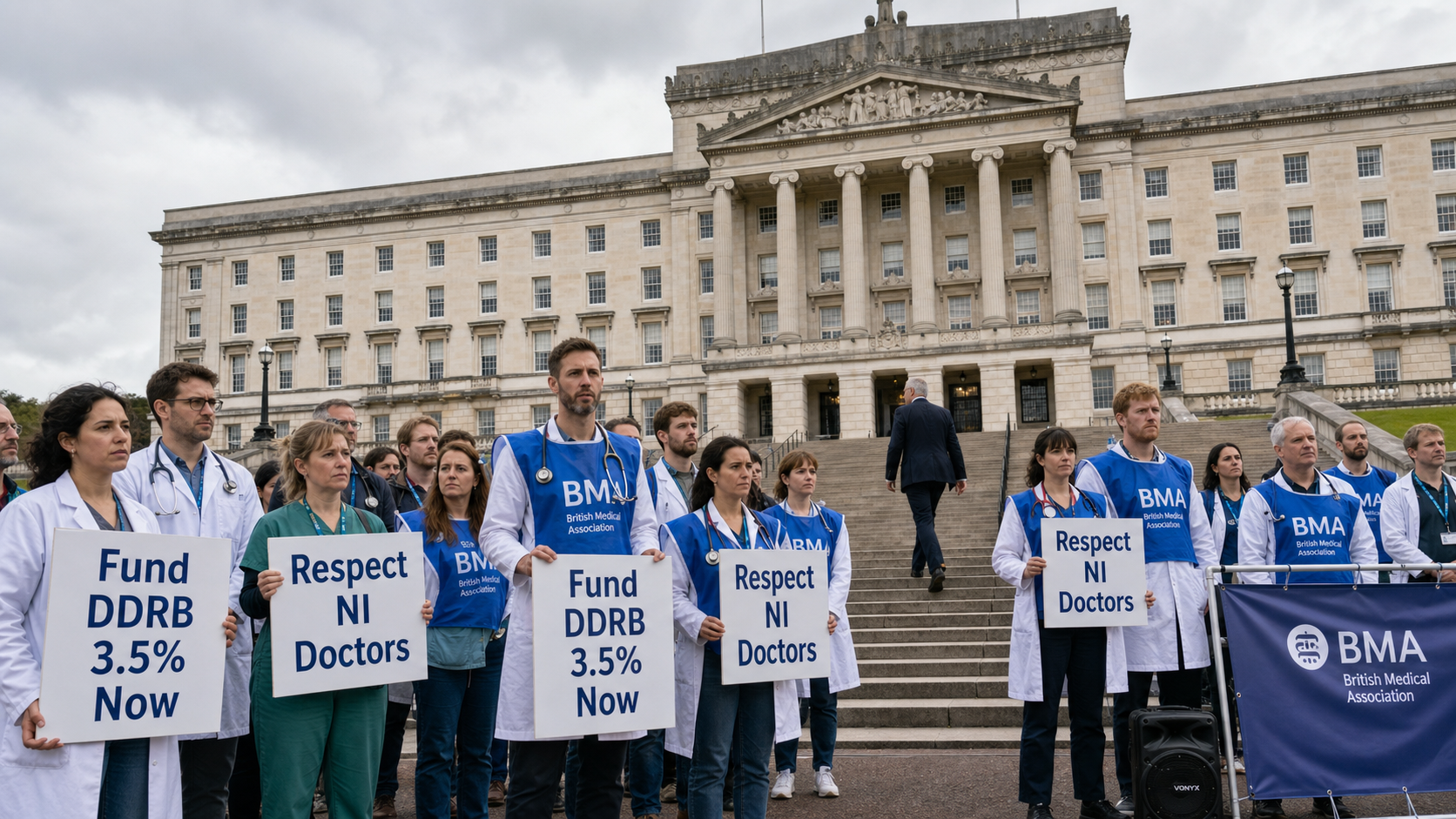
The historic joint strike by Northern Ireland's consultants and specialist doctors has done more than disrupt health services — it has exposed, with uncomfortable clarity, the political consequences of Stormont's ongoing failure to agree a budget, with Health Minister Mike Nesbitt publicly acknowledging that he cannot implement the independent pay review body's 3.5% recommendation because the Executive has not agreed the financial framework within which he must operate.
Background
Northern Ireland's devolved government has operated without a properly agreed budget for much of the past decade, a situation that reflects the broader dysfunction of the power-sharing arrangements established under the Good Friday Agreement. The mandatory coalition structure of the Stormont Executive — which requires the participation of both unionist and nationalist parties — has repeatedly broken down, leaving the province in periods of direct rule or caretaker government during which long-term financial planning is impossible.
The current budgetary impasse is the latest manifestation of this structural problem. The Executive parties have been unable to agree on the allocation of resources across government departments, leaving ministers operating on a form of financial continuity that prevents new spending commitments and forces a conservative approach to resource management. This situation has been particularly damaging for the health service, which requires sustained capital investment and the ability to make multi-year staffing commitments.
The independent pay review body (DDRB) — the Doctors and Dentists Review Body — recommended a 3.5% pay increase for consultants and specialist doctors in Northern Ireland as part of its 2026 review. This recommendation was accepted in principle by Health Minister Mike Nesbitt, but the minister has been unable to implement it because the Department of Health does not have the budget certainty required to make the commitment.
Key Developments
The political fallout from the 25 June strike has been immediate and significant. Minister Nesbitt's public statement — in which he acknowledged that he just does not have an agreed budget to implement the pay recommendation — was unusually candid for a serving minister and has been seized upon by opposition parties as evidence of the Executive's dysfunction.
Sinn Féin, the SDLP, and Alliance have all called on the Executive to prioritise the resolution of the budget impasse, arguing that the doctors' strike is a direct consequence of political failure. The DUP, which holds the Finance Ministry, has defended its approach to the budget process while acknowledging the seriousness of the situation in the health service.
The BMA has indicated that it will assess the outcome of the 24-hour strike before deciding on further action. However, the union has made clear that if the budget impasse is not resolved and the pay recommendation is not implemented, further and potentially longer strikes are likely. The prospect of a prolonged dispute involving both consultants and specialist doctors — affecting a far broader range of services than previous industrial action — has concentrated political minds considerably.
Why It Matters
The doctors' strike has made visible what has previously been an abstract political problem. The failure to agree a Stormont budget is not merely a matter of political inconvenience — it has direct, measurable consequences for the people of Northern Ireland, in the form of cancelled appointments, deteriorating services, and the ongoing exodus of medical professionals to better-paid positions elsewhere.
The political dynamics of the situation are complex. The DUP, as the party holding the Finance Ministry, bears primary responsibility for the budget process, but the failure to agree a budget reflects disagreements across the Executive rather than the position of any single party. The mandatory coalition structure means that all Executive parties share responsibility for the outcome, even if they disagree about the causes.
The situation also has implications for the broader debate about the future of devolution in Northern Ireland. If the Executive cannot agree a budget that allows it to implement an independent pay recommendation for doctors, it raises serious questions about the capacity of the power-sharing arrangements to deliver effective government. This is a question that goes to the heart of the constitutional settlement established by the Good Friday Agreement.
Local Impact
For patients across Northern Ireland — in Belfast, Derry, Newry, Antrim, and every town and village in between — the political failure has immediate, personal consequences. Cancelled appointments, longer waiting times, and the departure of experienced medical staff are not abstract policy outcomes; they are experiences that affect real people's health and wellbeing. The political parties at Stormont are acutely aware that the public's patience with the budget impasse is running thin.
For the medical profession, the strike represents a watershed moment. The decision by consultants and specialist doctors to take joint industrial action for the first time reflects a level of collective frustration that has been building for years. The profession's willingness to accept the reputational and personal cost of striking suggests that the situation has reached a point where the status quo is no longer sustainable.
What's Next
The Stormont Executive is expected to return to budget discussions in early July 2026, with the doctors' strike providing additional urgency to those talks. The BMA has set a clear expectation: if the budget is not agreed and the pay recommendation is not implemented, further action will follow. Political sources suggest that the Executive parties are aware of the need to reach agreement before the summer recess, though the specific obstacles to a deal remain significant. A resolution before the end of July is possible but not certain.