Stormont Budget Deadlock Branded 'Catastrophic' as NI Executive Fails to Agree Formal Spending Plan for Fifth Month
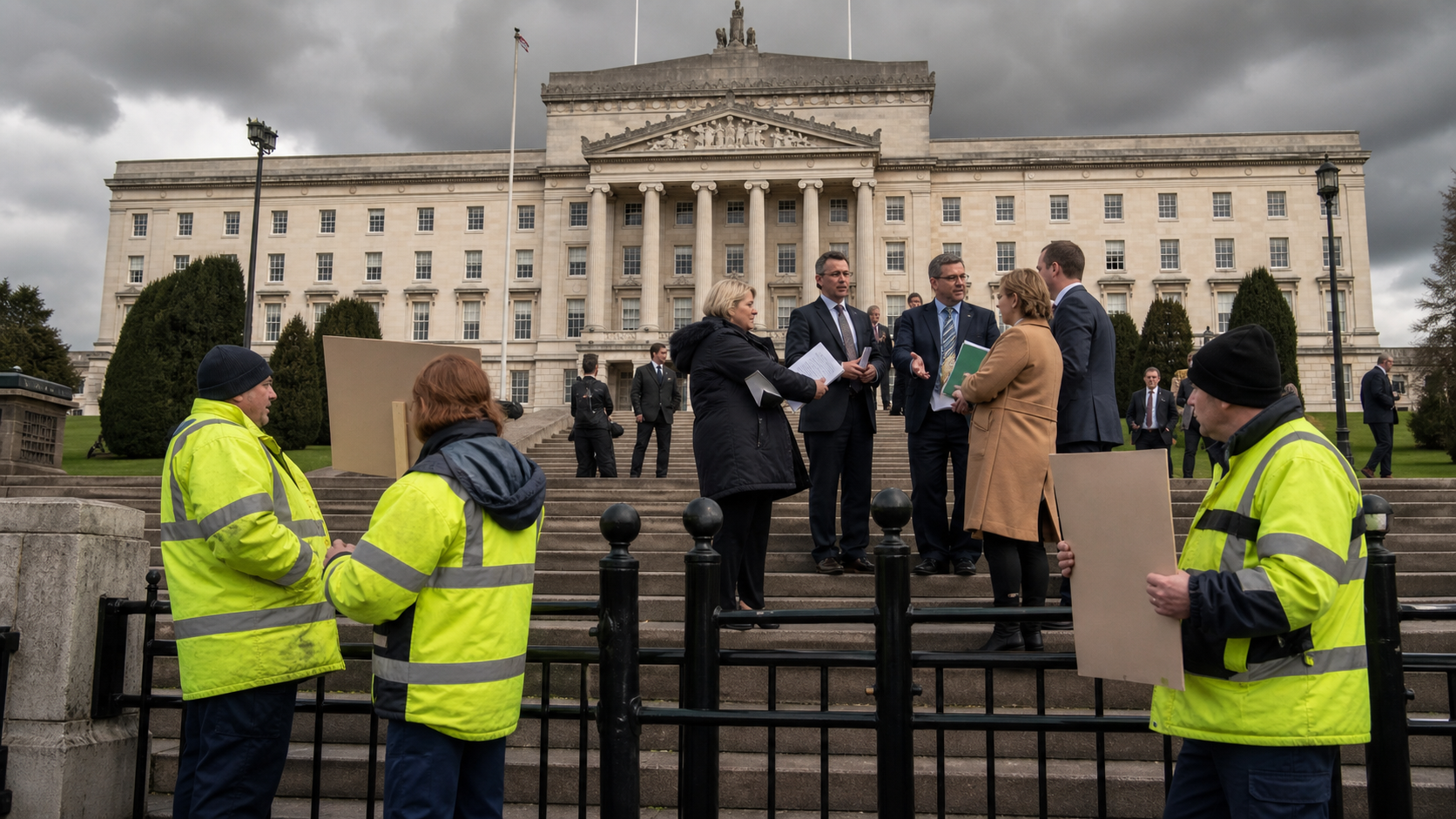
The Northern Ireland Executive has been branded 'catastrophic' by independent think tank Pivotal for its failure to agree a formal budget for the fifth consecutive month, with the Assembly operating on contingency spending arrangements that are stalling social housing projects, deepening the hospital emergency department crisis, and leaving critical environmental issues at Lough Neagh unaddressed — as the Executive enters the final year of its mandate with nine pieces of planned legislation still untabled.
Background
The Northern Ireland Executive operates under a mandatory coalition model established by the Good Friday Agreement, in which the largest unionist and nationalist parties must share power in government. This arrangement, while essential for political stability in a divided society, creates particular challenges for budget-setting, as all five Executive parties must reach agreement on spending priorities before a formal budget can be passed by the Assembly.
The current Executive, which was restored in February 2024 after a two-year collapse triggered by the DUP's withdrawal over the Northern Ireland Protocol, has struggled to achieve the level of political cohesion necessary for effective governance. The parties — Sinn Féin, the DUP, the Alliance Party, the SDLP, and the UUP — have found it difficult to agree on the allocation of a budget that is itself under severe pressure from the UK government's spending constraints and the particular cost pressures facing Northern Ireland's public services.
The failure to agree a formal budget has meant that the Executive has been operating on contingency arrangements since April 2026, with departments unable to make long-term spending commitments or to plan effectively for the delivery of services. This situation has been described by Pivotal, one of Northern Ireland's most respected independent policy organisations, as the "biggest shortcoming" of the current mandate.
Key Developments
Pivotal's assessment, published in early September 2026, catalogued the consequences of the budget deadlock in stark terms. Social housing projects have been stalled because NI Water cannot commit to the infrastructure investment needed to support new developments — a problem that is itself partly a consequence of the budget uncertainty. Hospital emergency departments across the region are operating under severe pressure, with waiting times at the Royal Victoria Hospital in Belfast, Altnagelvin in Derry, and Daisy Hill in Newry among the worst in the United Kingdom. Environmental remediation work at Lough Neagh, which has been suffering from a severe blue-green algae crisis, has been delayed by the absence of committed funding.
The political tensions within the Executive have been further exacerbated by the resignation of Health Minister Mike Nesbitt following a dispute over the proposed removal of emergency general surgery services at the Causeway Hospital in Coleraine. Nesbitt's departure — which came after he refused to implement a decision he believed was wrong for patients in the north coast area — has left the UUP scrambling to identify a replacement and has added to the sense of instability within the Executive.
The Assembly is in the final year of its current mandate, with an election required by 6 May 2027. The pressure to deliver on the legislative programme before dissolution is intense, but the budget deadlock is making it increasingly difficult for departments to bring forward the legislation and policy initiatives that were promised when the Executive was formed. Nine pieces of planned legislation — including the Race Equality Bill and the Good Jobs Bill — have yet to be tabled, and the time available to pass them before the Assembly dissolves is shrinking rapidly.
Why It Matters
The Stormont budget crisis matters because it is having real and measurable consequences for the people of Northern Ireland. The stalling of social housing projects is contributing to a housing shortage that is already severe, particularly in Belfast and Derry. The pressure on hospital services is resulting in patients waiting longer for treatment and, in some cases, experiencing worse outcomes as a result. The failure to address the Lough Neagh crisis is allowing environmental damage to continue that will take years and significant investment to reverse.
The crisis also matters because it raises fundamental questions about the capacity of the mandatory coalition model to deliver effective government in Northern Ireland. The model was designed to ensure that both communities have a voice in government, but it creates structural incentives for parties to prioritise their own political interests over the collective good. The current deadlock is a manifestation of these structural tensions, and it will not be resolved without a degree of political leadership and compromise that has been conspicuously absent from the Executive in recent months.
For context, Northern Ireland's public finances are under particular pressure because the region has a higher proportion of public sector employment and public service dependency than any other part of the United Kingdom. The consequences of budget uncertainty are therefore felt more acutely in Northern Ireland than they would be in a region with a more balanced economic structure.
Local Impact
The impact of the budget deadlock is felt across all six counties. In Belfast, the stalling of social housing projects is contributing to a housing waiting list that already exceeds 45,000 households. In Derry, the pressure on Altnagelvin Hospital's emergency department is resulting in patients waiting for many hours for treatment. In Fermanagh and Tyrone, the uncertainty about departmental budgets is affecting the delivery of rural services including road maintenance, school transport, and community health provision. In Antrim and Down, the wastewater infrastructure constraints that are blocking housing development are directly linked to the inability of NI Water to commit to capital investment without a settled budget.
What's Next
The Executive is expected to make another attempt to agree a formal budget in the coming weeks, with the pressure of the approaching election providing some incentive for compromise. The Assembly's Finance Committee is expected to hold emergency hearings on the budget situation, and the Secretary of State for Northern Ireland has indicated that the UK government is monitoring the situation closely. If the Executive fails to agree a budget before the end of the year, there is a risk that the UK government will intervene to set a budget for Northern Ireland — a step that would be deeply embarrassing for the devolved institutions and that all parties are keen to avoid.