Samson and Goliath: Belfast's Iconic Harland and Wolff Cranes Begin £3.1 Million Overhaul Ahead of Naval Shipbuilding Contracts
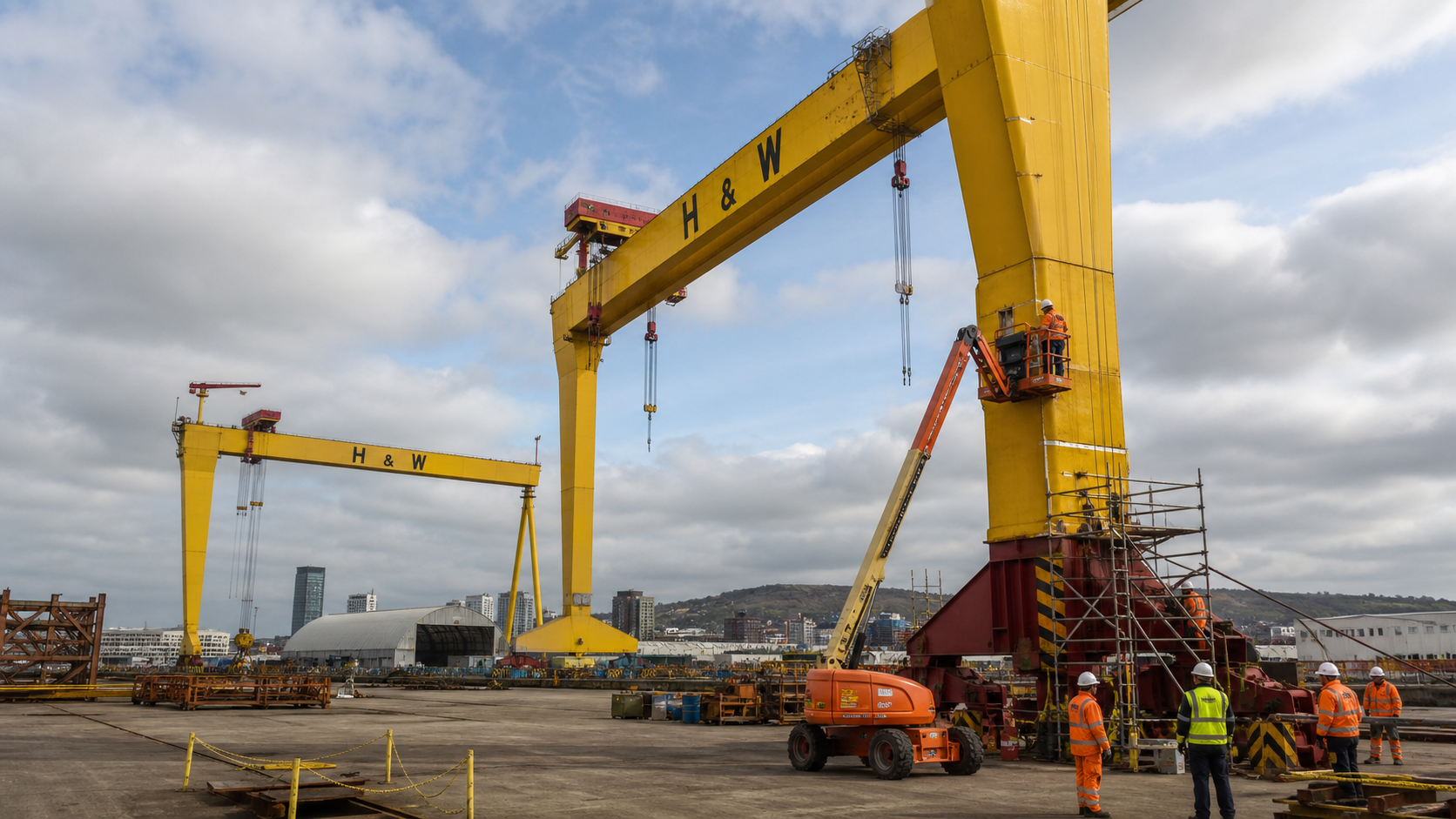
The two yellow gantry cranes that have defined Belfast's skyline for more than half a century are undergoing a comprehensive £3.1 million refurbishment by Navantia UK, the Spanish defence company that acquired the Harland and Wolff shipyard in 2025, with engineers working to restore Samson and Goliath to full operational capacity for the first time since 2003 in preparation for the construction of three Fleet Solid Support ships for the Royal Fleet Auxiliary.
Background
Samson and Goliath are not merely industrial infrastructure — they are among the most recognisable landmarks in Ireland, visible from miles around Belfast and embedded in the city's sense of itself in a way that few structures anywhere in the world can claim. Goliath, the older of the two, was built in 1969 and stands 96 metres tall. Samson followed in 1974, reaching 106 metres. Together, they can lift up to 840 tonnes — equivalent to the weight of four Boeing 747 jumbo jets — and were central to the shipbuilding operations that made Belfast one of the great industrial cities of the twentieth century.
The cranes last performed active shipbuilding work in 2003, when Harland and Wolff's commercial shipbuilding operations effectively ceased. In the years since, they have stood as monuments to a lost industrial era, maintained but not operational, their yellow paint fading slightly against the Belfast sky. The shipyard itself passed through several ownership changes before Navantia UK, a subsidiary of the Spanish state-owned defence company Navantia, acquired it in 2025 as part of a broader strategy to develop British naval shipbuilding capacity.
The acquisition came with a £98.5 million recapitalisation commitment — a figure that reflects the scale of investment required to transform a dormant yard into a functioning naval construction facility. The crane refurbishment, at £3.1 million, is one of the most visible components of that investment.
Key Developments
Work commenced on Goliath first, with engineers undertaking a comprehensive programme of mechanical, electrical, hydraulic, and structural maintenance. The engines of both cranes are being fully overhauled, catenary cables that supply power to the cranes are being replaced, and technology is being updated to ensure reliable operation at maximum capacity. Structural repairs are also being carried out to address decades of wear.
The refurbishment is not cosmetic. The cranes must be capable of lifting heavy steel blocks for the construction of the three Fleet Solid Support ships — the second-largest vessels in the British armed forces after the Queen Elizabeth-class aircraft carriers. That requirement demands engineering precision, not merely a fresh coat of paint.
Beyond the cranes, Navantia UK's investment has included expansion of the fabrication hall, installation of new plasma cutting equipment, and implementation of a new panel line. The company has set a target of expanding the shipyard's workforce from the current 450 employees to an estimated 1,500 by 2030 — a projection that, if realised, would represent a significant contribution to employment in east Belfast and the wider city.
Why It Matters
The restoration of Samson and Goliath to operational status is symbolically significant in ways that go beyond the practical. Belfast's industrial identity was built on shipbuilding, and the decline of that industry from the 1970s onwards left deep economic and social scars — particularly in the east of the city, where the yards were concentrated. The prospect of genuine naval shipbuilding returning to the Lagan is not something that can be taken for granted, and the investment by Navantia UK represents a more credible commitment than many previous announcements about the yard's future.
For Northern Ireland's economy, which has historically struggled to attract large-scale manufacturing investment, the Fleet Solid Support contract is a significant win. The ships will be built over several years, providing sustained employment and supply chain opportunities for businesses across the region. The 1,500-job target, if achieved by 2030, would make Navantia UK one of the largest manufacturing employers in Belfast.
Local Impact
In east Belfast, where the shipyard sits, the refurbishment has been welcomed by community representatives and local politicians across the political spectrum. The area has experienced significant economic deprivation since the decline of traditional industries, and the prospect of skilled manufacturing jobs returning to the Titanic Quarter and surrounding neighbourhoods carries real weight.
The cranes themselves are a source of civic pride that transcends political divisions in Belfast — they appear on tourist merchandise, in public art, and in the city's marketing materials. Their restoration to working order is, for many Belfastians, a statement about the city's capacity for renewal.
What's Next
The refurbishment of both cranes is expected to be completed before the end of 2026, with Samson following Goliath through the overhaul process. The first steel for the Fleet Solid Support ships is expected to be cut at the yard in 2027. Navantia UK has indicated that further investment announcements related to the yard's facilities and workforce are planned for later this year.