Northern Ireland's Mental Health Strategy Only 16% Funded as Nesbitt Warns of 'Sharpening of Focus'
Northern Ireland's ten-year Mental Health Strategy, launched in 2021 with the ambition of transforming how the region cares for people in psychological distress, has received just 16% of the funding it requires to deliver its 35 actions — a revelation that has prompted Health Minister Mike Nesbitt to announce a significant scaling back of ambitions for 2026/27, while experts warn that the consequences for a region with uniquely complex mental health needs could be severe. Of the strategy's 35 actions, 15 have not yet commenced and remain entirely unfunded, leaving the most vulnerable people in Northern Ireland without the services they were promised.
Background
The Mental Health Strategy 2021–2031 was developed in the aftermath of a period of intense scrutiny of mental health services in Northern Ireland, following a series of inquiries and reports that highlighted the inadequacy of provision across the region. Northern Ireland has long been recognised as having a disproportionately high burden of mental ill health, a legacy of the Troubles that has been extensively documented by researchers at Queen's University Belfast and Ulster University. The rates of post-traumatic stress disorder, depression, and anxiety in Northern Ireland are significantly higher than in comparable regions of the United Kingdom, and the demand for mental health services has consistently outstripped supply.
The strategy was intended to address this deficit comprehensively, with a ten-year framework that would transform the mental health system from one focused primarily on crisis intervention to one that provided early intervention, community-based support, and a genuine continuum of care. The estimated cost of implementing the strategy's 35 actions was £1.2 billion over the decade — a significant sum, but one that its architects argued was justified by the scale of the need and the long-term savings that effective mental health care would generate.
The strategy was welcomed by mental health organisations, service users, and clinicians across Northern Ireland, who saw it as a genuine commitment to addressing a problem that had been neglected for too long. The appointment of Professor Siobhán O'Neill as Northern Ireland's first Mental Health Champion was seen as a signal of the seriousness with which the government was approaching the issue. The subsequent failure to fund the strategy adequately has therefore been experienced as a profound betrayal by those who had invested hope in its promises.
Key Developments
A Department of Health review, published in October 2025 and now informing the 2026/27 planning cycle, revealed the stark reality of the strategy's implementation. Of the £1.2 billion estimated to be needed over the decade, only £12.3 million — representing 16% of the funding deemed necessary for the actions that have been initiated — had been allocated by the end of the 2024/25 period. Fifteen of the 35 actions had not commenced at all, remaining entirely unfunded and therefore undelivered.
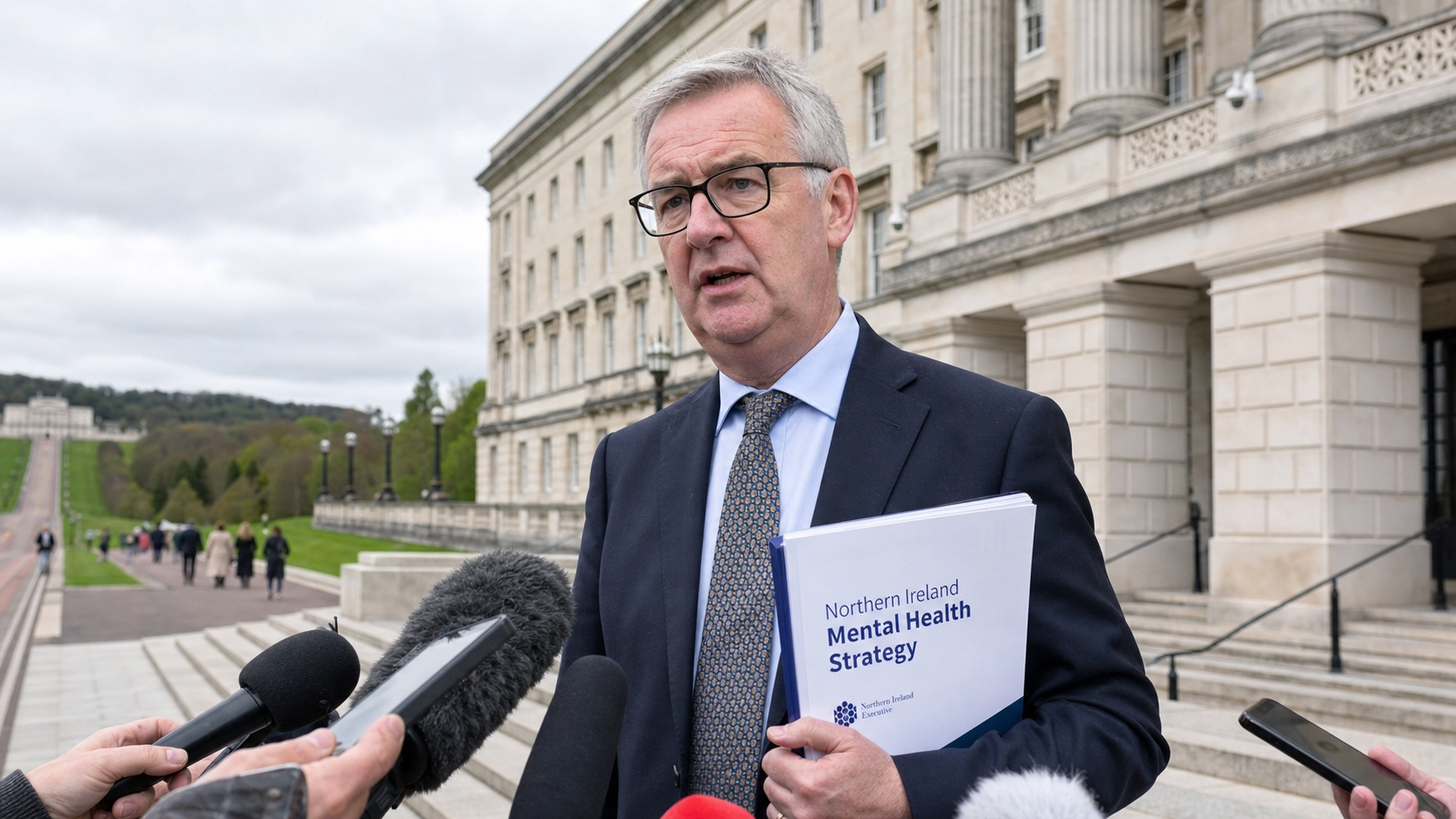
Health Minister Mike Nesbitt has responded to the review by announcing a "sharpening of focus" for 2026/27, concentrating available resources on two priority areas: the mental health workforce, with a particular emphasis on the community and voluntary sector, and the development of a regionally consistent mental health crisis service. The minister has been careful to frame this as a strategic prioritisation rather than an abandonment of the broader strategy, but critics have noted that the language of "sharpening of focus" is a euphemism for significant scaling back.
Professor Siobhán O'Neill, Northern Ireland's Mental Health Champion, has been unsparing in her assessment of the situation, describing the scaling back of the strategy as "disastrous" and "devastating." O'Neill has consistently argued that Northern Ireland's mental health needs are more complex than those of comparable regions, due to the legacy of the Troubles and the ongoing impact of political instability and social division on community wellbeing. The failure to fund the strategy adequately, she has argued, will have consequences that extend far beyond the individuals who are denied services.
Why It Matters
The mental health funding crisis matters because it represents a failure to honour a commitment made to some of the most vulnerable people in Northern Ireland. The strategy was not a vague aspiration — it was a detailed, costed plan with specific actions and timelines. The failure to fund it adequately is not a technical budgetary matter; it is a political choice with real consequences for real people.
Northern Ireland spends approximately £212 per capita on mental health services, compared to £264 in England — a gap that reflects years of underfunding and that has direct consequences for the quality and availability of care. The region's higher rates of mental ill health mean that this underfunding is particularly damaging: the people who need the most support are receiving the least.
The context of the current civil unrest in Belfast adds an additional dimension to the mental health crisis. Events of the kind that have unfolded this week — the violence, the displacement, the intimidation — have well-documented impacts on community mental health, particularly in communities that have already experienced trauma. The failure to adequately fund mental health services means that the system is poorly placed to respond to the additional demand that such events generate.
Local Impact
The impact of the mental health funding shortfall is felt across all five Health and Social Care trust areas, but it is particularly acute in the Western Trust, which serves Derry/Londonderry, Omagh, and the wider west of the region. The west of Northern Ireland has historically had higher rates of Troubles-related trauma and has been consistently underserved by mental health services relative to the Belfast area. The failure to implement the strategy's actions in this area perpetuates a geographic inequality that has been a source of grievance for decades.
Community and voluntary organisations — including MindWise, which has launched its own "Braver and Bolder" strategy for 2026–2031 — have been filling some of the gaps left by the underfunded statutory system. But these organisations are themselves under financial pressure, and their capacity to substitute for statutory services is limited. Service users across Northern Ireland report long waiting times for initial appointments and a reliance on charitable support as a stopgap for formal therapy.
What's Next
The Department of Health is developing its 2026/27 Mental Health Strategy Delivery Plan in collaboration with stakeholders across the Health and Social Care system, the community and voluntary sector, professional bodies, and service users. The plan is expected to be published in the coming weeks. Health Minister Nesbitt has indicated he will continue to press for additional funding for mental health services as part of the broader budget negotiations within the Executive. The Assembly's Health Committee is expected to hold a dedicated session on the mental health funding crisis in the coming months, with Professor O'Neill expected to give evidence.