Northern Ireland to Scrap German GCSE and Overhaul A-Level Structure in Biggest Exam Reform in a Generation
Northern Ireland's Council for the Curriculum, Examinations and Assessment has confirmed the withdrawal of German GCSE and a range of other qualifications by the end of the decade, while the Department of Education's TransformED reform programme will replace the current AS-level system with a new two-year modular A-level structure from 2029, in changes that Education Minister Paul Givan has described as the most significant overhaul of the qualification framework in a generation.
Background
Northern Ireland's examination system has long operated on a different basis from England and Wales, retaining the traditional A*-G grading scale for GCSEs while England moved to a 9-1 numerical system, and maintaining AS-levels as a standalone qualification at the end of Year 13. That distinctiveness has been a source of both pride and frustration — pride in a system that many educators regard as more rigorous, frustration at the administrative complexity of maintaining a separate qualification framework for a population of fewer than two million people.
The TransformED strategy, developed by the Department of Education under Minister Paul Givan, represents the most comprehensive review of Northern Ireland's qualifications since the introduction of the current GCSE and A-level structures. It was prompted by a combination of factors: concerns about over-assessment and student stress, the growing impact of artificial intelligence on take-home assignments, and a desire to align more closely with best practice in curriculum design without simply copying England's approach.
The decision to retain the A*-G grading scale — abandoning earlier proposals to switch to the 9-1 system — followed a public consultation that revealed strong opposition to the change among parents, teachers, and students. The consultation response was unusually clear-cut, and the Department responded accordingly.
Key Developments
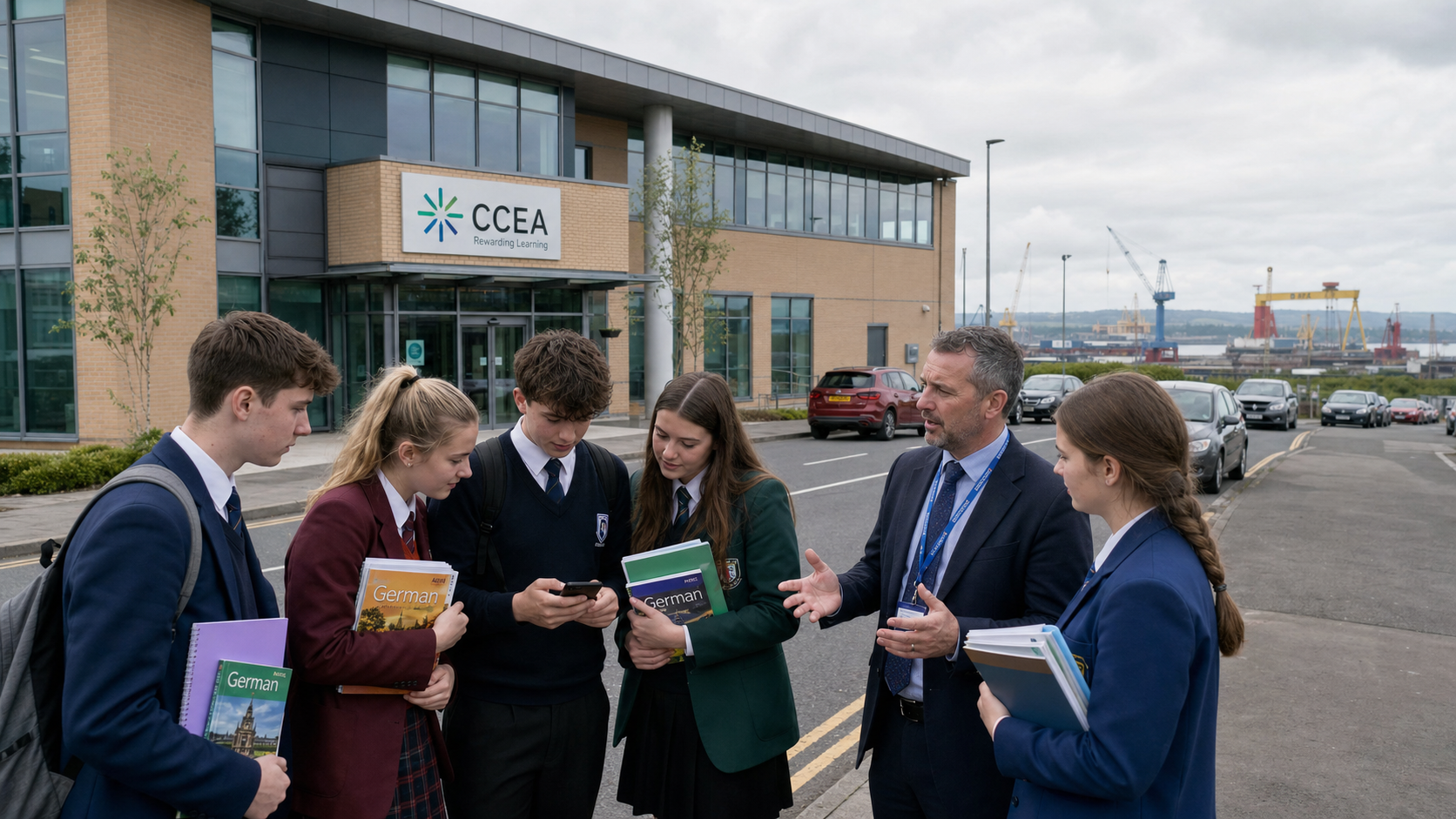
CCEA has confirmed that the following qualifications will be withdrawn by the end of the decade: at A-level, Professional Business Services; at GCSE, Engineering and Manufacturing, Leisure Travel and Tourism, Learning for Life and Work, Contemporary Crafts, and German. Final courses for the withdrawn GCSEs will commence in 2028, with final awards in 2030; the A-level withdrawal follows a year later.
Schools wishing to continue offering these subjects may do so by using English or Welsh exam boards, a provision that preserves some flexibility for institutions with established programmes in the affected areas. The withdrawal decisions were based on long-term sustainability assessments and candidate entry patterns — in several cases, the number of students sitting the qualifications had fallen to levels that made continued development and maintenance of the papers difficult to justify.
The structural reform of A-levels is more far-reaching. Under TransformED, the AS-level qualification will be replaced by a new two-year modular A-level. Students will retain the option to sit one set of exams at the end of Year 13, contributing 30% toward the final A-level grade, with the remaining 70% assessed at the end of Year 14. The AS-level name disappears, but the underlying assessment structure preserves some of its function.
Why It Matters
The withdrawal of German GCSE is the most immediately controversial element of the announcement. Modern languages have been in long-term decline across the UK and Ireland, and the loss of a GCSE option in German — even one with falling uptake — sends a signal about the direction of travel that language educators find troubling. Northern Ireland already has fewer modern language options than many comparable education systems, and the withdrawal of German narrows the field further.
The broader A-level reform is more nuanced. The replacement of AS-levels with a modular two-year structure addresses genuine concerns about the burden of Year 13 examinations on students who are simultaneously managing university applications and the psychological pressures of adolescence. The retention of a 30% Year 13 component preserves some of the formative assessment function of the AS-level without the full weight of a standalone qualification.
Givan's framing of the reforms as a response to AI is notable. The reduction in coursework and controlled assessments — except where practical skills must be evaluated — reflects a recognition that take-home assignments are increasingly difficult to authenticate in an era of large language models. Northern Ireland is among the first education systems in the UK to explicitly cite AI as a driver of assessment reform.
Local Impact
For schools across Northern Ireland — from grammar schools in Belfast's south and east to secondary schools in Derry, Newry, and Armagh — the reforms will require significant curriculum planning. Schools currently offering German GCSE will need to decide whether to continue through an English or Welsh board or to redirect resources to other modern languages. The timeline to 2028 provides some runway, but curriculum decisions of this scale require early action.
Students currently in Year 10 or below will be the first cohort to sit the reformed GCSEs. Those in Year 11 or 12 will complete their qualifications under the existing structure. The Department of Education has committed to providing detailed guidance to schools and to supporting teacher professional development ahead of the changes.
What's Next
CCEA will publish detailed specifications for the reformed qualifications over the coming months, with consultation periods for teachers and schools. The Department of Education has indicated that further announcements on curriculum content — as distinct from assessment structure — are expected before the end of 2026. The first cohort to sit the new two-year modular A-levels will begin their courses in September 2029.