Northern Ireland Records Near-Record Low Unemployment as Labour Market Defies Economic Headwinds
Northern Ireland's labour market has demonstrated remarkable resilience in the face of broader economic uncertainty, with the latest official statistics showing unemployment at 1.8% — among the lowest rates on record — payrolled employment at an all-time high, and annual redundancies falling to their lowest level in nearly three years.
Background
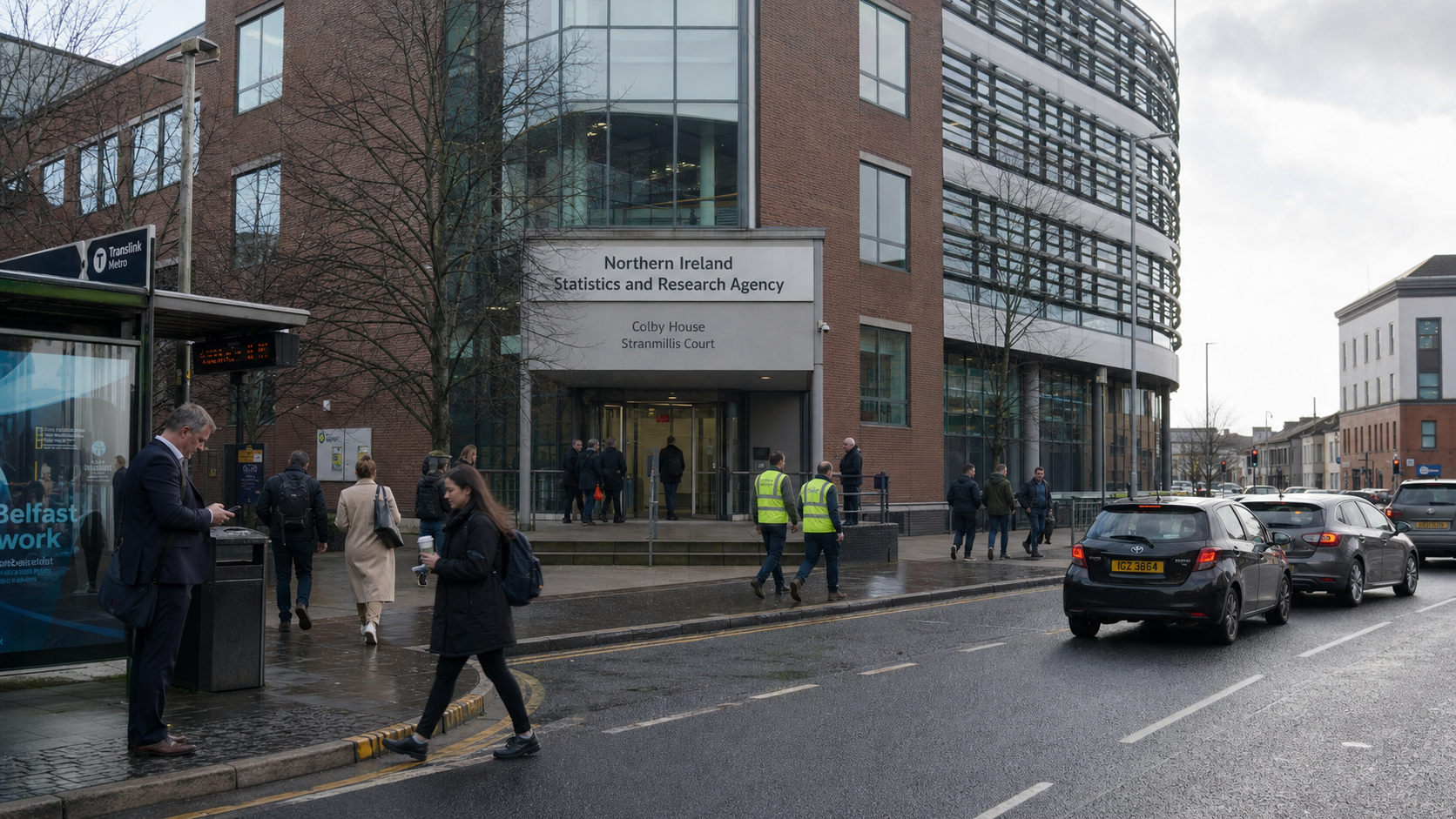
The Northern Ireland Statistics and Research Agency (NISRA) publishes monthly and quarterly labour market data that provides the most comprehensive picture available of employment conditions across the six counties. The data draws on two primary sources: the HMRC PAYE system, which captures the number of employees receiving pay through the tax system, and the Labour Force Survey (LFS), a household survey that provides estimates of employment, unemployment, and economic inactivity based on internationally standardised definitions developed by the International Labour Organisation.
Northern Ireland's labour market has historically been characterised by higher unemployment and lower employment rates than Great Britain, reflecting structural factors including the legacy of deindustrialisation, the impact of the Troubles on economic development, and the relatively small size of the private sector. However, the post-pandemic period has seen a significant improvement in labour market conditions across the region, driven by strong demand for workers in sectors including hospitality, construction, healthcare, and professional services.
The July 2026 report covers the period to June 2026 for PAYE data and the March to May 2026 quarter for LFS estimates. The figures represent the most current snapshot of labour market conditions available and provide important context for ongoing discussions about the Northern Ireland economy, including debates about public sector pay, investment attraction, and the impact of US tariffs on key export sectors.
Key Developments
The headline figure from the July 2026 report is a seasonally adjusted unemployment rate of 1.8% for the March to May 2026 period, representing a decrease of 0.4 percentage points over the quarter and 0.2 percentage points over the year. The employment rate for those aged 16 to 64 stood at 72.1%, an increase of 0.8 percentage points over the quarter, while the economic inactivity rate fell to 26.5%.
The PAYE data for June 2026 showed 820,800 employees receiving pay through the HMRC system, unchanged over the month but representing a 1.4% increase over the year. Median monthly pay reached £2,480, an increase of £21 over the month and £115 — or 4.9% — over the year. This represents a meaningful improvement in real wages for Northern Ireland workers, though the figure remains below the UK median and significantly below the equivalent figure for the Republic of Ireland.
The redundancy data was particularly encouraging. Just 60 redundancies were confirmed in June 2026, bringing the annual total to 1,670 — a decline of more than 23% compared to the 2,170 recorded in the previous year. This is the lowest annual redundancy figure since August 2023, suggesting that employers across Northern Ireland are retaining staff despite the cost pressures affecting many businesses.
Why It Matters
The labour market data provides important context for the ongoing debate about Northern Ireland's economic trajectory. The region has faced significant headwinds in recent months, including the impact of US tariffs on pharmaceutical exports — a sector that accounts for a disproportionate share of Northern Ireland's export earnings — and the broader uncertainty created by global trade tensions. Against that backdrop, the resilience of the labour market is a genuinely positive signal.
The 4.9% increase in median monthly pay is particularly significant. For much of the post-2008 period, Northern Ireland workers experienced real wage stagnation, with pay increases failing to keep pace with inflation. The current period of above-inflation wage growth represents a meaningful improvement in living standards for many workers, though the benefits are unevenly distributed across sectors and skill levels.
The comparison with the Republic of Ireland remains instructive. The Republic's unemployment rate has also been at historically low levels, and the two economies are increasingly integrated through cross-border employment flows, supply chains, and investment patterns. The convergence of labour market conditions on both sides of the border creates both opportunities and challenges for policymakers seeking to manage wage pressures and skills shortages.
Local Impact
The strong labour market data has practical implications for communities across Northern Ireland. In Belfast, where the service sector dominates employment, low unemployment has contributed to a tightening of the labour market that is being felt by employers in hospitality, retail, and professional services. In rural areas, including parts of Fermanagh, Tyrone, and Armagh, the agricultural and food processing sectors continue to face recruitment challenges despite the overall improvement in employment conditions.
For the Northern Ireland Executive, the positive labour market data provides some political breathing room at a time when the budget situation remains extremely tight. The Department for the Economy, which has responsibility for employment policy and investment attraction, will use the figures to support its case for continued investment in skills and infrastructure. Invest Northern Ireland, the regional development agency, is expected to reference the data in its ongoing engagement with potential investors considering the region as a location for new operations.
What's Next
The next NISRA Labour Market Report is due in August 2026 and will cover the period to July 2026 for PAYE data and the April to June 2026 quarter for LFS estimates. Economists will be watching closely for any signs that the US tariff impact on pharmaceutical exports is beginning to feed through into employment figures, particularly in the greater Belfast area where many of the sector's major employers are concentrated. The Department for the Economy is expected to publish its annual economic strategy update in the autumn, which will set out the Executive's priorities for employment and investment in the context of the current labour market conditions.