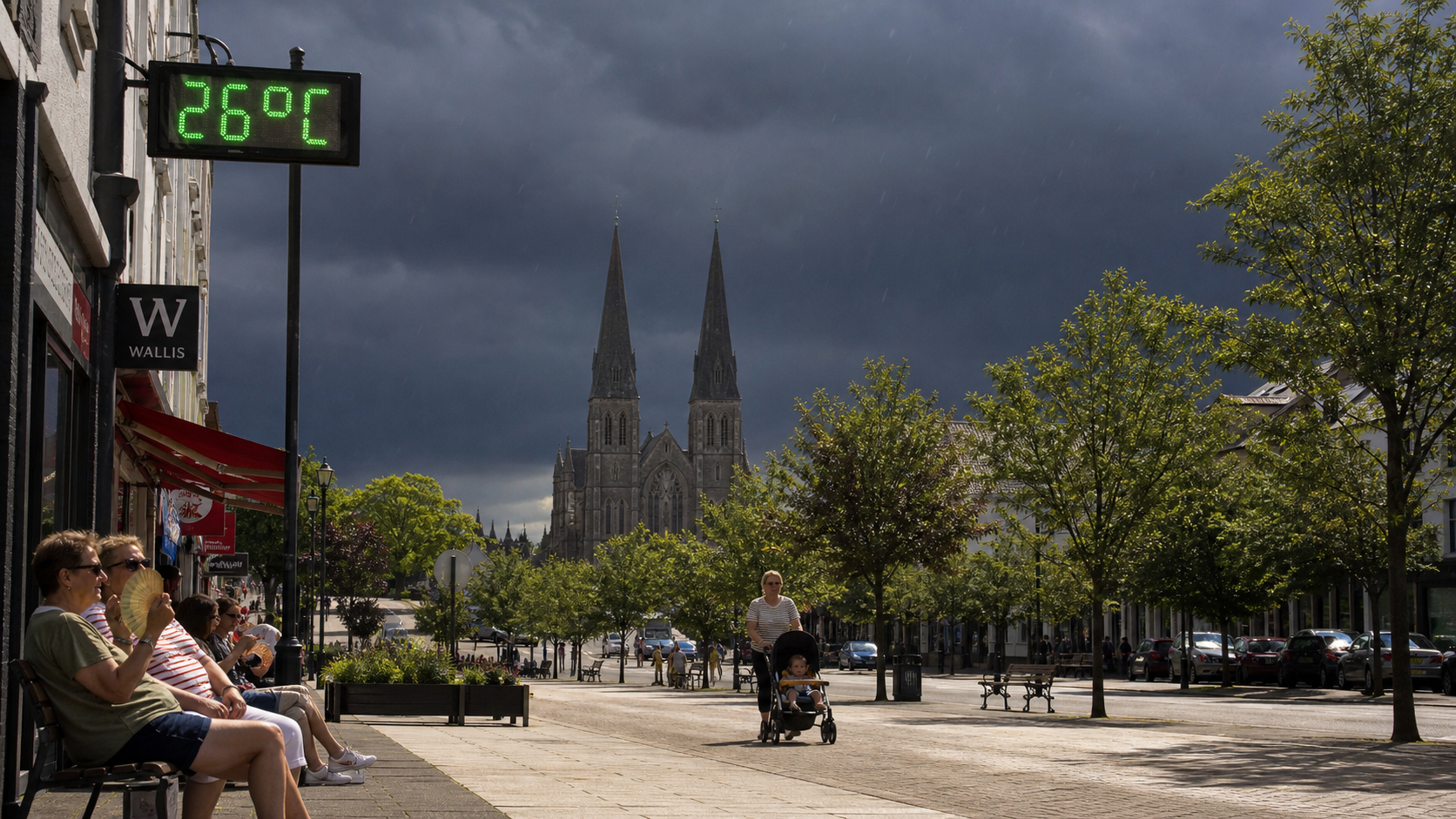
Northern Ireland Enters Fourth Heatwave of Summer as Thunderstorm Warning Issued
Northern Ireland has officially entered its fourth heatwave of the summer of 2026, with Armagh recording three consecutive days of temperatures at or above 25°C — the Met Office threshold for a heatwave — as forecasters simultaneously issued a thunderstorm warning for the entire region, warning of sudden downpours of up to 30mm in less than an hour alongside risks of lightning, hailstones, and gusty winds.
Background
The summer of 2026 has been exceptional by any historical measure for Northern Ireland. Provisional data from the Met Office places it on course to be the warmest summer on record for the region, with mean temperatures tracking 1.38°C above the long-term average — a margin that, while it may appear modest in isolation, represents an extraordinary departure from the climatic norms that have shaped Northern Ireland's landscape, agriculture, and infrastructure for centuries.
The first three heatwaves of the summer arrived in June and July, each bringing temperatures that broke local records and placed significant pressure on public health services, water supplies, and agricultural land. The fourth heatwave, which began on Tuesday, 11 August, has been characterised by high humidity as well as heat, making conditions feel more oppressive than the raw temperature figures suggest.
A heatwave is defined by the Met Office as a period during which an area records temperatures of 25°C or higher for at least three consecutive days. Armagh, which serves as the primary meteorological reference point for Northern Ireland, met this criterion on Thursday, 13 August, triggering the official designation.
Key Developments
The Met Office issued a yellow thunderstorm warning for all of Northern Ireland, effective from 11:00 BST on Thursday until 06:00 on Friday, 14 August. Meteorologists described the atmosphere as "unstable, warm, and humid," creating conditions in which severe thunderstorms could develop rapidly and produce sudden, intense rainfall. The warning specified that some areas could receive 10 to 20mm of rain in less than an hour, with localised totals of 20 to 30mm possible, alongside risks of lightning strikes, hailstones, and gusts of wind strong enough to cause localised damage.
The Public Health Agency issued guidance urging vulnerable people — including the elderly, young children, and those with chronic health conditions — to stay hydrated, avoid direct sunlight during the hottest parts of the day, and seek medical advice if they experienced symptoms of heat exhaustion. The Northern Ireland Water service warned of increased demand on the water network and urged customers to use water responsibly.
Following the passage of the thunderstorms, forecasters predicted that fresher Atlantic air would bring a gradual reduction in temperatures across Northern Ireland over the weekend, with highs of around 20°C expected by Sunday.
Why It Matters
Four heatwaves in a single summer is without precedent in Northern Ireland's recorded meteorological history. The pattern is consistent with the projections of climate scientists, who have long warned that the island of Ireland would experience more frequent and more intense heat events as global temperatures rise. What was once considered an exceptional occurrence — a single heatwave in a summer — has become, in 2026, a recurring feature of the season.
The implications extend well beyond personal discomfort. Northern Ireland's infrastructure — its roads, its water pipes, its buildings — was not designed for sustained high temperatures. The health service, already under severe pressure from waiting lists and staffing shortages, faces additional demand during heatwaves as heat-related illness increases. Farmers across the region have reported significant losses as pasture dries out and livestock require additional water and shade.
Local Impact
In Belfast, the combination of heat and humidity has been particularly challenging in densely built areas such as the city centre, the Markets, and parts of north and west Belfast where green space is limited. The Belfast City Council opened a number of cooling centres in public buildings, including libraries and leisure centres, for residents without access to air conditioning. In rural areas of County Antrim, County Down, and County Armagh, farmers reported that the prolonged dry spell was depleting silage reserves and forcing early supplementary feeding of livestock. The Northern Ireland Environment Agency issued a drought advisory for several river catchments, warning of reduced flows and elevated water temperatures that could affect fish populations.
What's Next
The thunderstorm warning expires at 06:00 on Friday, 14 August, after which conditions are expected to gradually improve. Met Office forecasters predict that temperatures will fall to more seasonal levels — highs of 18 to 22°C — over the weekend of 15 to 16 August, with some rainfall possible in the west and north of the region. The longer-range forecast suggests that the exceptional heat of the summer of 2026 is unlikely to return before the autumn, though forecasters cautioned that the unusual atmospheric patterns that have characterised the season make confident long-range prediction difficult.