Northern Ireland A-Level Results Rise for Third Consecutive Year as Education Minister Signals Reform
More than 26,000 students across Northern Ireland received their A-level, AS-level, and BTEC results this week, with the proportion achieving top A* or A grades rising to 30.7 per cent — up from 30.3 per cent in 2025 — marking the third consecutive year of improvement and prompting Education Minister Paul Givan to signal the most significant reform of the examination system in a generation.
Background
Northern Ireland's A-level system has long been regarded as one of the most rigorous in the United Kingdom, with consistently high standards that have served students well in university admissions and graduate employment. The region operates its own examination board, the Council for the Curriculum, Examinations and Assessment (CCEA), which sets papers and marks scripts independently of the English and Welsh boards, and the results it produces are generally regarded as comparable in standard to those of its counterparts across the water.
The past three years have seen a steady improvement in outcomes, a trend that education officials attribute to a combination of factors: improved teaching quality, better use of data to identify and support underperforming pupils, and a gradual recovery from the disruption caused by the pandemic years of 2020 and 2021, which had a lasting impact on the cohorts who sat their GCSEs during that period and are now completing their A-level studies.
The 2026 results are particularly significant because they represent the first cohort to have completed their entire post-primary education without any pandemic-related disruption to their examinations — a milestone that education officials had been anticipating with some anxiety, given concerns that grade inflation during the pandemic years might have set unrealistic expectations.
Key Developments
The headline figures are encouraging. The proportion of entries achieving A* or A grades rose to 30.7 per cent, up from 30.3 per cent in 2025, while the proportion achieving the top A* grade increased to 8.8 per cent from 8.7 per cent. The overall pass rate — grades A* through E — reached 98.9 per cent, up from 98.7 per cent the previous year. Mathematics remained the most popular A-level subject, accounting for one in ten entries, and STEM subjects as a whole represented 38.2 per cent of all A-level entries.
Minister Givan, speaking at a press conference in Belfast on Thursday, described the results as "a testament to the hard work of students and the dedication of teachers across Northern Ireland." He also used the occasion to announce the most significant reform of the examination system in many years: the phasing out of standalone AS-levels by 2029, to be replaced by a new two-year modular A-level structure under the "TransformED" reform programme.
The minister acknowledged that the proportion of 18-year-olds applying to university has declined slightly, from 52.8 per cent in 2022 to 49.1 per cent in 2026, but argued that this reflected a positive diversification of pathways rather than a decline in ambition, with growing numbers of students opting for Higher Level Apprenticeships and other vocational routes.
Why It Matters
The gender dimension of the results deserves particular attention. Boys accounted for just four in ten A-level entries in Northern Ireland this summer — the lowest proportion of any UK nation that sits the examinations — a disparity that has been widening for several years and that education researchers describe as a structural problem rather than a cyclical one. The gap in attainment between boys and girls at A-level is not unique to Northern Ireland, but it is more pronounced here than elsewhere in the UK, and the TransformED reforms will need to address this directly if they are to be judged a success.
The decline in university application rates also warrants scrutiny. While the minister's framing of this as a positive diversification is not without merit — Higher Level Apprenticeships do offer genuine career pathways — there is a risk that some students are being steered away from university not by genuine preference but by the cost of tuition and living expenses, which have risen significantly in recent years. Unlike students in the Republic, who benefit from a free fees scheme, Northern Ireland students attending universities in England, Scotland, or Wales face fees of up to £9,535 per year.
Local Impact
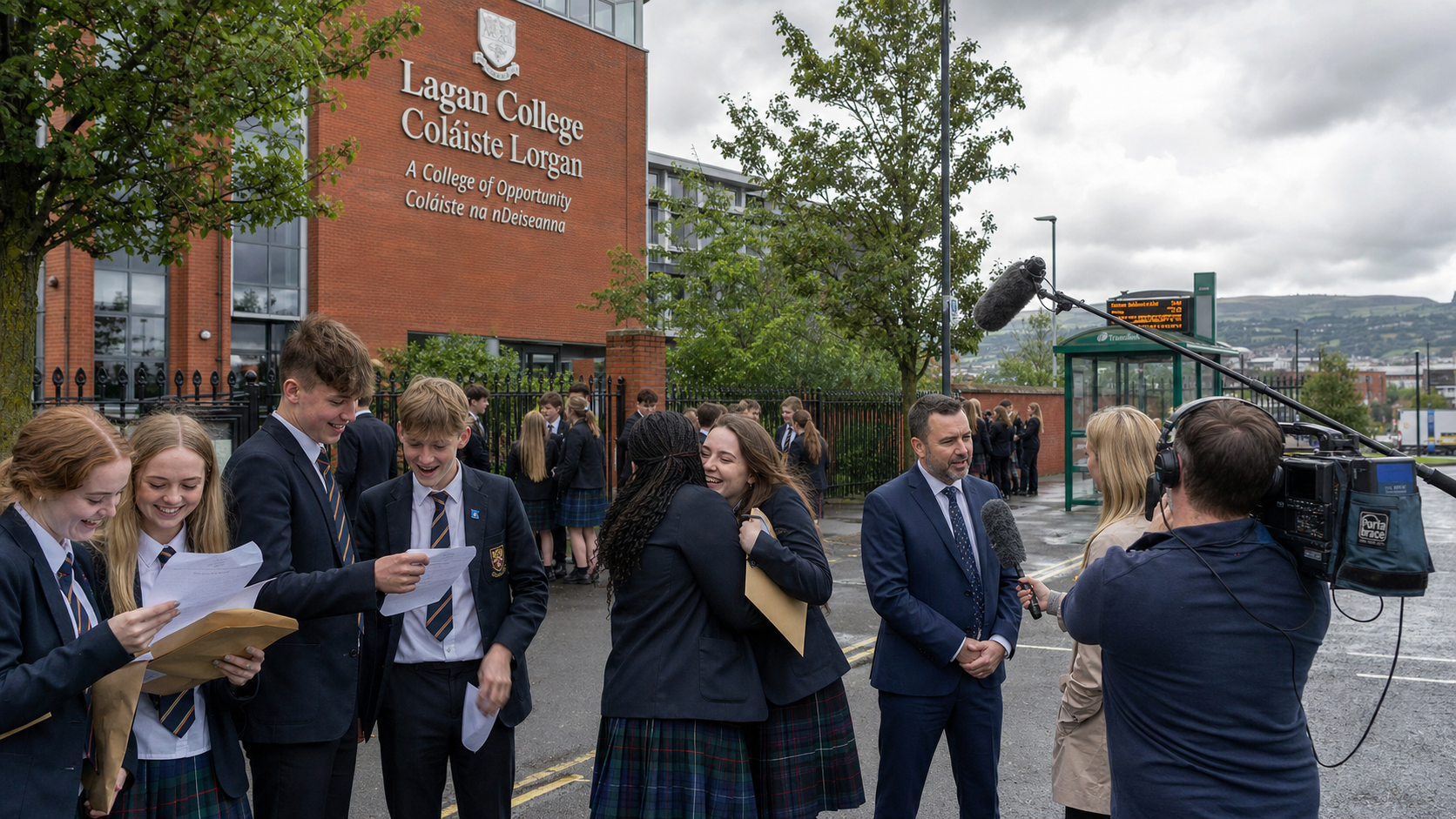
Across Northern Ireland's grammar and secondary schools, the results day scenes were familiar: students gathering in school halls, opening envelopes, and reacting with a mixture of relief, joy, and occasional disappointment. The CCEA results helpline and the Department for the Economy's careers service both reported high volumes of calls from students seeking guidance on clearing options and alternative pathways. Queen's University Belfast and Ulster University both confirmed that their clearing processes were running smoothly, with places available in a range of courses.
What's Next
The TransformED consultation process will continue through the autumn, with a final decision on the new modular A-level structure expected before the end of 2026. The Department of Education has committed to a phased implementation that will give schools, teachers, and students adequate time to prepare for the changes. The first cohort to sit the new-style examinations is expected to do so in 2029.