North Belfast Bus Lane Extension Postponed After 40 Objections Halt Infrastructure Plan
The Department for Infrastructure has postponed plans to extend bus lane operating hours on several major arterial routes in north Belfast, after a statutory consultation period generated 40 formal objections and four representations. Infrastructure Minister Liz Kimmins confirmed the delay on Monday, stating that all concerns must be thoroughly reviewed before a final decision is made — a move welcomed by local businesses but criticised by public transport advocates who argue that bus users in poorer communities are being let down.
Background
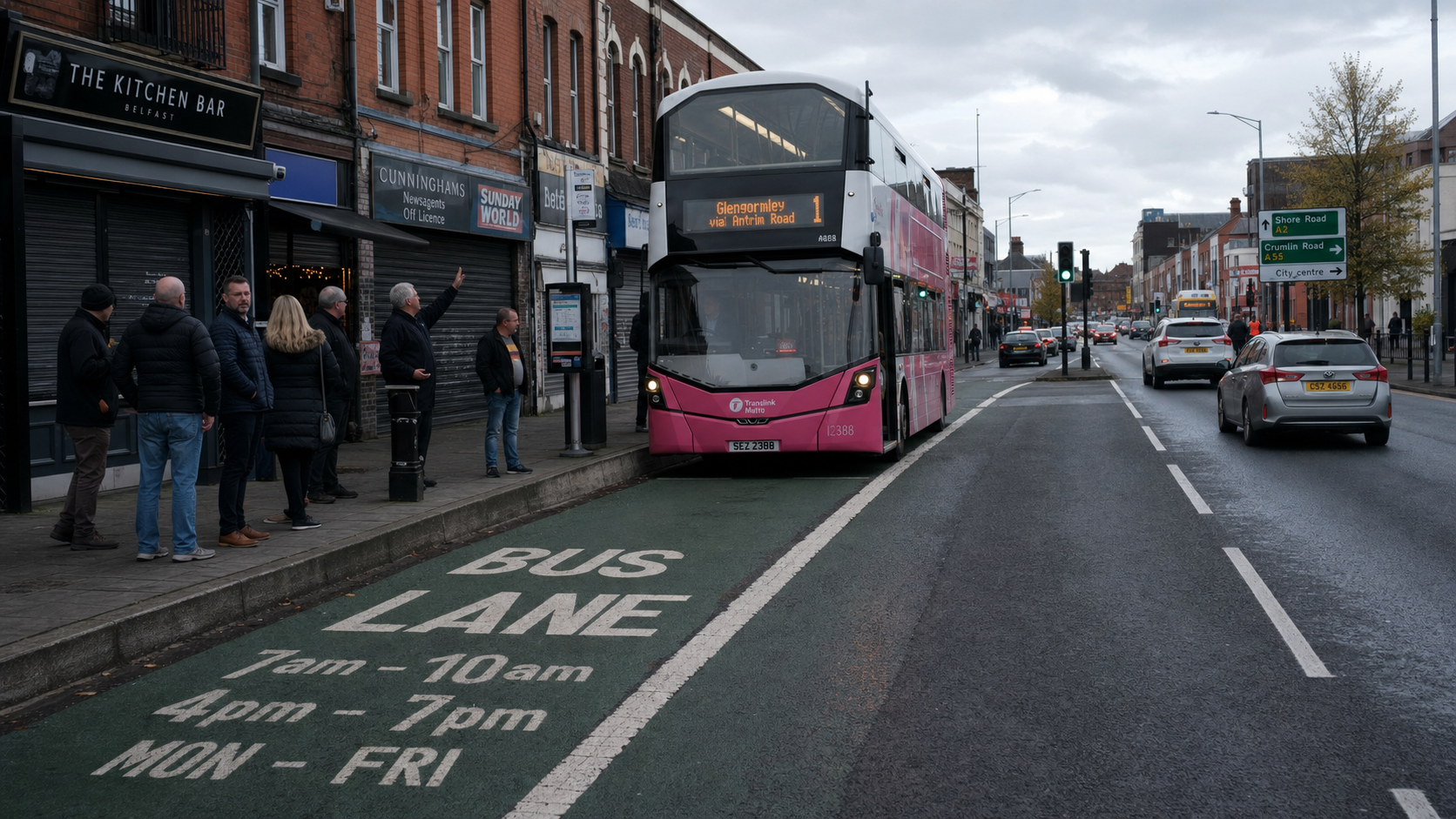
The proposed experimental traffic control scheme was designed to extend the operating hours of inbound and outbound bus lanes on five key arterial routes in north Belfast: the Antrim Road, Shore Road, York Road, York Street, and Crumlin Road. Under the proposal, bus lanes on these routes would have operated during an additional afternoon slot from 3:30pm to 6:30pm, in addition to the existing morning peak period. The aim was to improve bus journey time reliability on routes that serve some of Belfast's most densely populated residential areas.
The scheme followed the successful extension of bus lane hours in south Belfast, which the Department for Infrastructure credited with improving service punctuality and increasing passenger numbers on routes serving the Lisburn Road, Malone Road, and Ormeau Road corridors. The south Belfast experience was cited as evidence that bus lane prioritisation works — that giving buses dedicated road space during peak hours translates into faster, more reliable services that attract more passengers and reduce car dependency.
North Belfast presents a different set of challenges. The arterial routes in question serve a mix of residential, commercial, and industrial uses, and the businesses along these corridors — many of them small, independent traders — expressed concern that restricting car access during afternoon hours would damage trade. The Antrim Road Business Association was among the organisations that engaged with the consultation process, raising concerns about delivery access and customer parking.
Key Developments
The consultation period ran from 10 June to 2 July 2026. By its close, the Department for Infrastructure had received 40 objections and four representations — a volume of feedback that Minister Kimmins said warranted a full review before any decision to proceed. The minister confirmed that the implementation of the scheme would be postponed to allow for that review, with no new timeline given for when a decision might be made.
The DUP's Phillip Brett, who represents north Belfast in the Assembly, welcomed the postponement, describing the original proposal as "ill-thought-out" and expressing concern that it would have increased congestion and harmed local businesses. His view was echoed by several other north Belfast representatives who had received representations from constituents and business owners during the consultation period.
The Green Party's Mal O'Hara took a sharply different view, criticising the minister for prioritising the concerns of car users over those of bus passengers. O'Hara argued that the communities along the north Belfast arterial routes include a high proportion of people who do not own cars and depend on public transport for their daily journeys — and that those people are being failed by a decision to delay improvements to bus services in deference to objections from a minority of car-dependent businesses.
Why It Matters
The north Belfast bus lane controversy is a microcosm of a wider tension in urban transport policy: the conflict between the short-term interests of businesses that depend on car access and the long-term interests of communities that need reliable, affordable public transport. This tension is not unique to Belfast — it plays out in cities across these islands — but it has particular resonance in north Belfast, where the arterial routes in question pass through communities with high levels of deprivation and low rates of car ownership.
The evidence from south Belfast suggests that bus lane prioritisation does work. Journey times on the Lisburn Road and Malone Road corridors improved measurably after the extension of bus lane hours, and passenger numbers on those routes increased. If the same effect could be achieved on the Antrim Road and Shore Road, the benefits for north Belfast commuters would be significant. The question is whether the political will exists to push through a measure that will inevitably generate some short-term friction with local businesses.
Unlike the Republic, where Transport for Ireland has been more assertive in implementing bus priority measures in Dublin, the Department for Infrastructure in Northern Ireland has historically been cautious about measures that restrict car access. The postponement of the north Belfast scheme fits that pattern, though the minister has been careful to frame the delay as a procedural necessity rather than a policy retreat.
Local Impact
For the tens of thousands of people who travel into and out of north Belfast by bus each day — on Translink Metro routes serving the Antrim Road, Shore Road, and Crumlin Road — the postponement means continued uncertainty about when, if ever, their journeys will become more reliable. The routes in question serve communities including Glengormley, Newtownabbey, Whiteabbey, and the north Belfast suburbs, as well as the city centre. Delays on these routes during the afternoon peak are a daily frustration for commuters, and the failure to implement bus priority measures means that frustration will continue for the foreseeable future.
What's Next
The Department for Infrastructure will now conduct a full review of the 40 objections and four representations received during the consultation. There is no confirmed timeline for when that review will be completed or when a decision on the scheme will be made. Minister Kimmins has indicated that she remains committed to improving bus journey time reliability in north Belfast, but has not specified what alternative measures might be considered if the experimental scheme is ultimately abandoned. Translink has been consulted throughout the process and is expected to provide further evidence to the department as the review proceeds.