NI Breastfeeding Action Plan Targets UK's Lowest Rates as New Three-Year Strategy Launched
Northern Ireland's Department of Health has launched a new Breastfeeding Action Plan covering 2026 to 2029, aimed at addressing the region's persistent status as having the lowest breastfeeding rates in the United Kingdom — a public health challenge that Health Minister Mike Nesbitt described as a matter of health inequality that demands urgent and sustained action.
Background
The statistics are stark. According to data from the Public Health Agency, approximately 53.6 per cent of infants in Northern Ireland were breastfed at hospital discharge in 2023/24 — a figure that, while not negligible, is significantly lower than the rates recorded in England, Scotland, and Wales. By six weeks, that proportion had fallen to 36.9 per cent, and by three months to just 30.9 per cent. These figures place Northern Ireland not just at the bottom of the UK table but among the lowest in Europe, a distinction that carries real public health consequences given the well-established benefits of breastfeeding for both infant and maternal health.
The previous strategy, "Breastfeeding — A Great Start," ran from 2013 to 2024 and was extended by a year to allow for a final review. That review found that while some progress had been made — particularly in expanding the "Breastfeeding Welcome Here" scheme, which now covers nearly 1,500 registered venues across Northern Ireland — the strategy had failed to meet its specific 2025 targets for breastfeeding rates. The new plan is designed to learn from those shortcomings and to take a more targeted, evidence-based approach to the challenge.
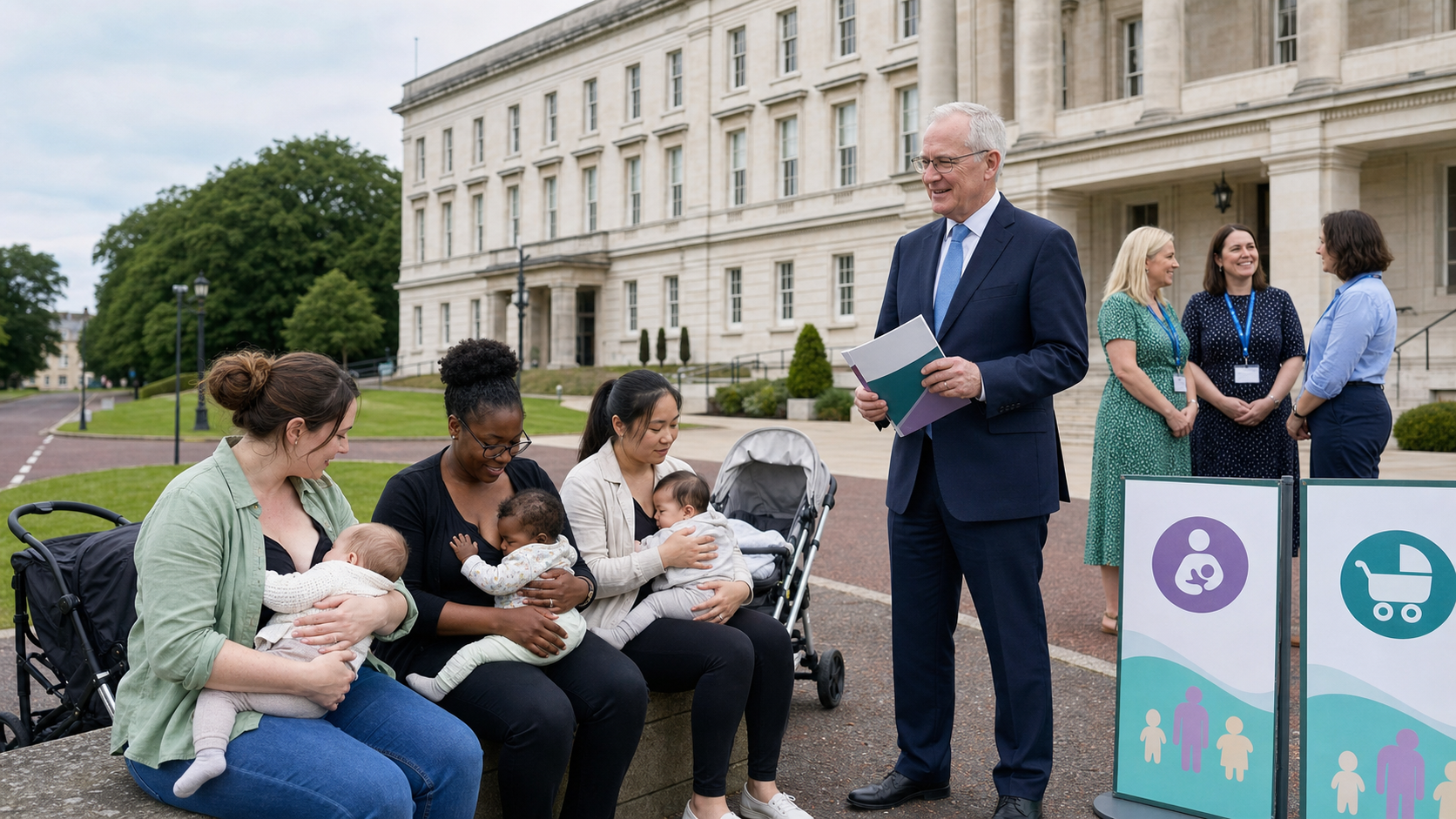
The launch took place at the annual "Breastival" event at Stormont in July, with Minister Nesbitt joined by representatives from the Public Health Agency, the five health and social care trusts, and a range of voluntary and community organisations working in the infant feeding space. The event itself — a celebration of breastfeeding that has been running for several years — drew a large crowd and provided a vivid illustration of the community energy that exists around this issue.
Key Developments
The new action plan focuses on four core areas. First, enhanced support: the plan commits to increasing the availability of community-based breastfeeding support services, including peer support groups and specialist lactation consultants, and to improving training for healthcare professionals across all five trusts. Second, public awareness: a significant campaign is planned to educate the public on the health benefits of breastfeeding and to challenge the stigma that many mothers report experiencing when breastfeeding in public or in the workplace. Third, environment: the "Breastfeeding Welcome Here" scheme will be expanded, with a particular focus on workplaces, where many mothers report feeling unsupported when they return to employment. Fourth, measurable targets: unlike the previous strategy, the new plan commits to specific, publicly reported targets for breastfeeding rates at discharge, six weeks, and three months.
Interim Assistant Director for Starting Well at the Public Health Agency, Deidre Ward, emphasised that the success of the plan would depend on a broader social effort. "This is not just a health system issue," she said. "It requires families, communities, employers, and the wider public to understand and support breastfeeding as a normal and healthy part of infant care."
Why It Matters
The health case for breastfeeding is well established. Breastfed infants have lower rates of respiratory infections, gastrointestinal illness, and sudden infant death syndrome, and there is growing evidence of long-term benefits for cognitive development and immune function. For mothers, breastfeeding is associated with reduced rates of breast and ovarian cancer, type 2 diabetes, and postnatal depression. The economic case is equally compelling: a 2016 Lancet study estimated that increasing breastfeeding rates to near-universal levels globally would prevent 823,000 child deaths and 20,000 maternal deaths from breast cancer annually.
Northern Ireland's low rates are not simply a matter of individual choice. Research consistently shows that mothers from lower socio-economic backgrounds are statistically less likely to breastfeed, reflecting a complex interplay of factors including access to support, workplace conditions, and social norms. The new action plan's emphasis on reducing health inequalities is therefore not just a rhetorical flourish but a recognition that the problem is structural as well as individual.
Local Impact
The five health and social care trusts — Belfast, South Eastern, Southern, Western, and Northern — will each be required to develop local implementation plans under the new strategy, with specific targets tailored to the demographic and geographic characteristics of their areas. The Southern Trust, which covers County Armagh, County Down, and parts of County Tyrone, has historically had some of the lowest breastfeeding rates in Northern Ireland and is expected to be a particular focus of the new plan's community support initiatives.
What's Next
The Department of Health and the Public Health Agency will publish an annual progress report against the plan's targets, with the first report due in spring 2027. A mid-term review is planned for 2028, and the plan will be subject to a full evaluation before the end of 2029. Minister Nesbitt has indicated that he is open to revising the plan's targets upward if early progress is stronger than anticipated.