NI Agriculture Minister Andrew Muir Faces No-Confidence Vote as Cattle Cull Row Escalates
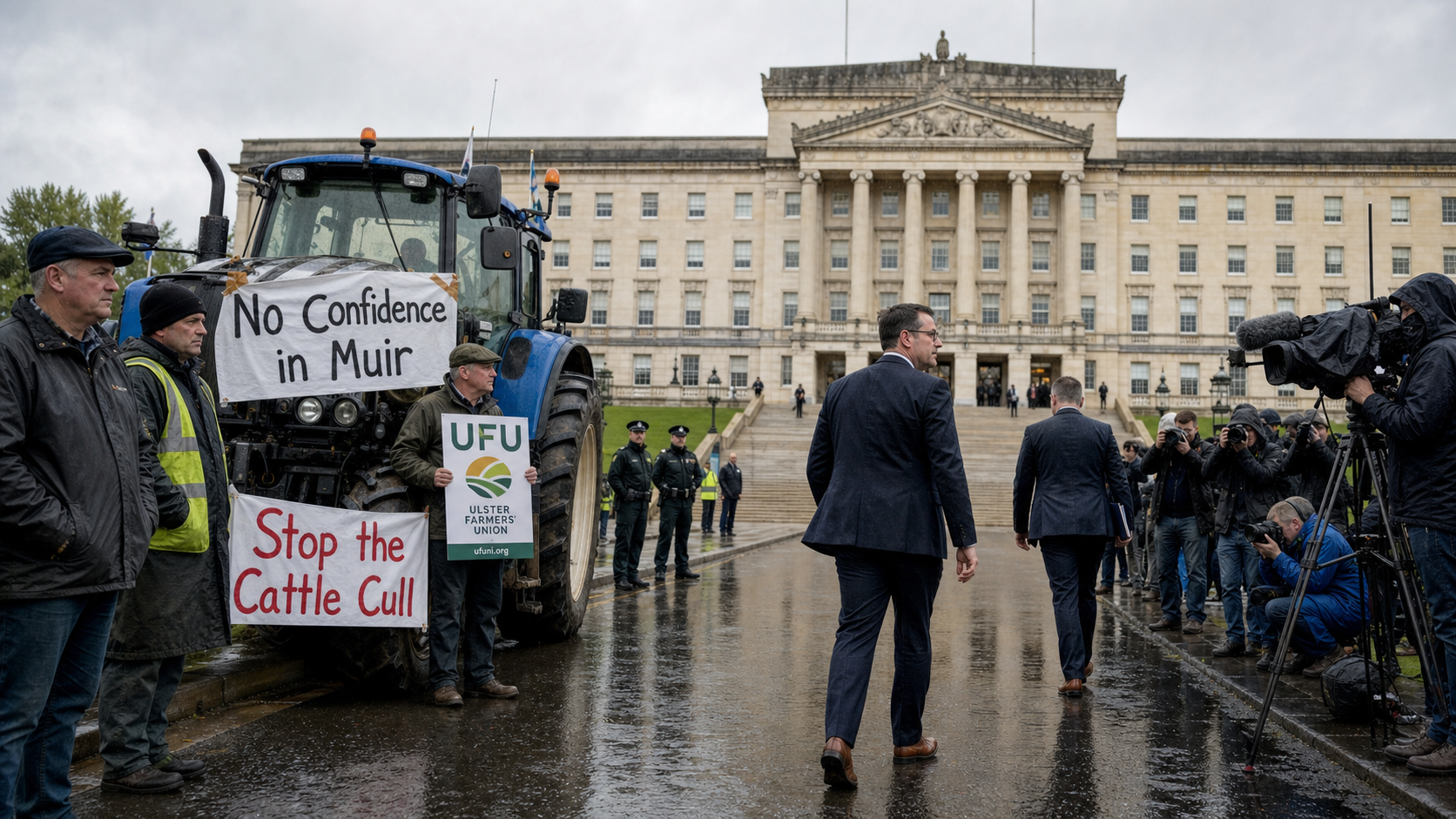
Northern Ireland Agriculture Minister Andrew Muir has confirmed he was physically assaulted in Belfast's North Street area as the controversy over the culling of 51 cattle in County Tyrone continues to escalate into one of the most serious political crises facing the Stormont Executive, with the Ulster Farmers' Union passing a formal motion of no confidence in the minister and farming communities across the province expressing fury at the department's handling of the operation.
Background
The controversy centres on the culling of 51 cattle on a County Tyrone farm following a bovine tuberculosis outbreak. The Department of Agriculture, Environment and Rural Affairs ordered the cull as part of its standard TB eradication protocol, but the manner in which the operation was carried out — and the communication with the farm family involved — has generated intense anger within the farming community. The family at the centre of the case have spoken publicly about their distress, describing the experience as traumatic and accusing the department of acting without adequate sensitivity or transparency.
Bovine tuberculosis is a serious and persistent problem in Northern Ireland, where the disease has proven difficult to eradicate despite decades of testing and culling programmes. The department's TB eradication strategy requires the compulsory slaughter of cattle that test positive for the disease, a policy that is deeply unpopular with farmers but that is considered essential by veterinary authorities to prevent the spread of the disease through the herd. The Tyrone case has reignited a long-standing debate about whether the current approach to TB eradication is proportionate and whether the department's communication with affected farmers is adequate.
Andrew Muir, the Alliance Party MLA who holds the Agriculture portfolio in the Stormont Executive, has been at the centre of the storm since the details of the Tyrone cull became public. The minister has defended the department's actions as consistent with established protocol and has pointed to the scientific evidence supporting the TB eradication strategy. But his defence has failed to satisfy the farming community, and the Ulster Farmers' Union's decision to pass a formal motion of no confidence in him represents a significant escalation of the dispute.
Key Developments
The confirmation that Minister Muir was physically assaulted in Belfast's North Street area has added a deeply troubling dimension to the controversy. The minister has confirmed the incident and has indicated that it has been reported to the PSNI. While the assault has been widely condemned across the political spectrum, it has also prompted reflection on the intensity of feeling within the farming community and the extent to which the controversy has generated personal animosity towards the minister.
The Ulster Farmers' Union's motion of no confidence, passed at an emergency meeting of the union's council, calls on the minister to resign and for a fundamental review of the department's TB eradication strategy. UFU President David Brown described the department's handling of the Tyrone case as unacceptable and said the union had lost confidence in the minister's ability to represent the interests of Northern Ireland's farming community.
Muir has refused to resign, stating that he has appointed an independent reviewer to examine the department's handling of the Tyrone operation and that he will await the outcome of that review before taking any further action. He has also indicated that he is open to a broader review of the TB eradication strategy, including the communication protocols used when cattle are compulsorily slaughtered.
Why It Matters
The cattle cull controversy matters for several reasons. It has exposed a significant breakdown in trust between the Department of Agriculture and the farming community — a relationship that is essential to the effective implementation of animal disease control policies. If farmers do not trust the department to act fairly and transparently, the cooperation that is essential to the success of the TB eradication programme will be undermined, with potentially serious consequences for animal health across Northern Ireland.
The physical assault on the minister is also deeply concerning. Whatever the merits of the dispute over the cattle cull, the use of violence against an elected representative is wholly unacceptable and represents a serious threat to the functioning of democratic politics. The PSNI's investigation into the assault will be closely watched, and the political parties have been united in their condemnation of the incident.
Local Impact
In County Tyrone, where the cull took place, the farming community has been deeply affected by the controversy. The family at the centre of the case have received significant support from neighbours and from farming organisations, and their story has resonated with farmers across the province who have had their own difficult experiences with the TB eradication programme. In Fermanagh, Armagh, and Down — counties where TB is also a significant problem — farmers have been following the controversy closely and have expressed solidarity with the Tyrone family. The Ulster Farmers' Union has indicated it will maintain pressure on the minister and the department until a satisfactory resolution is reached.
What's Next
The independent reviewer appointed by Minister Muir is expected to report within six to eight weeks. The review will examine the department's handling of the Tyrone operation, including the communication with the farm family, the decision-making process that led to the cull, and whether the department's actions were consistent with its own protocols. The Ulster Farmers' Union has indicated it will engage with the review process but has reserved the right to take further action if the outcome is not satisfactory. The Stormont Assembly's Agriculture Committee is expected to hold an emergency session to examine the controversy, with the minister expected to appear before the committee to answer questions about the department's handling of the case.