Ireland Commits €10 Million to Ukraine Military Training Facilities as EU Defence Ministers Meet in Wicklow
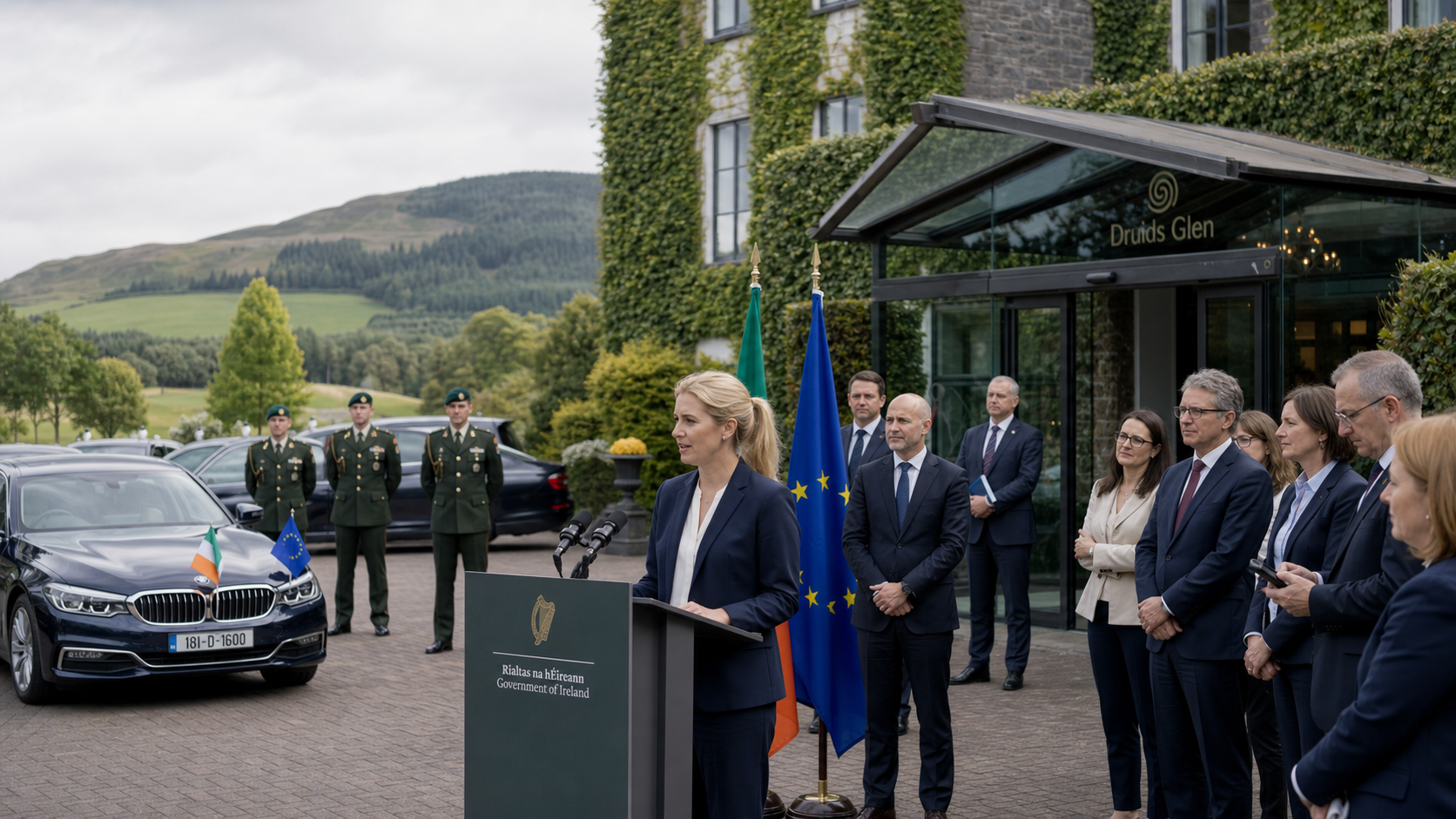
Ireland has committed €10 million to fund the construction and modernisation of military training facilities inside Ukraine, in a significant policy shift announced by Minister for Defence and Foreign Affairs Helen McEntee at an informal gathering of EU defence ministers at Druids Glen, County Wicklow — a meeting that also addressed plans for a new European mission to support Lebanese security forces as the UNIFIL mandate approaches its end.
Background
Ireland's approach to the war in Ukraine has been shaped by the country's constitutional commitment to military neutrality and its long tradition of participation in United Nations peacekeeping operations. Since Russia's full-scale invasion of Ukraine in February 2022, the Irish government has navigated a careful path between solidarity with Ukraine and the constraints imposed by its neutrality — providing humanitarian aid, hosting Ukrainian refugees, and contributing to EU-level support measures, while stopping short of providing lethal military equipment.
The €125 million aid package for Ukraine, announced by the Irish government in July 2026, represented a significant escalation of Ireland's financial commitment to the country. The package included humanitarian aid, reconstruction support, and funding for non-lethal military assistance — a category that has been interpreted broadly to include training, logistics, and now, with the September announcement, the physical infrastructure of military training.
The informal meeting of EU defence ministers at Druids Glen, County Wicklow, was one of a series of high-level events hosted by Ireland as part of its presidency of the Council of the European Union. The choice of Wicklow — a county known for its natural beauty and its proximity to Dublin — as the venue for the defence ministers' meeting was deliberate, reflecting Ireland's desire to project an image of a country that takes its European responsibilities seriously while remaining committed to its own distinctive foreign policy tradition.
Key Developments
Minister McEntee announced the €10 million commitment during the Wicklow meeting, describing the military training facilities as "a critical piece of infrastructure" for Ukraine's current combat and training priorities. Denmark has pledged an additional €3 million towards the same project, and EU High Representative Kaja Kallas confirmed that the European Union is working to fund the modernisation of military training grounds and facilities using contributions from member states.
"Ireland has been clear from the beginning that we stand with Ukraine," McEntee said. "This funding will help to ensure that Ukrainian soldiers have the training facilities they need to defend their country and their people. It is consistent with our commitment to supporting Ukraine within the framework of our neutrality."
The announcement coincided with heightened regional tensions following a hybrid attack involving an explosive-laden drone at Leipzig airport, which the German government attributed to Russia. EU defence ministers used the Wicklow meeting to discuss the broader security implications of Russian hybrid warfare and to coordinate their responses.
The meeting also addressed plans for a new EU mission to advise and train the Lebanese Armed Forces and Internal Security Forces, following the announcement that the UNIFIL mandate will expire at the end of 2026. EU officials confirmed that at least ten member states have expressed willingness to contribute personnel and resources to the new mission, with an official Council decision expected in October 2026.
Why It Matters
Ireland's €10 million commitment to Ukrainian military training facilities is significant for several reasons. It represents a further evolution of Irish policy on Ukraine — one that moves closer to the kind of direct military support that other EU member states have been providing, while remaining within the boundaries that Ireland's neutrality tradition permits. The distinction between funding training facilities and providing weapons is a fine one, but it is a distinction that the Irish government has been careful to maintain.
The announcement also reflects the broader shift in European security thinking that has been accelerated by the war in Ukraine. The informal consensus that prevailed in Europe before 2022 — that military spending could be reduced and that security could be outsourced to NATO — has been shattered by Russia's invasion. Ireland, which has historically been one of the EU member states most resistant to increased defence spending, is now being drawn into a more active engagement with European security questions.
The discussion of the Lebanon mission at the Wicklow meeting is also significant for Ireland, which has a long history of participation in UNIFIL. Irish troops have served in Lebanon since 1978, and the question of what role Ireland will play in any successor mission is one that will be closely watched by the Defence Forces and by the Irish public.
Local Impact
In County Wicklow, the hosting of the EU defence ministers' meeting at Druids Glen was a source of considerable local pride and economic benefit. The event brought significant media attention to the county and generated business for local hotels, restaurants, and service providers. More broadly, Ireland's EU presidency has provided a platform for the country to demonstrate its commitment to European values and its capacity to host high-level international events.
For the Defence Forces, the announcement of the €10 million commitment to Ukraine and the discussion of the Lebanon mission have implications for future deployments and resource planning. The Defence Forces are already stretched by their existing commitments, and any new mission — whether in Ukraine or Lebanon — will require careful consideration of the resources available.
What's Next
The EU Council is expected to make an official decision on the Lebanon mission in October 2026, with deployment of personnel anticipated in late 2026 or early 2027. Ireland's role in the mission has not yet been confirmed, but the government has indicated that it is open to contributing personnel within the framework of its neutrality. The €10 million commitment to Ukrainian military training facilities will be disbursed over the coming months, with the first tranche expected to be released before the end of 2026.