Former Nuclear Bunker in Northern Ireland Now Houses Over a Million Government Files in Remarkable Repurposing
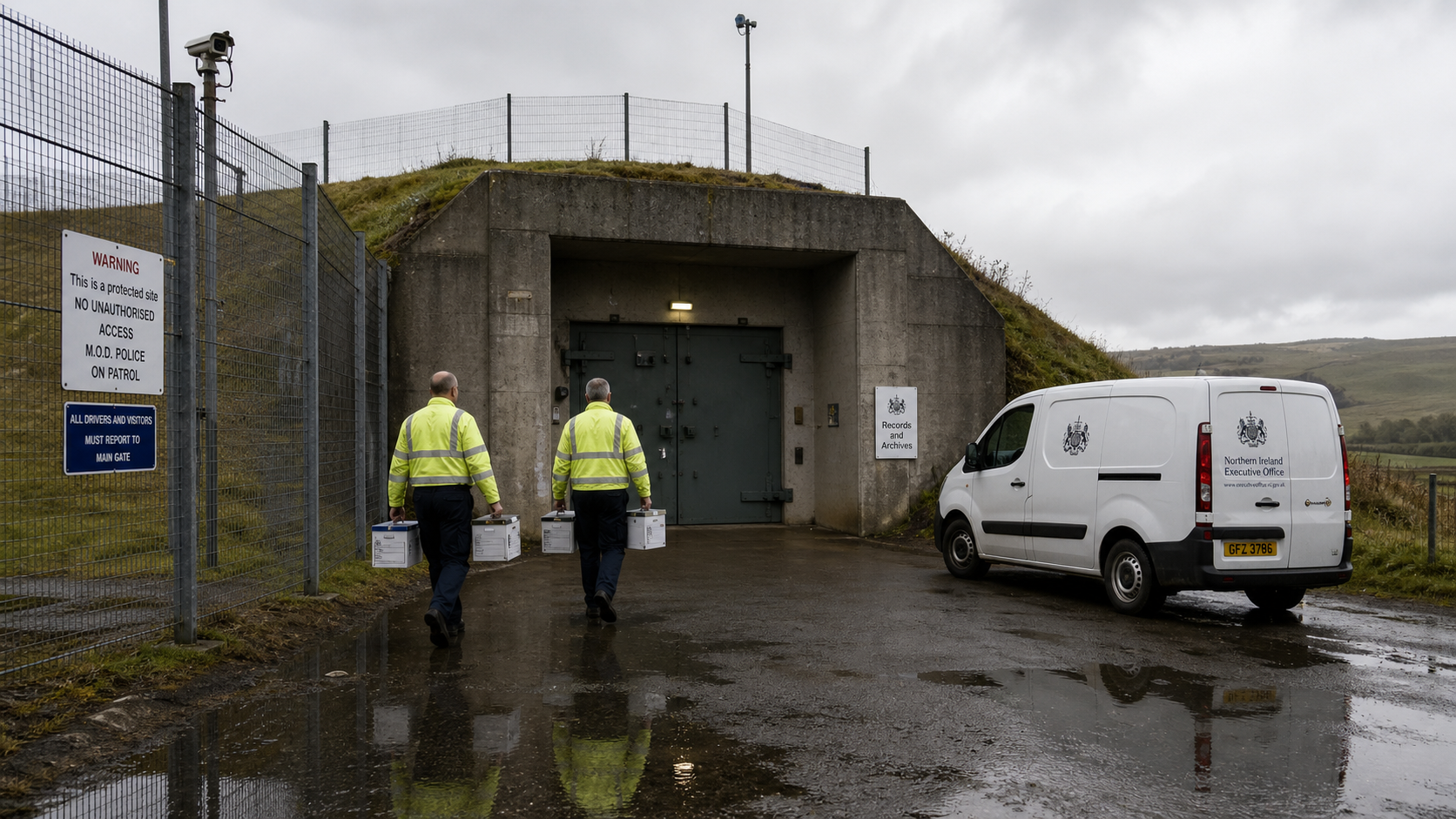
A former nuclear bunker in Northern Ireland, constructed during the height of the Cold War to shelter government officials and essential personnel in the event of a nuclear attack, has been repurposed as a secure archive facility and now contains more than one million government files — a remarkable transformation that has given new purpose to one of the most unusual structures in the province.
Background
The Cold War produced a remarkable range of civil defence infrastructure across the United Kingdom, much of it hidden from public view and classified for decades. Northern Ireland, as a strategically significant part of the United Kingdom with its own particular political complexities, was the site of several such facilities — bunkers, communications centres, and emergency government headquarters designed to maintain some semblance of administrative continuity in the event of a nuclear exchange.
The facility now being used as an archive was built in the 1950s and 1960s, during the period when the threat of nuclear war was considered a genuine and immediate possibility. It was designed to house hundreds of government officials, military personnel, and essential workers for an extended period — weeks, potentially months — underground, with its own power generation, water supply, and communications equipment. The construction was substantial: reinforced concrete walls, blast-proof doors, and a depth sufficient to provide meaningful protection against the overpressure effects of a nuclear detonation at a distance.
Like most Cold War bunkers in the United Kingdom, it was decommissioned in the years following the end of the Cold War, as the threat environment changed and the cost of maintaining such facilities became difficult to justify. For a period, it sat largely unused — a relic of a particular moment in history, maintained at minimal cost but without a clear purpose.
Key Developments
The decision to repurpose the facility as a document archive was driven by a combination of practical and financial considerations. Government archives require secure, climate-controlled storage — conditions that the bunker's robust construction and underground location provide naturally. The thick concrete walls maintain a stable temperature and humidity level that is ideal for the long-term preservation of paper documents. The blast-proof doors and reinforced structure provide a level of physical security that would be expensive to replicate in a purpose-built facility.
The facility now contains more than one million government files, spanning a range of departments and covering periods from the mid-twentieth century to the present day. The files include administrative records, policy documents, correspondence, and other materials that are subject to the Public Records Act and must be retained for specified periods before being either transferred to the Public Record Office of Northern Ireland or destroyed in accordance with retention schedules.
Staff who work in the facility describe an environment that is functional rather than atmospheric — the Cold War infrastructure has been adapted for its new purpose, with modern shelving, lighting, and climate control systems installed alongside the original structure. But the scale of the original construction is still evident: the corridors are wide enough to accommodate the vehicles that would have been needed to supply the facility during an extended period of occupation, and the blast doors, though no longer operational, remain in place as a reminder of the building's original purpose.
Why It Matters
The repurposing of Cold War infrastructure for civilian use is a pattern that has been repeated across the United Kingdom and Ireland, as governments have sought to extract value from facilities that were expensive to build and maintain but no longer serve their original purpose. In Northern Ireland, the process has been complicated by the particular sensitivity of some Cold War-era facilities, which were associated with the security apparatus of a period that remains politically contested.
The use of the bunker as an archive is, in that context, a relatively uncontroversial repurposing — one that serves a genuine public interest without raising the kind of political questions that might accompany, say, the conversion of a former RUC facility. The million-plus files it contains are a significant portion of Northern Ireland's administrative memory, and their secure preservation is a matter of genuine public importance.
The facility also represents a form of historical continuity that is worth acknowledging. The bunker was built to preserve the capacity for government in the most extreme circumstances imaginable; it now preserves the records of government in more ordinary times. There is something fitting about that transition — a structure designed for catastrophe repurposed for the mundane but essential work of institutional memory.
Local Impact
For researchers, historians, and members of the public seeking access to government records, the facility's existence is largely invisible — files are requested through the Public Record Office of Northern Ireland in Belfast, and the physical location of the storage is not a matter of public concern. But for the civil servants and archivists who work there, the facility is a distinctive and occasionally striking workplace, one that carries the weight of a particular moment in history even as it serves an entirely contemporary function.
The facility also provides a small number of specialist jobs in document management and archival science — roles that require a combination of technical knowledge and attention to detail that is not easily replicated. In an area where public sector employment is a significant component of the local economy, those jobs, though few in number, are a modest but real contribution.
What's Next
The Public Record Office of Northern Ireland is currently reviewing its long-term storage strategy, with a view to ensuring that the province's archival infrastructure is adequate for the volume of records expected to be generated over the next two decades. The bunker facility is expected to remain in use for the foreseeable future, with its capacity sufficient to accommodate the current rate of file transfers from government departments. A formal review of the facility's long-term future is expected to be completed by 2028.