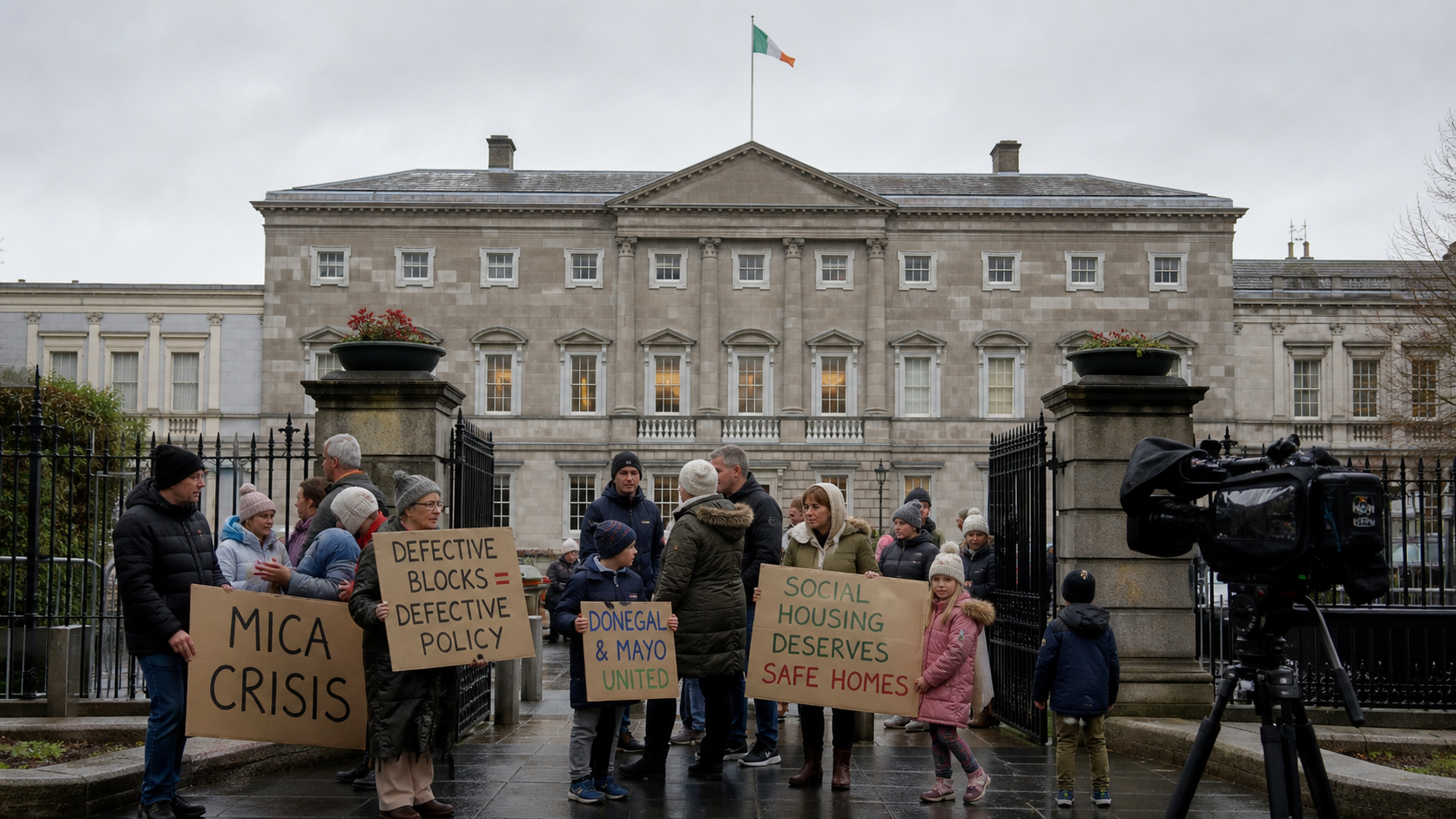
Dáil to Debate Social Housing Defective-Block Scheme as Mica Homeowners Await Clarity on Remediation
The Dáil is set to debate a social housing defective-block scheme as thousands of homeowners in Donegal, Mayo, and other affected counties continue to await clarity on the remediation process for homes built with defective concrete blocks, with the government facing mounting pressure over the pace of implementation and the adequacy of financial support for families whose homes are literally crumbling around them.
Background
The defective concrete blocks crisis — commonly referred to as the mica crisis, after the mineral that has caused structural damage to thousands of homes — is one of the most significant housing scandals in the history of the Irish state. Homes built using concrete blocks containing excessive amounts of mica or pyrite have been found to be structurally compromised, with walls cracking, crumbling, and in some cases collapsing. The problem is most acute in County Donegal, where thousands of homes are affected, but significant numbers of properties in Mayo, Clare, and other counties have also been identified as defective.
The government introduced a remediation scheme in 2022, following years of campaigning by affected homeowners, but the scheme has been criticised for its complexity, its slow pace of implementation, and the financial burden it continues to place on families who are already dealing with the stress of living in damaged homes. The scheme provides grants to cover the cost of demolition and rebuilding, but homeowners have reported significant difficulties navigating the application process and accessing the support to which they are entitled.
The extension of the scheme to social housing — homes owned by local authorities and housing associations — is a significant development, as it acknowledges that the defective blocks problem is not confined to private ownership and that the state has a direct responsibility for the condition of the social housing stock it manages.
Key Developments
The Dáil debate on the social housing defective-block scheme is expected to focus on the timeline for assessing and remediating affected social housing units, the funding arrangements for the scheme, and the implications for tenants who are currently living in defective properties. Opposition TDs are expected to press the government on the pace of the overall remediation programme, with particular attention to the backlog of private homeowner applications that has built up since the scheme was introduced.
Donegal TDs from across the political spectrum have been among the most vocal advocates for affected homeowners, and they are expected to use the Dáil debate to highlight specific cases where families have been waiting years for their applications to be processed. The government has acknowledged that the pace of the scheme has been slower than intended, citing the complexity of the assessment process and the limited capacity of the construction sector to carry out the volume of remediation work required.
Housing Minister James Browne is expected to outline a series of measures to accelerate the scheme, including streamlined assessment processes and increased funding for local authorities to manage the social housing element of the programme.
Why It Matters
The defective blocks crisis is not merely a housing issue — it is a human rights issue. Families in Donegal and Mayo are living in homes that are structurally unsafe, watching their properties deteriorate year by year, and facing the prospect of having to demolish and rebuild the homes they have spent their lives paying for. The psychological toll of this situation — the stress, the uncertainty, the sense of having been failed by the state — is immense and largely invisible in the political debate.
The extension of the scheme to social housing is welcome, but it also raises uncomfortable questions about the state's oversight of the construction industry during the period when defective blocks were being used. If social housing built by local authorities is also affected, it suggests that the problem was systemic rather than confined to individual private builders, and that regulatory failures at multiple levels contributed to the crisis.
Local Impact
In Donegal, where the crisis has been most acute, communities in areas including Letterkenny, Buncrana, Milford, and Dungloe have been living with the consequences of defective blocks for years. Local councillors report that the issue dominates their constituency work, with families in desperate need of clarity about when their homes will be assessed and when remediation work will begin. The social housing element of the scheme will affect tenants in local authority housing across the county, many of whom have been unaware that their homes may be structurally compromised.
What's Next
The Dáil debate is expected to result in a series of commitments from the government on the timeline for the social housing scheme and on measures to accelerate the private homeowner programme. A review of the overall scheme is expected to be published before the end of the year, and the government has indicated that it will consider further amendments to the scheme in light of the review's findings. Affected homeowners' groups have called for a dedicated ombudsman to handle complaints about the scheme's administration and for a clear timeline for the completion of all remediation work.