Drumcree Crisis Pushes Stormont to Breaking Point as DUP Pursues No-Confidence Motion Against O'Neill
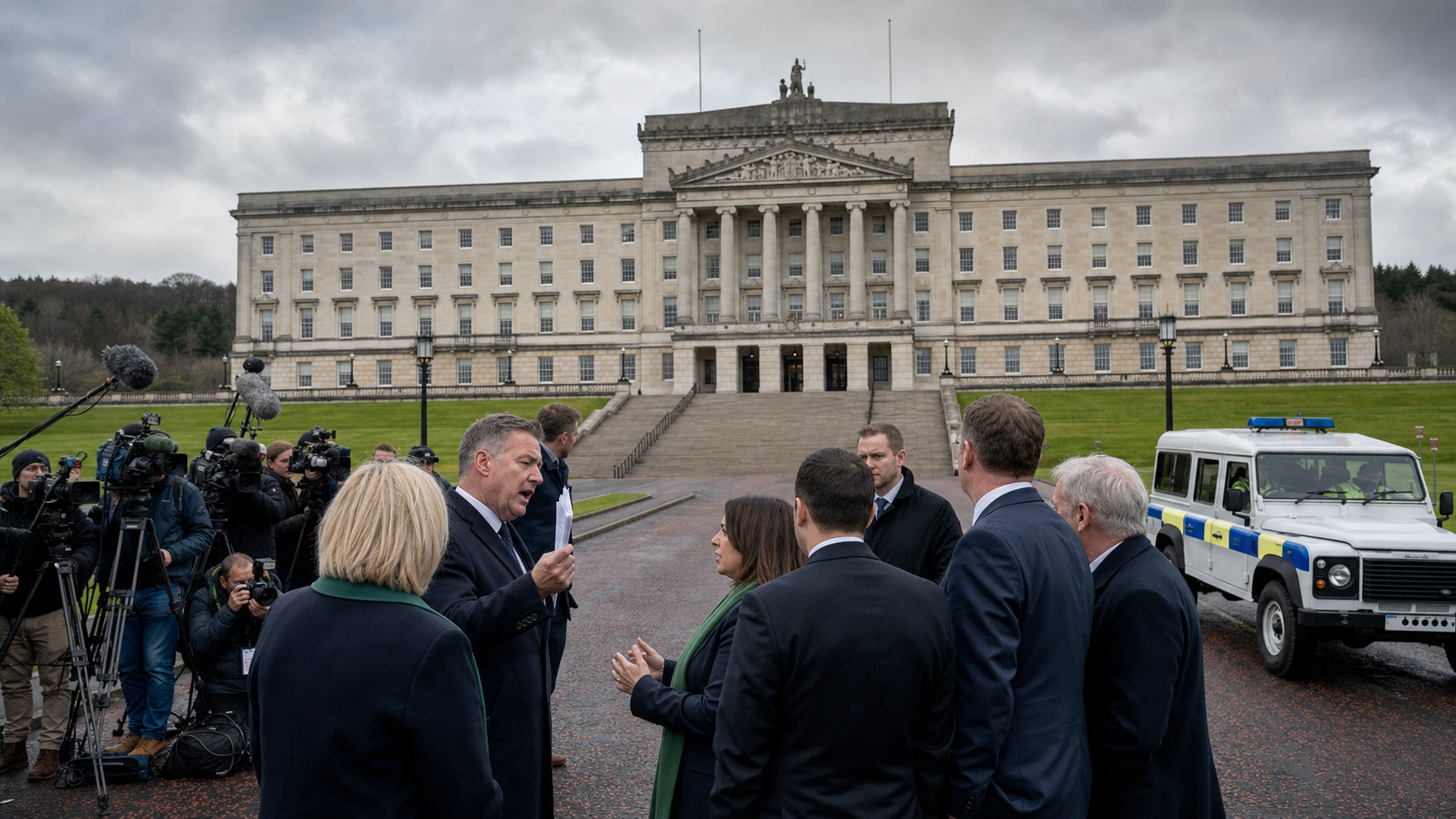
The Drumcree standoff has triggered the most serious political crisis at Stormont since the restoration of devolution, with the DUP pursuing a formal no-confidence motion against First Minister Michelle O'Neill following her decision to join protesters on the Garvaghy Road, while Assembly Speaker Edwin Poots publicly rebuked the First Minister for failing to attend the chamber to answer urgent questions about the dispute.
Background
The power-sharing institutions established by the Good Friday Agreement are built on a fundamental principle: that the leaders of the two main communities in Northern Ireland — unionist and nationalist — must govern together, sharing executive authority and collective responsibility for the decisions of the Executive. The First Minister and Deputy First Minister hold equal status, and the system is designed to prevent either community from dominating the other. It is a system that requires, above all else, a willingness to work within shared institutions even when political disagreements are profound.
The Drumcree dispute has tested that principle to its limits. When First Minister Michelle O'Neill travelled to the Garvaghy Road on Sunday to stand with protesters blocking a legally authorised Orange Order parade, she made a decision that her unionist counterparts regard as a fundamental breach of the obligations of her office. The DUP's argument is straightforward: the First Minister of Northern Ireland cannot simultaneously hold office and publicly defy a determination of the Parades Commission, a statutory body whose authority underpins the management of contentious parades across the province.
O'Neill's defence is equally straightforward: she attended the protest in her capacity as Sinn Féin vice president, not as First Minister, and she has the same right as any citizen to participate in a peaceful protest. The distinction between her party role and her governmental role is one that she has drawn consistently, but it is a distinction that her unionist critics regard as constitutionally untenable — arguing that the First Minister cannot simply remove her ministerial hat when it becomes politically inconvenient.
Key Developments
The DUP has filed a formal complaint with the Assembly's Commissioner for Standards, alleging that O'Neill's conduct at the Garvaghy Road constitutes a breach of the Ministerial Code. The party has also tabled a motion of no confidence in the First Minister, which is expected to be debated when the Assembly returns from recess. While the motion is unlikely to pass — Sinn Féin, the SDLP, and Alliance together command a majority — the debate itself will provide a platform for the DUP to make its case to the unionist electorate ahead of the 2027 Stormont election.
Assembly Speaker Edwin Poots added to the pressure on O'Neill by publicly rebuking her for failing to attend the chamber to answer urgent oral questions about the Drumcree dispute. Poots described her absence as "gross discourtesy" and "unprecedented," noting that the Assembly had convened specifically to allow members to question the First Minister on a matter of urgent public concern. O'Neill's office indicated that she was engaged in talks with the Northern Ireland Secretary and was unable to attend, a justification that Poots declined to accept.
The Orange Order, meanwhile, called for the resignation of PSNI Chief Constable Jon Boutcher and Assistant Chief Constable Ryan Henderson, arguing that the police had failed to enforce the Parades Commission's determination and had effectively allowed an illegal blockade to succeed. The Police Federation defended the force's restraint, noting that the alternative — using force to remove hundreds of protesters, including the First Minister — would have created a far more dangerous situation.
Why It Matters
The Drumcree crisis is a stress test for the Good Friday Agreement institutions at a moment when they are already under strain. The power-sharing arrangements have survived previous crises — the collapse of the Executive in 2017, the three-year suspension that followed, and the ongoing budget disputes with Westminster — but the current situation is qualitatively different. It involves the First Minister herself in a direct confrontation with the rule of law, and it has reopened the deepest fault lines in Northern Ireland's divided society in a way that the political institutions were specifically designed to prevent.
The 2027 Stormont election looms over everything. Both the DUP and Sinn Féin are acutely aware that their handling of the Drumcree crisis will be judged by their respective electorates, and both are playing to their bases in ways that make compromise more difficult. The DUP cannot be seen to accept O'Neill's conduct without alienating its core unionist support; Sinn Féin cannot be seen to abandon the Garvaghy Road residents without undermining its nationalist credentials. The space for the kind of quiet, pragmatic deal-making that has resolved previous Stormont crises is correspondingly narrow.
Local Impact
The political crisis at Stormont has real consequences for the delivery of public services across Northern Ireland. The Executive's ability to take decisions on the budget, on health service reform, on housing, and on a range of other pressing matters is compromised when the relationship between the First Minister and Deputy First Minister is as strained as it currently is. In Belfast, where the Executive's decisions on public transport, housing, and economic development have the most immediate impact, the political paralysis is a source of frustration for community leaders and business representatives who need the institutions to function. In Portadown, where the standoff continues, the human cost of the political crisis is most visible — a community divided, a town disrupted, and a dispute that shows no sign of resolution.
What's Next
The Assembly is expected to return from recess within days to debate the Drumcree crisis, with the DUP's no-confidence motion likely to be the centrepiece of proceedings. Sir Chris Bryant's search for an international mediator acceptable to both sides continues, and the outcome of that search will determine whether the standoff can be resolved through dialogue or whether it will drag on into the winter. The Parades Commission has indicated that it will keep the situation under review, and further legal challenges from both sides remain possible. The 2027 Stormont election, now less than eighteen months away, casts a long shadow over every political calculation being made in Belfast and Portadown.