Daughter of Man Killed by Partner Launches Campaign to Encourage Men to Seek Help for Domestic Abuse
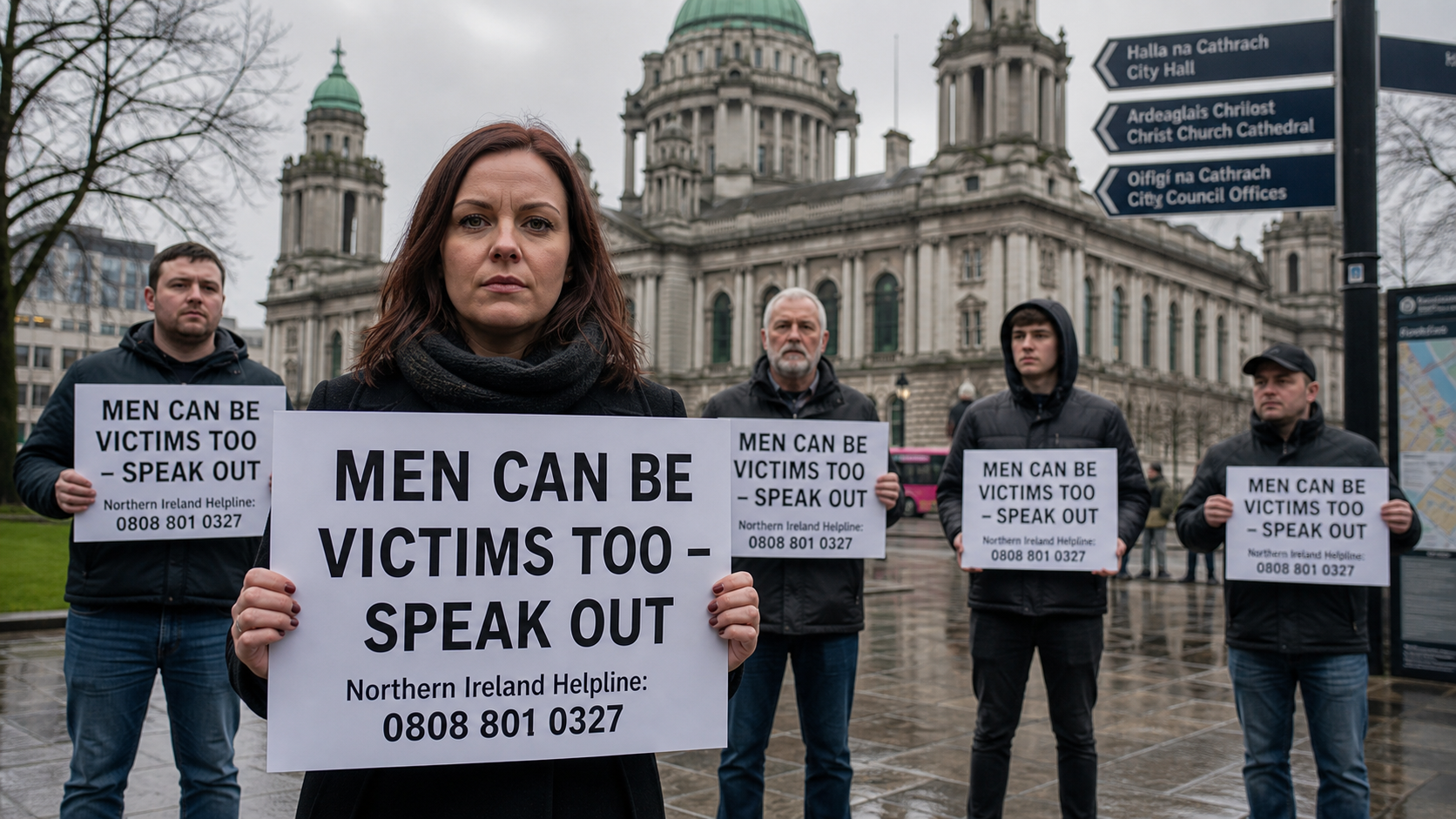
The daughter of a Northern Ireland man who was killed by his partner has launched a public awareness campaign encouraging men experiencing domestic abuse to seek help, describing the silence around male victimisation as a barrier that costs lives — and calling on the PSNI, health trusts, and community organisations across the six counties to do more to reach men who are suffering in isolation.
Background
Domestic abuse in Northern Ireland is a persistent and serious problem. The PSNI records tens of thousands of domestic abuse incidents each year, and the province has consistently had some of the highest rates of domestic abuse-related crime in the United Kingdom. The majority of victims are women, and the majority of perpetrators are men — a pattern that is reflected in the design of most support services, which are primarily oriented toward female victims.
But men are also victims of domestic abuse, and the evidence suggests that they are significantly less likely to report it. The reasons are multiple and well-documented: stigma, shame, a fear of not being believed, concerns about the impact on children, and a cultural expectation that men should be able to manage their own problems without seeking help. In Northern Ireland, those barriers are compounded by a particular cultural context — one in which traditional notions of masculinity remain influential, and in which the legacy of the Troubles has left many communities with a complicated relationship with statutory authorities.
The case that prompted this campaign is a stark illustration of what can happen when those barriers are not overcome. The woman's father was killed by his partner — a crime that, she has said publicly, might have been prevented if he had felt able to seek help at an earlier stage. His death has given her a personal motivation to speak out that she describes as both painful and purposeful.
Key Developments
The campaign, which launched this week, centres on a simple message: domestic abuse happens to men, it is not their fault, and help is available. It uses a combination of social media content, community outreach, and engagement with statutory bodies to reach men who may be experiencing abuse but have not yet sought support.
The PSNI has expressed support for the campaign, with a spokesperson noting that the force is committed to taking reports of domestic abuse from male victims as seriously as those from female victims. Domestic abuse charities operating across Northern Ireland — including Men's Advisory Project, which provides specialist support to male victims — have also endorsed the initiative and offered to provide resources and referral pathways.
The woman behind the campaign has spoken publicly about the difficulty of coming forward after her father's death. "He didn't tell anyone what was happening," she said. "He was ashamed, and he thought no one would believe him. That silence cost him his life. I don't want any other family to go through what we went through."
Why It Matters
The campaign addresses a genuine gap in the public conversation about domestic abuse. While awareness of female victimisation has grown significantly over the past two decades — driven by sustained advocacy, legislative reform, and high-profile cases — the experience of male victims remains largely invisible in public discourse. Research consistently shows that men who experience domestic abuse are less likely to report it, less likely to access support services, and less likely to be believed when they do come forward.
In Northern Ireland, the Men's Advisory Project estimates that approximately one in three victims of domestic abuse is male — a figure that is broadly consistent with research from other parts of the United Kingdom. But the proportion of male victims who access specialist support is considerably lower than that, suggesting a significant unmet need. The campaign aims to close that gap by normalising help-seeking behaviour among men and by challenging the cultural assumptions that make it difficult.
The legislative framework for addressing domestic abuse in Northern Ireland has strengthened in recent years, with the Domestic Abuse and Civil Proceedings Act (Northern Ireland) 2021 introducing a new offence of domestic abuse that covers coercive and controlling behaviour as well as physical violence. That legislation applies equally to male and female victims, but its practical impact depends on men feeling able to report abuse in the first place.
Local Impact
Across Northern Ireland's health and social care trusts — the Belfast, South Eastern, Southern, Western, and Northern trusts — domestic abuse is a significant driver of demand for mental health services, emergency department attendances, and social work interventions. The trusts have invested in domestic abuse training for frontline staff in recent years, but advocates argue that the training needs to be more explicitly inclusive of male victimisation.
In rural areas — in Fermanagh, Tyrone, and south Armagh — the isolation that can accompany domestic abuse is compounded by geographic distance from support services. The campaign has specifically targeted rural communities, recognising that the barriers to help-seeking are often higher in areas where anonymity is limited and community ties are strong.
What's Next
The campaign is expected to run through the autumn, with a series of community events planned across Belfast, Derry, Newry, and Antrim. The organisers are also in discussions with the Department of Justice about the possibility of incorporating the campaign's messaging into the statutory domestic abuse awareness programme that is delivered through schools and community organisations. A formal evaluation of the campaign's reach and impact is planned for early 2027.