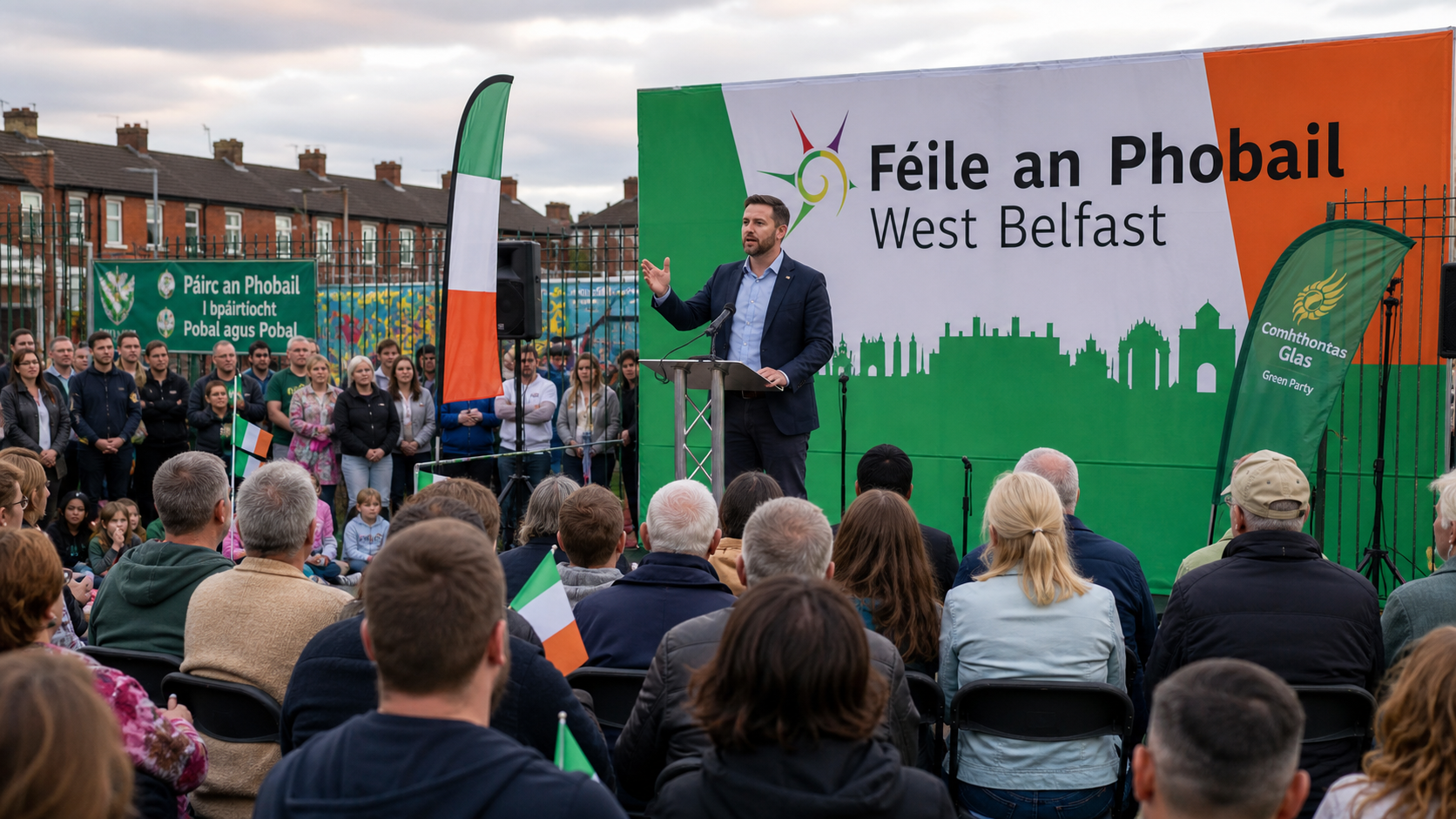
Colum Eastwood Tells Féile an Phobail That Momentum Toward Irish Unity Is 'Unstoppable'
Former SDLP leader and Foyle MP Colum Eastwood has declared that the momentum toward Irish unity is "unstoppable" while speaking at a Féile an Phobail discussion in west Belfast, drawing a parallel between the inclusive spirit of the Fleadh Cheoil na hÉireann — which has drawn over one million visitors to Belfast this week — and the vision of a "New Ireland" that he argues must be built on persuasion rather than assertion.
Background
Féile an Phobail, the west Belfast festival that has run annually since 1988, has long served as a platform for political debate as well as cultural celebration. Founded in the aftermath of the Milltown Cemetery attack and the killings that followed, the festival was conceived as an act of community resilience and has grown into one of the largest community arts festivals in Ireland. Its political discussions — held in venues ranging from the Falls Park to the Felons Club — attract speakers from across the nationalist and republican spectrum and beyond.
Colum Eastwood chairs the SDLP's New Ireland Commission, a body established to develop the party's thinking on constitutional change and to build the cross-community and cross-border relationships that a successful unity referendum would require. The commission has held a series of public events over the past two years, engaging with business leaders, civic society organisations, and members of the unionist community who are open to discussing the constitutional question.
The political context for Eastwood's remarks is significant. A LucidTalk poll published in July 2026 showed Sinn Féin at a five-year low in Northern Ireland, with the SDLP rising to 13% and the UUP surging to 16%. The poll also showed a slight narrowing of the gap between those who would vote for unity and those who would vote to remain in the UK — a reminder that the outcome of any future referendum is far from predetermined.
Key Developments
Speaking at a discussion titled "Le Chéile — Next steps to Irish unity," Eastwood argued that the momentum toward constitutional change is now irreversible, driven by demographic shifts, the legacy of Brexit, and a growing sense among younger voters in Northern Ireland that their future lies in a different constitutional arrangement. However, he was careful to distinguish between momentum and inevitability, emphasising that the "middle ground" — voters who do not identify strongly as either nationalist or unionist — will determine the outcome of any referendum.
Eastwood drew a direct parallel between the Fleadh Cheoil na hÉireann, which has brought together musicians and visitors from across the island and beyond in a spirit of shared cultural celebration, and the vision of a New Ireland that he believes must be built on inclusion rather than exclusion. "The island is at its best when different traditions come together," he said, arguing that a positive, inclusive vision is the only way to convince a broader segment of the population that constitutional change offers the best future for everyone on the island.
Why It Matters
Eastwood's remarks reflect a broader shift in how the constitutional question is being discussed in Northern Ireland. The language of inevitability — once the preserve of Sinn Féin — is now being adopted by the SDLP, a party that has historically been more cautious about the pace and framing of the unity debate. This convergence of language, if not of strategy, reflects the degree to which the constitutional question has moved from the margins to the mainstream of Northern Ireland political discourse.
The emphasis on the "middle ground" is strategically significant. Polling consistently shows that a substantial proportion of Northern Ireland's electorate — perhaps 20 to 25% — does not hold a strong constitutional preference and would make their decision in a referendum based on practical considerations: pensions, healthcare, economic security, and the quality of public services. Eastwood's argument that unity advocates must "relentlessly" engage with these voters and provide clear answers to their questions is a recognition that the constitutional debate cannot be won on identity politics alone.
Local Impact
In west Belfast, where Féile an Phobail is rooted, the discussion of Irish unity is not abstract — it is a lived political reality for a community that has experienced the Troubles, the peace process, and the ongoing uncertainties of post-Brexit Northern Ireland. The Fleadh Cheoil na hÉireann, which has brought unprecedented numbers of visitors to the Falls Road area and the city centre, has provided a vivid backdrop for Eastwood's argument that cultural connection can precede and enable political change. The economic boost from the Fleadh — estimated at over £53 million — has also demonstrated that Belfast's future prosperity does not depend on any particular constitutional arrangement, a point that unity advocates are keen to make to sceptical middle-ground voters.
What's Next
The SDLP's New Ireland Commission is expected to publish a further report on the practical dimensions of Irish unity before the end of 2026, focusing on issues including pensions, healthcare, and economic integration. Eastwood is also expected to engage with the Irish government's Shared Island Unit, which has been conducting research on the practical and economic dimensions of constitutional change. The next Northern Ireland Assembly election must be held by May 2027, and the constitutional question is expected to be a central theme of that campaign.