Carmel McConnellogue's FND Diagnosis Shines Light on Northern Ireland's 'Postcode Lottery' of Neurological Care
A Derry woman who was admitted to Altnagelvin Hospital for dehydration suddenly found herself unable to move, speak, or feel her face — an MRI scan confirmed she had Functional Neurological Disorder, a condition affecting an estimated 5,000 people in Northern Ireland for which there are virtually no dedicated services, leaving patients to navigate a fragmented and underfunded system largely on their own.
Background
Functional Neurological Disorder (FND) is a condition in which the brain's ability to send and receive signals to the body is impaired, resulting in a wide range of neurological symptoms including paralysis, tremors, seizures, speech difficulties, and sensory disturbances. Unlike conditions such as multiple sclerosis or Parkinson's disease, FND does not involve structural damage to the brain or nervous system that is visible on standard imaging — a characteristic that has historically led to it being dismissed or misunderstood by both medical professionals and the general public.
The condition is now recognised as a genuine neurological disorder by leading medical bodies, and research has established that it is as common as multiple sclerosis and more common than Parkinson's disease. However, awareness among clinicians and the public remains low, and dedicated treatment pathways are scarce. In Northern Ireland, the Department of Health does not currently record FND as a primary condition in its data systems, making it impossible to accurately quantify the number of people affected or to plan services accordingly. The charity FND Matters NI estimates that approximately 5,000 people in Northern Ireland live with the condition.
The condition is frequently linked to stress, trauma, and other psychological factors, though it is emphatically not a psychological condition in the traditional sense — it is a neurological disorder with real, measurable physical symptoms. The misconception that FND is "all in the mind" has caused enormous harm to patients, who often face scepticism from medical professionals and social stigma from their communities.
Key Developments
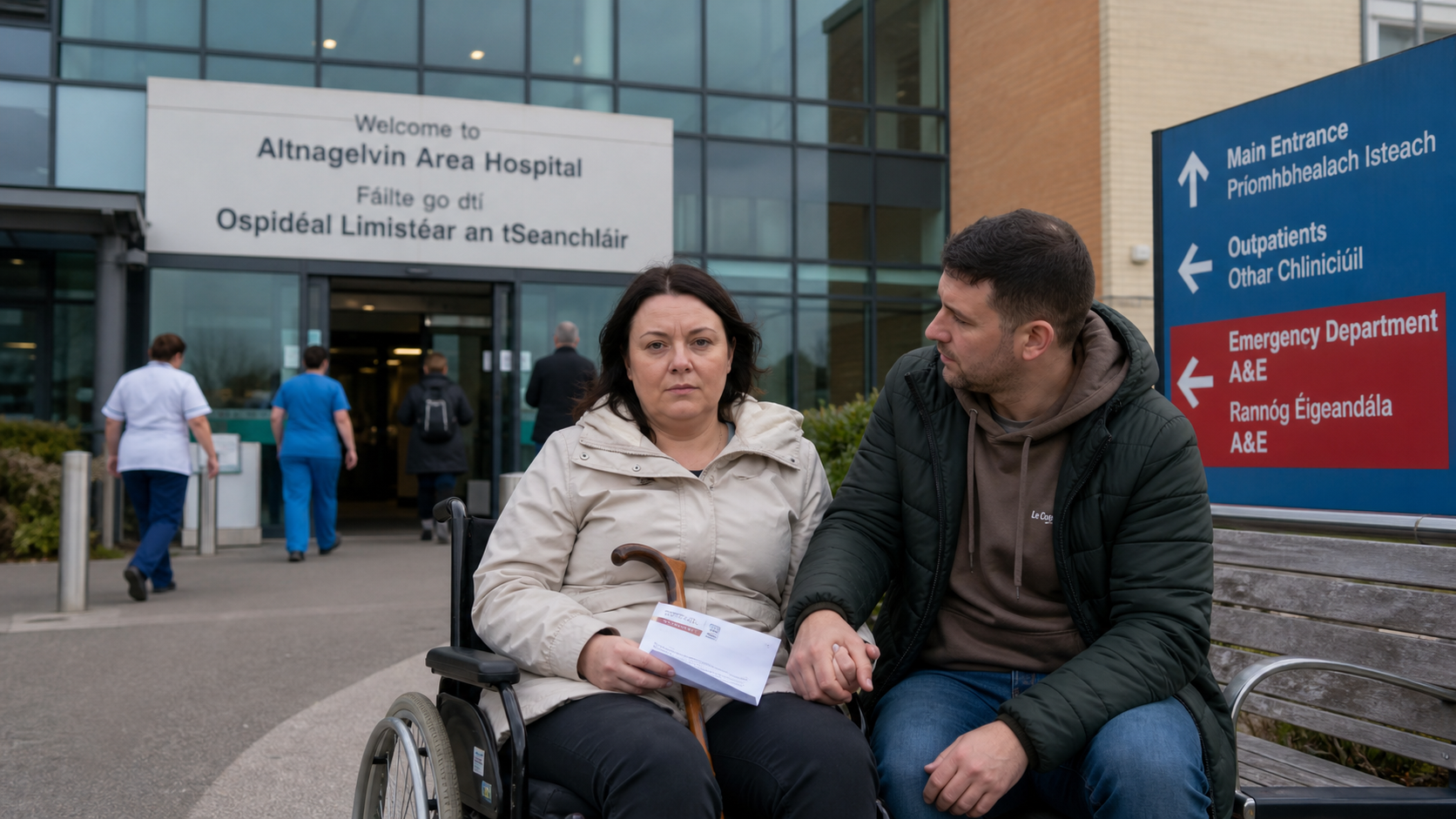
Carmel McConnellogue, a Derry City Football Club supporter and resident of the city, was admitted to Altnagelvin Hospital in Londonderry for treatment of dehydration when she experienced a sudden and terrifying neurological event. She described the sensation as a total shutdown — unable to move, unable to speak, unable to feel her face. Medical staff initially considered the possibility of a stroke, but an MRI scan ruled out structural brain damage and confirmed a diagnosis of FND.
Doctors explained the condition to McConnellogue using the analogy of a computer with too many open tabs — the brain, overwhelmed by stress and trauma, had failed to properly process and transmit signals to the body. She spent five weeks in hospital receiving rehabilitation, including physiotherapy, occupational therapy, and speech and language therapy. The recovery process has been gruelling: she now requires a zimmer frame or crutch to walk and needs assistance with many daily tasks that she previously took for granted.
McConnellogue has since become an advocate for FND awareness, sharing her journey on social media to combat the stigma that surrounds the condition. Her story, featured by BBC NI this week, has resonated strongly with other FND patients across Northern Ireland who recognise the experience of being disbelieved, dismissed, or left without adequate support. FND Matters NI trustee Helen Dickson described the treatment landscape as a "postcode lottery," with access to appropriate care varying enormously depending on where a patient lives.
Why It Matters
The absence of dedicated FND services in Northern Ireland is a significant gap in the region's neurological care provision. Patients with FND typically require a multidisciplinary approach involving neurology, physiotherapy, occupational therapy, speech and language therapy, and psychological support — a combination that is rarely available in a coordinated way through the NHS in Northern Ireland. Many patients are referred to services in Great Britain, adding cost and inconvenience to an already difficult situation, while others receive no specialist input at all.
The situation in Northern Ireland compares unfavourably with Scotland, where NHS Lothian has developed a dedicated FND service that has been cited as a model for other health systems. In the Republic of Ireland, the HSE has also begun to develop more structured pathways for FND patients, though provision remains patchy. The contrast highlights the extent to which Northern Ireland's health system has fallen behind in this area, and the need for the new Health Minister, Robbie Butler, to prioritise the development of dedicated neurological services as part of his reform agenda.
Local Impact
In Derry/Londonderry, where Altnagelvin Hospital serves as the main acute facility for the Western Health and Social Care Trust, the lack of FND services is acutely felt. The Western Trust covers a large and geographically dispersed population across Derry city, Strabane, Omagh, and the surrounding rural areas, and patients requiring specialist neurological care often face long journeys to Belfast or beyond. Community support groups for FND patients have emerged in recent years to fill some of the gap left by statutory services, but they operate on minimal resources and rely heavily on the voluntary efforts of patients and carers.
What's Next
FND Matters NI is calling on the Department of Health to formally recognise FND in its data collection systems and to commission a dedicated service development plan for the condition. The charity is also seeking a meeting with Health Minister Robbie Butler to discuss the specific needs of FND patients in Northern Ireland. McConnellogue has indicated that she will continue to share her story publicly in the hope of accelerating change, and she is in contact with other FND advocates across the UK and Ireland to build a coordinated campaign for better services.