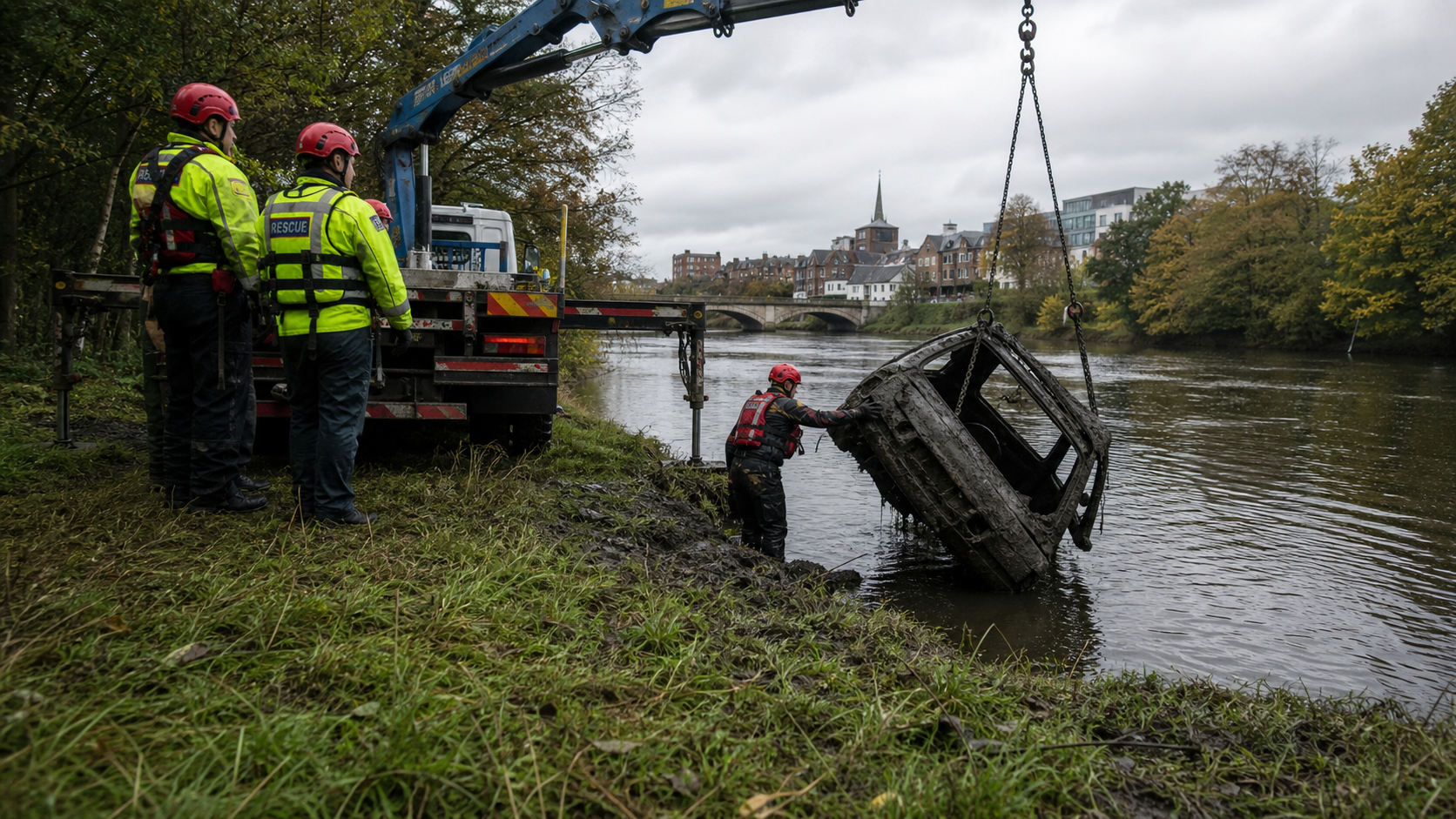
Car Submerged in River Lagan for 53 Years Finally Removed in Four-Hour Community Rescue Operation
A car that had been sitting on the bed of the River Lagan near Lisburn for more than half a century has finally been partially removed, following a four-hour operation by the Community Rescue Service that brought to an end years of political frustration, inter-agency disputes, and environmental concern about the vehicle's impact on one of Northern Ireland's most important waterways.
Background
The car's presence in the Lagan had been an open secret in the Lisburn area for decades. Local residents, anglers, and environmental groups had long been aware of the submerged wreck, which had become something of a grim landmark in the stretch of river near the town. Over the years, it had attracted periodic media attention and political comment, but the question of who was responsible for removing it had proved remarkably difficult to resolve.
The Department for Infrastructure had previously stated that it had no plans to remove the car because it did not pose a significant flood risk. The Northern Ireland Environment Agency indicated that responsibility for remedial action typically falls to the landowner or the local council. Lisburn and Castlereagh City Council, for its part, argued that the matter fell within the remit of the DfI. The result was a classic example of institutional buck-passing that left the car in the river while the agencies responsible for the waterway debated who should act.
Environmental advocates had been warning for years that the car was acting as a slow poison for the river, releasing heavy metals, microplastics, and potential chemical residues from its degraded components into the water. The Lagan is a designated Area of Special Scientific Interest in parts of its course, and the presence of a deteriorating vehicle on its bed was considered incompatible with the river's protected status. Alliance councillor Nicola Parker and assembly member Robbie Butler had both raised the issue repeatedly, describing the situation as an embarrassment and calling for urgent action.
Key Developments
The Community Rescue Service, a volunteer organisation that operates across Northern Ireland, ultimately took matters into its own hands, conducting a four-hour operation to extract the upper portions of the vehicle. CRS Regional Commander Sean McCarry noted that the extraction was driven by public interest and safety considerations, and that the vehicle had deteriorated to less than half of its original structure — its condition described as "paper thin" after five decades in the water.
The operation involved gaining access to the riverbank and utilising specialist equipment to extract what remained of the car's upper sections. The base of the vehicle, which had become embedded in the riverbed over the course of more than half a century, could not be removed and remains in place. The recovered material was taken away for disposal. The CRS indicated it would continue to coordinate with local authorities to assess and potentially remove further visible debris when river conditions allow.
The Department for Infrastructure confirmed the partial removal and said it would work with the relevant agencies to assess what further action might be required to address the remaining embedded material.
Why It Matters
The story of the Lagan car is, in microcosm, a story about how public institutions can fail to act on environmental problems when responsibility is unclear and the political cost of inaction appears lower than the cost of intervention. The car had been in the river for 53 years — longer than many of the officials who were debating responsibility for it had been alive. The fact that it took a volunteer rescue organisation to finally act, rather than any of the statutory bodies with formal responsibility for the waterway, is a damning commentary on the effectiveness of Northern Ireland's environmental governance.
The Lagan is not just any river. It flows through the heart of Belfast and Lisburn, it supports significant biodiversity, and it is a recreational resource for hundreds of thousands of people. The presence of a deteriorating vehicle on its bed for more than half a century represents a failure of stewardship that should not be allowed to recur. The partial removal is welcome, but the fact that the base of the car remains embedded in the riverbed means the job is not finished.
Local Impact
In Lisburn, the removal of the car has been welcomed by residents and environmental groups who had campaigned for action for years. The Lagan Valley Regional Park, which encompasses much of the river corridor between Belfast and Lisburn, has long sought to improve the ecological quality of the waterway, and the removal of the vehicle is seen as a positive step in that direction. Local anglers, who use the stretch of river near where the car was located, have expressed relief that the wreck is no longer a hazard. The Lagan Canoe Club, which operates on the river, has also welcomed the development. Lisburn and Castlereagh City Council has been urged by environmental groups to use the incident as a catalyst for a broader audit of other potential pollution sources in the river corridor.
What's Next
The CRS has indicated it will return to the site when river conditions allow to assess whether the embedded base of the vehicle can be removed. The Northern Ireland Environment Agency is expected to conduct a water quality assessment of the area in the coming weeks to determine whether the partial removal has had any measurable impact on pollution levels. Lisburn and Castlereagh City Council has been asked to commission an independent review of the inter-agency communication failures that allowed the car to remain in the river for so long, with a view to establishing clearer protocols for future cases of this kind.