Burnham Border Poll Row Rumbles On as Bryant Insists UK Government 'Full Square Behind' Good Friday Agreement
Northern Ireland Secretary Sir Chris Bryant has attempted to contain the political fallout from Prime Minister Andy Burnham's declaration that an Irish border poll is "off the table", insisting that the UK government stands "full square behind" the Good Friday Agreement and its provisions regarding a referendum on Irish unity — but nationalist parties remain far from satisfied, with Sinn Féin and the SDLP continuing to press for a formal, unambiguous clarification of the government's legal position.
Background
The controversy was ignited during Prime Minister Andy Burnham's first official visit to Northern Ireland, when he told reporters that a border poll was "off the table" — citing the need for long-term healing after divisive referendums such as Brexit and the Scottish independence vote. The remarks were immediately condemned by Sinn Féin and the SDLP, who argued that they were legally inaccurate and incompatible with the Good Friday Agreement, which gives the Secretary of State for Northern Ireland the power to call a border poll if it appears likely that a majority would vote for a united Ireland.
The Good Friday Agreement's provisions on a border poll are clear: the Secretary of State must call a referendum if it appears likely that a majority of those voting would express a wish for Northern Ireland to become part of a united Ireland. The decision is not at the discretion of the Prime Minister, and no Prime Minister has the authority to declare that a poll is "off the table" in perpetuity. Burnham's remarks were therefore not merely politically contentious — they were, in the view of constitutional lawyers, legally questionable.
Downing Street subsequently issued a clarification reaffirming the government's commitment to the Good Friday Agreement, but the clarification was widely regarded as insufficient by nationalist parties, who argued that it did not directly address the legal question of whether the Prime Minister's remarks were consistent with the Agreement's provisions.
Key Developments
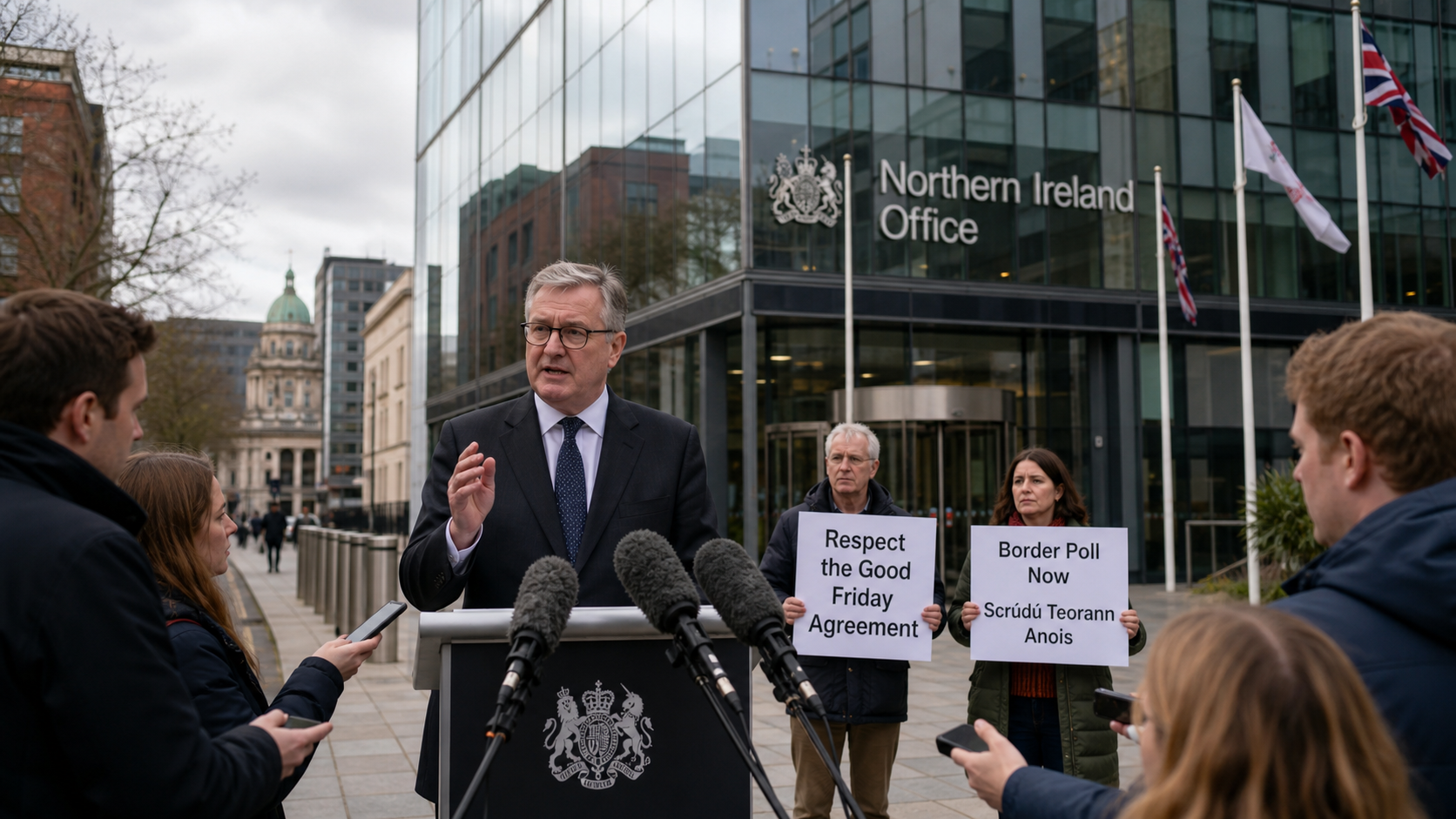
Speaking on Monday, Sir Chris Bryant sought to move the issue on, telling reporters that the government's position was clear: it stands "full square behind" the Good Friday Agreement in all its dimensions, including the provisions relating to a border poll. Bryant acknowledged that Burnham's original remarks had caused "some confusion" but insisted that the government's commitment to the Agreement was absolute and that there was no contradiction between the Prime Minister's comments and the legal framework established by the Agreement.
The response from nationalist parties was sceptical. Sinn Féin's Michelle O'Neill, speaking separately, described Bryant's clarification as inadequate and called for a formal written statement from the government setting out its understanding of the legal obligations imposed by the Good Friday Agreement in relation to a border poll. The SDLP's Colum Eastwood said the government needed to "stop digging" and acknowledge that Burnham's original remarks were wrong.
Why It Matters
The border poll controversy matters for several reasons beyond the immediate political row. First, it has exposed a degree of unfamiliarity with the constitutional architecture of the Good Friday Agreement at the highest levels of the new UK government — a government that came to power promising to repair the UK's relationship with Ireland and to be a constructive partner in the peace process. Second, it has given Sinn Féin a significant political opportunity to frame the debate around Irish unity in terms of rights and democratic entitlement rather than aspiration, which is a more powerful and legally grounded argument. Third, it has complicated the relationship between the new UK government and the Irish government at a moment when cross-border cooperation on a range of issues — from the economy to health to infrastructure — is particularly important.
Local Impact
In Northern Ireland, the row has played out differently across the community divide. For unionists, Burnham's original remarks were broadly welcome — a signal that the new government would not be pushing for constitutional change. For nationalists and republicans, they were a provocation that reinforced the sense that the British government does not take the Good Friday Agreement's provisions on Irish unity seriously. In Belfast, where the political temperature is always sensitive to signals from London, the controversy has added to a sense of uncertainty about the direction of UK policy on Northern Ireland that has been building since the change of government.
What's Next
The Stormont Assembly is expected to debate the border poll controversy when it returns from recess in September, with nationalist parties likely to table a motion calling on the UK government to formally reaffirm its obligations under the Good Friday Agreement. In Dublin, the Taoiseach has been careful not to inflame the situation but has made clear that the Irish government expects the UK to honour all its commitments under the Agreement. The controversy is unlikely to be fully resolved until the UK government issues a clear, formal statement on its understanding of the border poll provisions — something it has so far been reluctant to do.