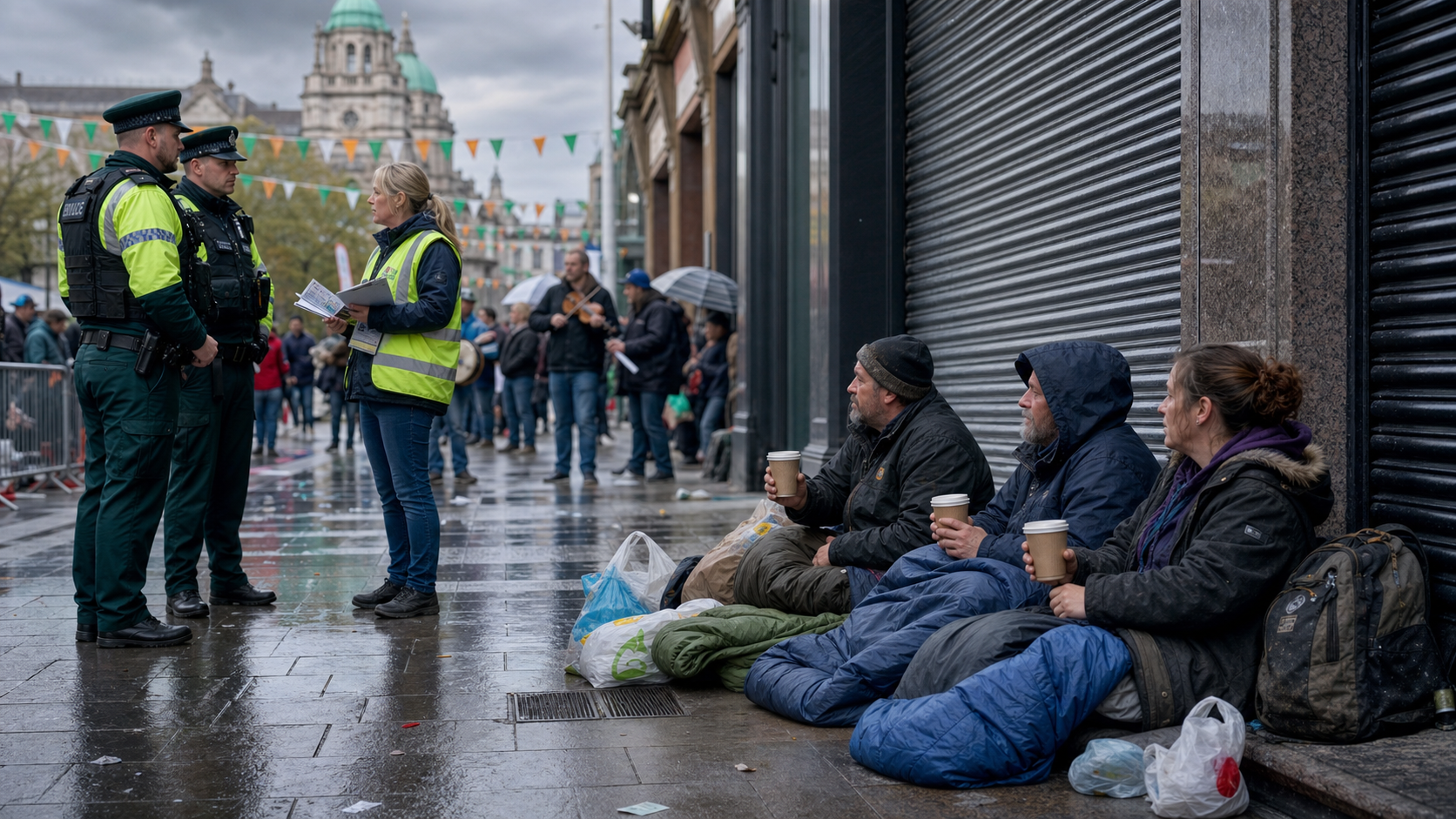
Belfast's Homeless Pushed to City Margins During Fleadh as Charities Raise Alarm
As Belfast celebrated the conclusion of Fleadh Cheoil na hÉireann on Sunday — a festival that drew more than one million visitors and delivered an economic windfall estimated to exceed £53 million — homeless charities were raising urgent concerns about the treatment of the city's rough sleepers during the week-long event. Reports of police pressure, threats of arrest, and displacement from support networks have cast a shadow over what was otherwise a landmark moment for the city.
Background
Belfast's homelessness crisis has been building for years. On any given night, approximately 70 or more people sleep rough in the city centre, with many more in temporary or emergency accommodation. The city's homeless population is served by a network of charities and outreach organisations, including The People's Kitchen and Team Haven, which provide food, clothing, and support to rough sleepers across the city centre. These organisations have developed detailed knowledge of where their service users sleep and how to reach them — knowledge that depends on the homeless population remaining in broadly predictable locations.
The decision to host Fleadh Cheoil na hÉireann in Belfast for the first time was a significant achievement for the city, and the festival's success — with visitor numbers far exceeding the projected 800,000 — has been widely celebrated. The economic benefits are real and substantial. But the festival also created a set of pressures on the city's most vulnerable residents that were, according to charities, inadequately anticipated and poorly managed by the authorities responsible for the event.
The Northern Ireland Housing Executive, which is responsible for emergency accommodation provision, initially confirmed that no additional emergency bed spaces had been commissioned for the festival period. This decision was criticised by charities as a failure of planning, given that the influx of more than a million visitors was always going to create additional pressure on the city centre and on the services that operate within it.
Key Developments
Paul McCusker, a Belfast City councillor and founder of The People's Kitchen, reported that service users had told him they were being instructed by police to remain away from the city centre until after midnight during the festival. Volunteers from Team Haven reported that some rough sleepers were threatened with arrest if they attempted to sit or place sleeping bags on the ground within the festival zone. These accounts were corroborated by multiple sources and were reported by the Irish Times and Belfast Live during the festival week.
The displacement of rough sleepers from the city centre created significant challenges for outreach services. Charities that normally know where to find their service users found that those individuals had been scattered to peripheral areas — the university quarter, the Botanic area, and beyond — making it much harder to ensure their safety and wellbeing. During the early days of the festival, there were reports of five overdoses on the streets, a figure that charities attributed in part to the disruption of normal support networks.
The Northern Ireland Housing Executive eventually provided an additional 20 emergency bed spaces for overnight provision during the festival, but charities described this as an "11th hour" measure that was inadequate to the scale of the need. They also questioned why such capacity could not be maintained throughout the year, rather than being deployed only when the presence of homeless people became inconvenient for a major public event.
Why It Matters
The treatment of Belfast's homeless population during the Fleadh matters because it reveals a troubling set of priorities. A city that can mobilise enormous resources to host a million-visitor festival — and that can celebrate, rightly, the economic and cultural benefits that flow from such an event — should also be capable of ensuring that its most vulnerable residents are not made to feel like an embarrassment to be hidden away. The reports of police pressure and threats of arrest suggest that the welfare of rough sleepers was, at best, an afterthought in the planning for the festival.
There is also a broader point about the relationship between major events and social inequality. Festivals, concerts, and sporting events generate significant economic activity, but the benefits of that activity are not evenly distributed. The people who sleep rough in Belfast city centre do not benefit from the Fleadh's economic boost; they experience it as a period of heightened vulnerability and displacement. A genuinely inclusive approach to hosting major events would take account of that reality and plan accordingly.
Belfast City Council issued a statement acknowledging the concerns raised about the treatment of the city's vulnerable population, but charities have called for a more substantive response — including a commitment to maintaining the additional emergency bed spaces that were provided during the festival and to developing a proper protocol for the treatment of homeless people during future major events.
Local Impact
For the rough sleepers who were displaced during the Fleadh, the experience was one of fear, confusion, and isolation. Being pushed away from familiar locations and support networks is not merely an inconvenience — it is a genuine threat to safety and wellbeing. The five overdoses reported during the festival week are a reminder that homelessness is a life-threatening condition, and that anything which disrupts the support systems that help people survive on the streets can have fatal consequences. The charities that serve Belfast's homeless population have called for an urgent meeting with Belfast City Council and the Northern Ireland Housing Executive to discuss how to prevent a repeat of what happened during the Fleadh.
What's Next
Belfast City Council has indicated that it will review the arrangements for the treatment of homeless people during major events, following the concerns raised by charities during the Fleadh. The Northern Ireland Housing Executive is expected to be involved in that review. Charities have called for the additional emergency bed spaces provided during the festival to be maintained on a permanent basis, and for a formal protocol to be developed that guarantees the rights and welfare of rough sleepers during future events. The review is expected to be completed before the end of 2026, with recommendations to be implemented ahead of any future major events in the city.