Belfast's Bus Boat Sets Sail: Artist Turns Old Citybus into 14-Metre River Vessel on the Bann
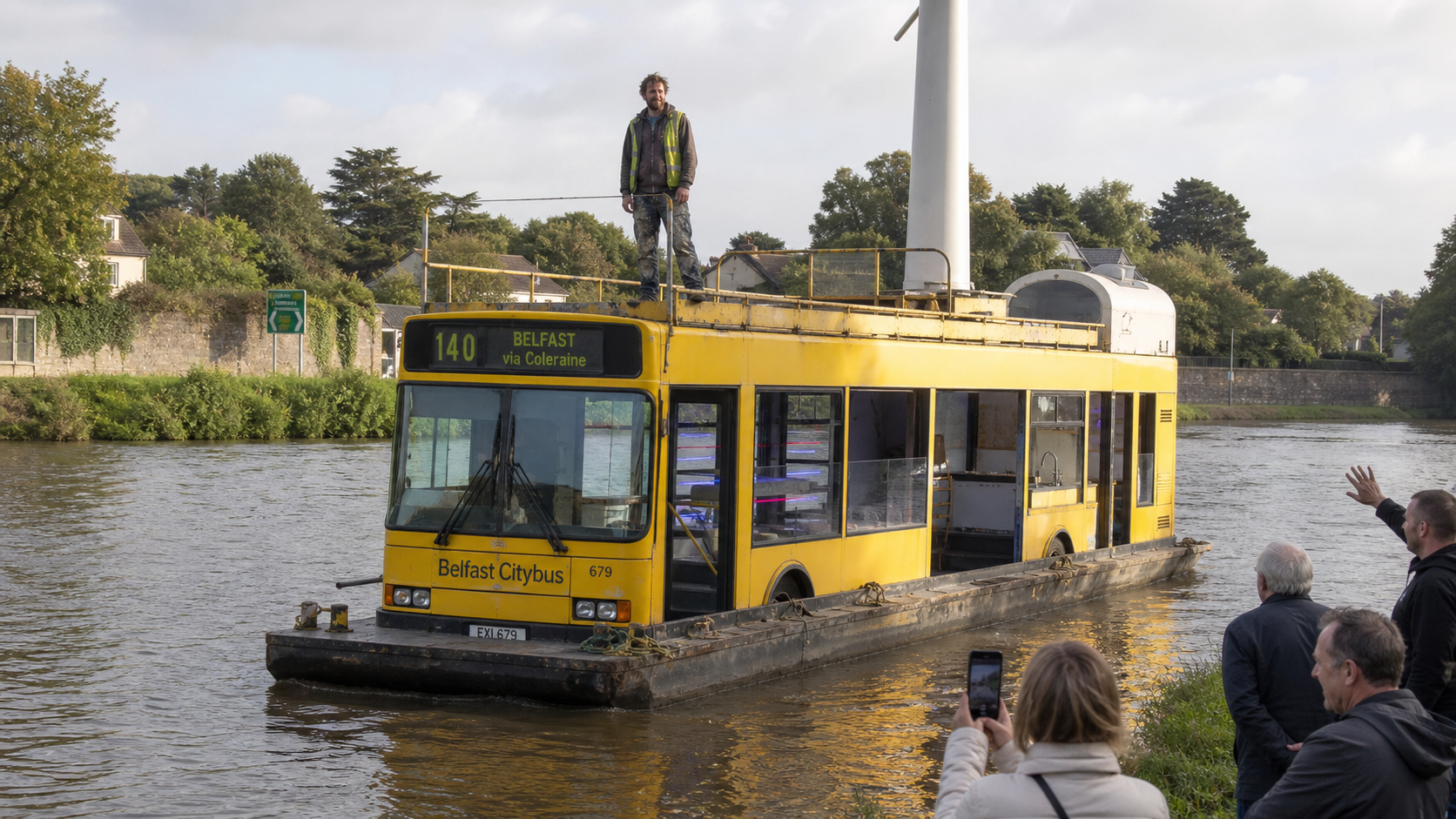
Belfast-based artist and engineer Paddy Bloomer has launched a remarkable 14-metre vessel on the River Bann, constructed over two years from a discarded Belfast Citybus and a redundant wind turbine mast — a project that has captured the imagination of communities along the river and stands as one of the more inventive pieces of public art to emerge from Northern Ireland in recent years.
Background
Paddy Bloomer has spent years working at the intersection of art, engineering, and community engagement in Belfast and beyond. His projects have consistently sought to find new uses for discarded materials and to create spaces for social interaction and cultural exchange in unexpected settings. The Bus Boat project, which he has been developing for two years, represents his most ambitious undertaking to date.
The raw materials for the vessel came from two sources: a decommissioned Belfast Citybus, one of the iconic double-deckers that served the city's public transport network for decades, and a redundant wind turbine mast. The combination of these two objects — one a symbol of urban public life, the other a piece of renewable energy infrastructure — gives the vessel a distinctly Northern Irish character, drawing on the region's industrial heritage and its more recent engagement with green technology.
The project began in Belfast before moving to Coleraine in September 2024, where the construction work was completed at the harbour. The launch at Coleraine Harbour in August 2026 marked the culmination of a process that Bloomer has described as both technically demanding and deeply rewarding, requiring him to develop skills in marine engineering alongside his existing expertise in fabrication and design.
Key Developments
The vessel, officially designated Bus2554, weighs 11 tonnes and measures 14.2 metres in length. Its interior has been configured as a social space rather than a conventional boat, featuring an open-plan layout with a dance floor, a basic kitchen, and sleeping quarters for the captain. The original bus headsign, indicating a destination of Portadown, has been retained as a playful nod to the vessel's origins.
Following its launch, the Bus Boat made its first voyage to the Kilrea Fairy Thorn Festival in Portglenone, where it attracted considerable attention from festival-goers and local residents. Bloomer has described the vessel as intended for travel, social interaction, and "a bit of craic" — a characteristically understated description of what is, by any measure, an extraordinary object.
The project has generated significant media interest, with the BBC and several local outlets covering the launch and the vessel's early voyages. Bloomer has been candid about the practical challenges that remain, including the need to find suitable winter docking arrangements for a vessel of Bus2554's considerable size.
Why It Matters
The Bus Boat is more than a quirky novelty. It represents a particular tradition of community-centred art-making that has deep roots in Northern Ireland, where artists have long used creative practice as a means of building connections across divided communities and reimagining the possibilities of shared public space. By taking a familiar object — the Belfast Citybus — and transforming it into something entirely new, Bloomer invites people to see both the object and the river in a different light.
The River Bann, which flows from the Mourne Mountains through Lough Neagh and out to the sea at Coleraine, passes through communities on both sides of the sectarian divide and has historically been a shared resource rather than a contested boundary. A vessel that travels the river, stopping at festivals and communities along the way, has the potential to serve as a genuinely inclusive cultural project.
The timing of the launch, coming in the wake of Belfast's hugely successful hosting of the Fleadh Cheoil na hÉireann, also speaks to a growing confidence in Northern Ireland's cultural sector and its capacity to produce work that resonates beyond the region's borders.
Local Impact
In Coleraine, where the vessel was built and launched, the Bus Boat has become a source of local pride and curiosity. The harbour area, which has been the focus of regeneration efforts in recent years, provided an ideal setting for the launch, and the project has drawn visitors to the town who might not otherwise have made the journey. Along the River Bann, communities from Portglenone to Coleraine have had the opportunity to encounter the vessel and engage with Bloomer's vision for what it might become.
Translink, whose predecessor Citybus provided the raw material for the project, has been characteristically good-humoured about the repurposing of one of its former vehicles. The company's fleet of modern buses continues to serve communities across Northern Ireland, but Bus2554 has found a second life that its original designers could never have anticipated.
What's Next
Bloomer plans to navigate the River Bann and visit various festivals and community events over the coming months, using the vessel as a floating social space and cultural venue. He is also seeking suitable winter docking arrangements, a practical challenge given the vessel's size. Longer-term, he has expressed interest in exploring other waterways and developing the Bus Boat as a platform for community arts programming. The search for winter moorings is expected to be resolved before the end of the season.