Belfast Artist Kerrie McNeill Speaks Out Against Online Copycats Stealing and Selling Her Work
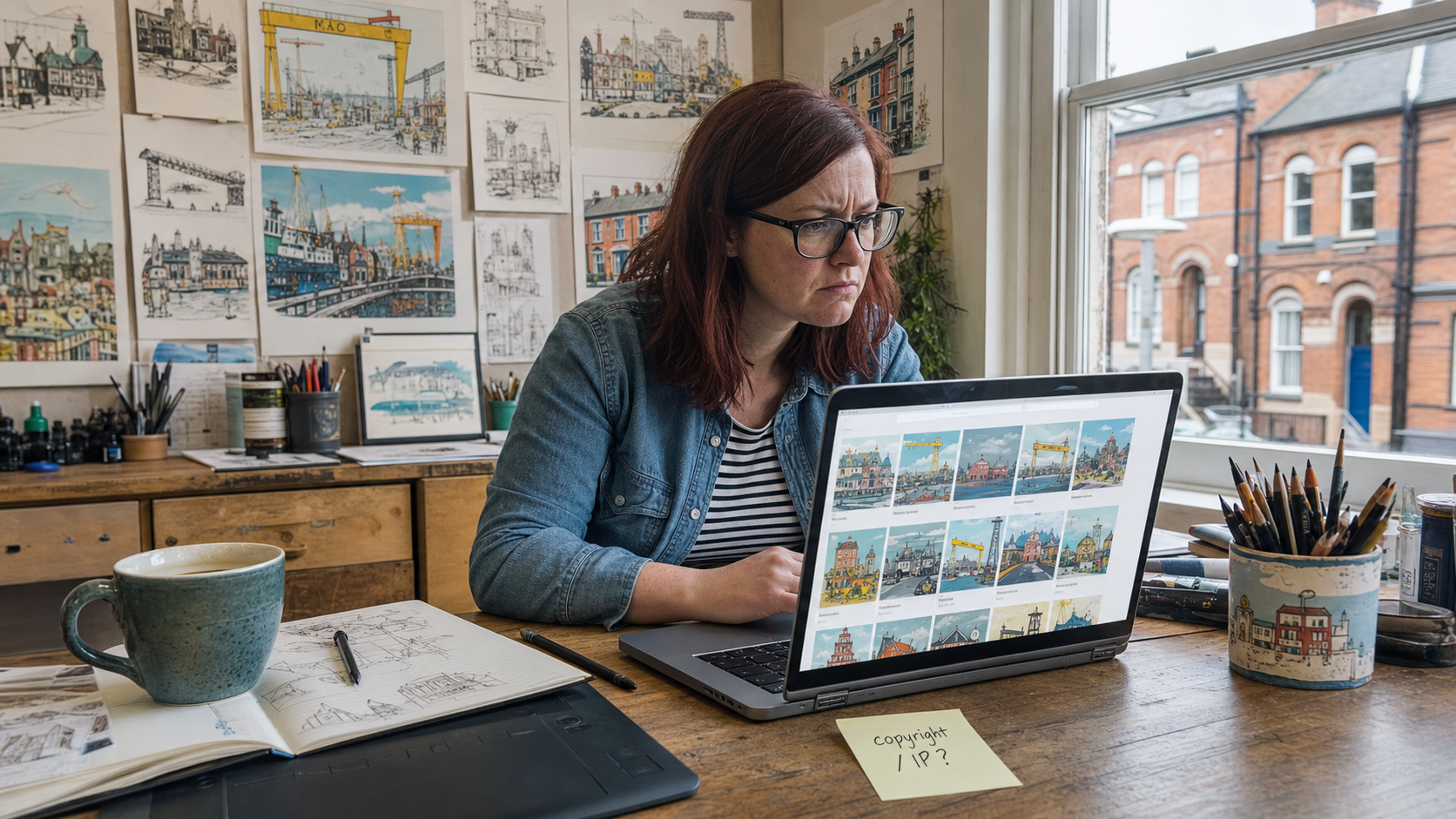
Belfast illustrator Kerrie McNeill has spoken publicly about the anger and frustration of discovering her creative work being copied and sold without permission on online marketplaces, joining a growing number of Northern Ireland artists who are raising the alarm about the scale of intellectual property theft in the digital economy — a problem that is costing local creatives both income and recognition.
Background
The theft of artists' work online is not a new phenomenon, but the scale and ease with which it now occurs has accelerated dramatically with the growth of print-on-demand platforms and online marketplaces. Sites that allow third parties to upload designs for printing on merchandise — T-shirts, mugs, phone cases, prints — have created a vast and largely unregulated marketplace in which stolen artwork can be listed for sale within minutes of being uploaded. For artists like McNeill, who build their livelihoods on the originality and distinctiveness of their work, the consequences are both financial and deeply personal.
McNeill is one of a number of Belfast-based illustrators and visual artists who have built significant followings on social media platforms, using Instagram and other channels to share their work and connect with customers. This visibility, while essential for building a creative business, also makes their work more accessible to those who would copy it. The irony is not lost on artists: the same platforms that enable them to reach audiences also expose them to exploitation.
The issue has been compounded in recent months by the rise of generative artificial intelligence tools, which some bad actors are using to create derivative works that closely mimic the style of established artists without technically reproducing their specific images. This creates a grey area in intellectual property law that existing legislation was not designed to address, and artists across Northern Ireland and the Republic have been calling for updated legal protections.
Key Developments
McNeill described discovering her work being sold by third parties on online marketplaces as a gut-punch — a violation of both her creative labour and her commercial interests. She has taken steps to report the infringing listings to the relevant platforms, but the process is slow and frustrating, with new listings often appearing as quickly as old ones are removed. The platforms' reporting mechanisms, while technically available, are widely criticised by artists as inadequate and poorly resourced.
Her experience is far from unique. The Arts Council of Northern Ireland has received a significant increase in queries from artists seeking advice on intellectual property protection in recent years, and the organisation has been working with legal partners to develop guidance for creative practitioners. The issue has also been raised at Stormont, with MLAs from several parties calling for the Department for the Economy to develop a specific support package for artists affected by online theft.
Why It Matters
The theft of artists' work online is not a victimless crime. For illustrators, designers, and visual artists who rely on the sale of their work for their income, every stolen sale is a direct financial loss. But the harm goes beyond economics. When someone else profits from an artist's creativity without acknowledgement or compensation, it undermines the entire value proposition of original creative work. It also distorts the market, making it harder for legitimate artists to compete with sellers who have no production costs because they have simply stolen the designs they are selling.
Northern Ireland's creative sector is a significant contributor to the regional economy, and the Arts Council has consistently argued that investment in the arts generates returns well beyond the cultural sphere. The growth of Belfast's creative industries — from illustration and graphic design to film, music, and theatre — has been one of the city's success stories in recent years. Protecting the intellectual property of the artists who drive that growth is not a niche concern; it is a matter of economic policy.
Local Impact
For Belfast's creative community, concentrated in areas like the Cathedral Quarter, the Titanic Quarter, and the emerging creative hubs of east Belfast, the issue of online theft is a daily reality. Many of the city's most talented illustrators and designers operate as sole traders or small businesses, without the legal resources to pursue infringers through the courts. The cost of intellectual property litigation is prohibitive for most individual artists, meaning that the burden of enforcement falls almost entirely on the platforms themselves — and the platforms' record on this front has been poor. The Arts Council of Northern Ireland has indicated it is exploring whether a collective legal fund for artists could be established, similar to models that exist in other European countries.
What's Next
McNeill and other affected artists are calling on the major online marketplaces to implement more robust proactive monitoring for stolen artwork, rather than relying on artists to identify and report infringements themselves. They are also calling on the UK government to update intellectual property legislation to better reflect the realities of the digital economy, including clearer rules on the use of artists' work to train generative AI systems. The Arts Council of Northern Ireland has committed to publishing updated guidance for artists on protecting their work online before the end of 2026, and the issue is expected to feature prominently at the Creative Industries Forum scheduled for October.