Bank of Ireland Reaffirms Guidance as Whiskey Tariff Split Hits Republic
Bank of Ireland has reaffirmed its financial guidance for 2026 after reporting solid lending growth in the first quarter, but its plans to delist from the London Stock Exchange and a damaging split in US tariff policy on Irish and Northern Irish whiskey have cast a complex light on the economic outlook.
Background
Bank of Ireland is one of the "Big Four" commercial banks in Ireland and plays a crucial role in the national economy. Its performance is often seen as a bellwether for the health of Irish businesses and consumers. In recent years, the bank has been navigating a complex operating environment, marked by rising interest rates, economic uncertainty, and a major industry-wide review by UK regulators into historical motor finance practices. The bank has been focused on growing its loan book while managing costs and risks.
Simultaneously, the all-island economy faces a period of divergence. The unique post-Brexit trading arrangements for Northern Ireland have created both opportunities and challenges. One of the most recent and starkest examples of this divergence has emerged in the spirits industry, where a US decision on tariffs has created a significant competitive advantage for distilleries in Northern Ireland over their counterparts in the Republic, highlighting the complex economic realities of the new EU-UK relationship.
Key Developments
In a first-quarter trading update, Bank of Ireland announced that its customer loan book had grown to €83.6 billion, up from €82.5 billion at the end of 2025, representing annualised growth of approximately 5%. As reported by the London Stock Exchange's news service, the bank's net interest income remained flat, but it reaffirmed its full-year guidance of €3.4 billion. Fee income saw a modest 1% increase, while operating expenses rose by 2%. The bank also confirmed it had taken a £374 million provision to cover potential redress related to the UK's Financial Conduct Authority (FCA) review of the motor finance market.
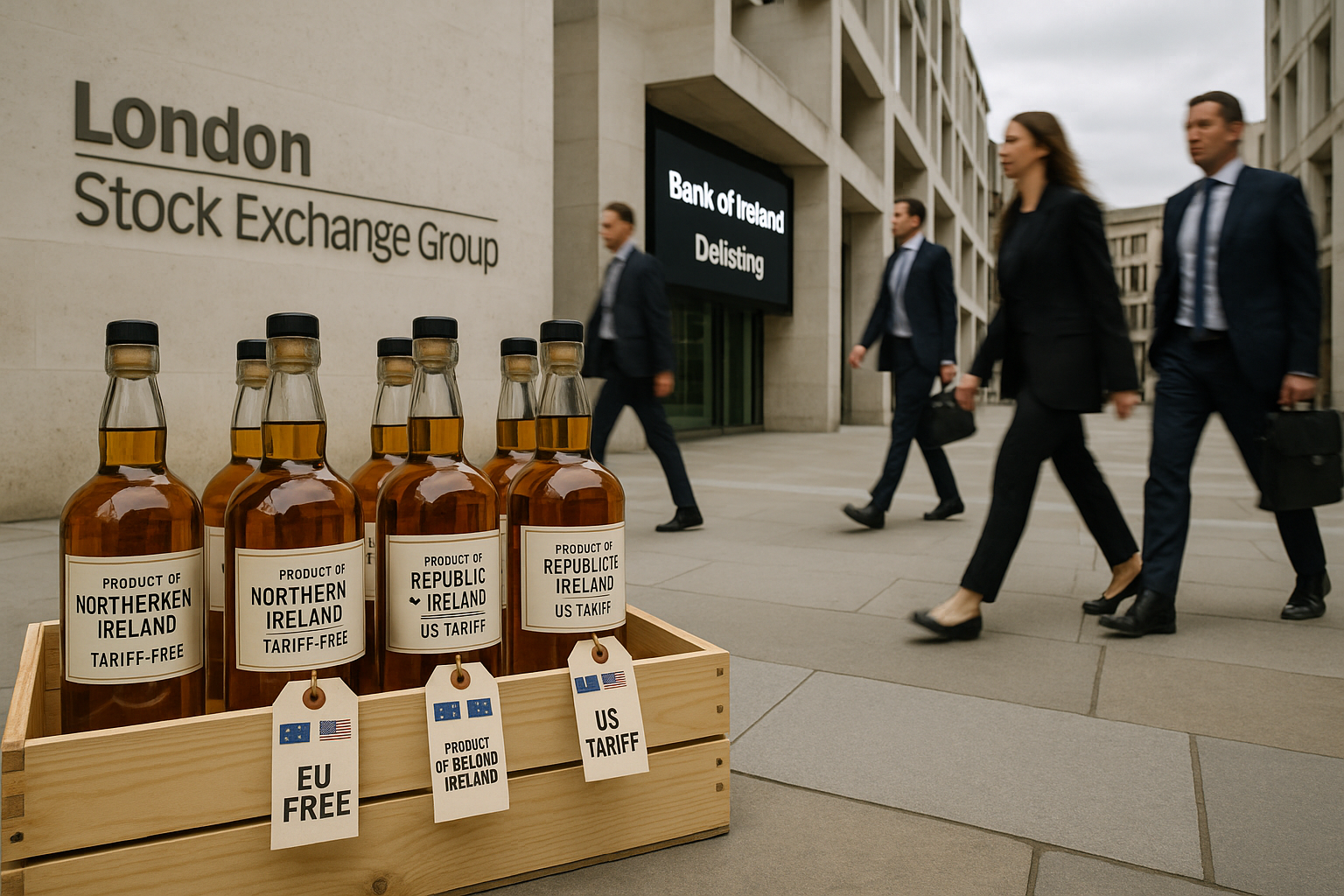
In a significant strategic move, the bank is proposing to exit its listing on the London Stock Exchange, a legacy of its bailout during the financial crisis. The board argues that the limited liquidity of the London listing no longer justifies the cost and complexity. Shareholders will vote on the proposal on May 21. Despite the mixed news, shares in the bank rose 0.4% to €16.62. CEO Myles O'Grady commented that the results were in line with expectations and that the bank's strategy was delivering for shareholders.
However, wider economic news was less positive. As reported by The Irish News, a damaging transatlantic trade ruling will see whiskey producers in Northern Ireland benefit from the removal of certain US tariffs, while distilleries in the Republic of Ireland will continue to face a 15% tariff. This creates a significant price disadvantage for southern producers in the lucrative US market. This comes as the Irish GDP growth forecast for 2026 was revised down to just 1.6%.
Why It Matters
Bank of Ireland's decision to delist from London is symbolic. It represents a further retrenchment to its core Irish market and a simplification of its corporate structure. While presented as a cost-saving measure, it also reflects the diminishing role of London as a trading hub for major Irish corporates post-Brexit. The bank's steady performance, despite the significant motor finance provision, suggests a degree of resilience in the Irish domestic economy, but the flat interest income points to a challenging environment for banking profitability.
The whiskey tariff issue is a stark illustration of the economic divergence on the island of Ireland. It demonstrates how the Northern Ireland Protocol and Windsor Framework can create tangible competitive advantages for businesses north of the border. While beneficial for NI producers, it creates an uneven playing field that could harm one of the Republic's flagship export industries. This two-tier system poses a significant challenge for the concept of an integrated all-island economy.
Local Impact
For Bank of Ireland's customers and shareholders, the steady results and reaffirmed guidance provide a degree of reassurance. However, the proposed delisting from London may concern UK-based investors. The most significant local impact comes from the whiskey tariff split. For distilleries in the Republic, many of which are located in rural areas and are key local employers, the 15% US tariff is a major blow that could impact profitability, investment, and jobs. Conversely, for their counterparts in Northern Ireland, the tariff removal is a major boon that could fuel expansion and job creation, exacerbating economic disparities on the island.
What's Next
The key date for Bank of Ireland is May 21, when shareholders will vote on the proposed delisting from the London Stock Exchange. The bank's performance will continue to be closely watched as a barometer of the Irish economy. For the whiskey industry, the focus will now be on intense lobbying efforts in Dublin, Brussels, and Washington to try and resolve the damaging tariff disparity. The Irish government is under pressure to find a diplomatic solution to protect a vital export sector.