)
UAE's Shock OPEC Exit Threatens to Reshape Global Oil Market
The United Arab Emirates has announced its intention to withdraw from the Organisation of the Petroleum Exporting Countries, delivering a potentially devastating blow to the oil cartel's cohesion at a moment of acute global energy market volatility — a development that could fundamentally alter the dynamics of global oil production and pricing for years to come.Background
OPEC, founded in 1960, has been one of the most influential organisations in the global economy for over six decades. By coordinating the production decisions of its member states, the cartel has sought to manage global oil supply and maintain prices at levels that serve the interests of producing nations. At its peak, OPEC controlled over 50% of global oil production and wielded enormous influence over the world economy. The 1973 oil embargo, which triggered a global energy crisis, demonstrated the cartel's power to reshape the economic fortunes of nations that depended on imported oil.
The UAE has been a member of OPEC since 1967 and has grown to become one of the cartel's most significant producers, with production capacity of approximately 4 million barrels per day. The country has invested heavily in expanding its oil production infrastructure and has been one of the most vocal advocates within OPEC for higher production quotas, reflecting its desire to monetise its oil reserves before the global energy transition reduces demand for fossil fuels.
Tensions between the UAE and other OPEC members — particularly Saudi Arabia — have been building for several years. The UAE has repeatedly pushed for higher production quotas, arguing that its expanded production capacity entitles it to a larger share of the cartel's output. These disputes have occasionally threatened to fracture the cartel's unity, and the current announcement suggests that the UAE has concluded that its interests are better served outside OPEC than within it.
Key Developments
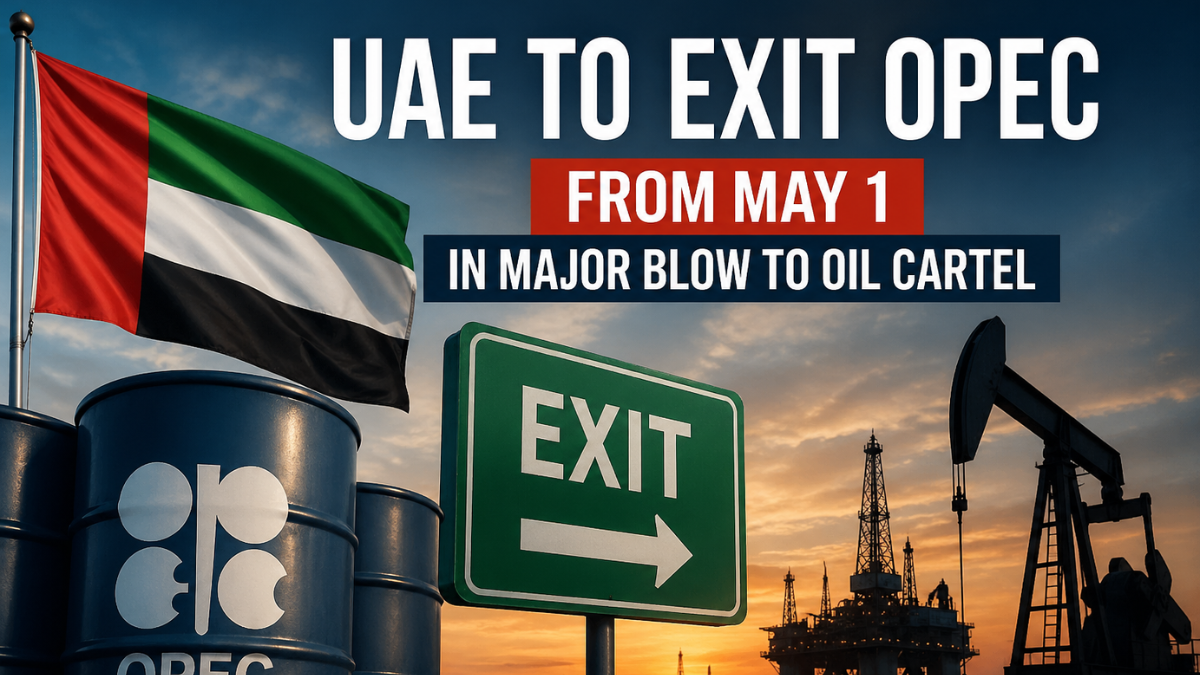
The UAE announced its intention to exit OPEC on 27 April 2026, with the decision confirmed the following day. The announcement has been described as a major blow to the oil cartel, of which the UAE has been a key member for nearly six decades. The timing of the decision is notable, coming amidst stalled US-Iran negotiations and heightened volatility in the oil market. The UAE's departure could undermine OPEC's ability to coordinate production levels and influence global oil prices, potentially heralding a new era of competition among major oil-producing nations.
The immediate market reaction to the announcement was significant, with oil prices falling sharply on the expectation that the UAE will increase production outside the constraints of OPEC quotas. The UAE has indicated that it intends to expand production to its full capacity of 4 million barrels per day, a level that would represent a significant increase from its current OPEC-constrained output. Saudi Arabia, which has been the dominant force within OPEC and has borne the largest share of production cuts in recent years, faces a difficult decision about how to respond to the UAE's departure.
Why It Matters
The UAE's exit from OPEC is potentially the most significant development in the global oil market since Russia's invasion of Ukraine in 2022. If the departure triggers a broader unravelling of OPEC's production coordination — with other members following the UAE's lead and increasing production — the result could be a sustained period of lower oil prices. For energy-importing nations like the UK and Ireland, lower oil prices would be welcome relief from the inflationary pressure of the past year. However, the transition to lower prices is unlikely to be smooth: the immediate period of uncertainty and market volatility could itself cause disruption. For the UK's North Sea oil industry, lower prices would reduce the profitability of existing fields and potentially accelerate the decommissioning of marginal assets. For the global energy transition, lower oil prices could reduce the economic incentive to invest in renewable energy alternatives, potentially slowing the shift away from fossil fuels.
Local Impact
For UK and Irish consumers, the UAE's OPEC exit has the potential to deliver lower petrol and energy prices over the medium term, if the departure leads to increased global oil supply and lower prices. However, the short-term picture is more uncertain: the market volatility triggered by the announcement could itself cause price spikes before any sustained reduction materialises. For the UK government, which is facing intense political pressure over the cost of living crisis, the prospect of lower energy prices is welcome, but the uncertainty makes it difficult to plan fiscal policy around any specific price trajectory. In Ireland, where consumer confidence has already fallen sharply in response to rising fuel costs, any sustained reduction in energy prices would provide significant relief to households and businesses.
What's Next
OPEC is expected to hold an emergency meeting in the coming weeks to discuss the implications of the UAE's departure and to consider its response. Saudi Arabia faces a critical decision: whether to maintain production discipline in the hope of stabilising prices, or to increase its own production in response to the UAE's exit, potentially triggering a price war. Watch for the OPEC emergency meeting announcement and the Saudi response, which will be the key determinants of the global oil price trajectory in the coming months.
Sources: Associated Press — Iran war live updates, 28 April 2026; Reuters — Middle East energy, 27 April 2026