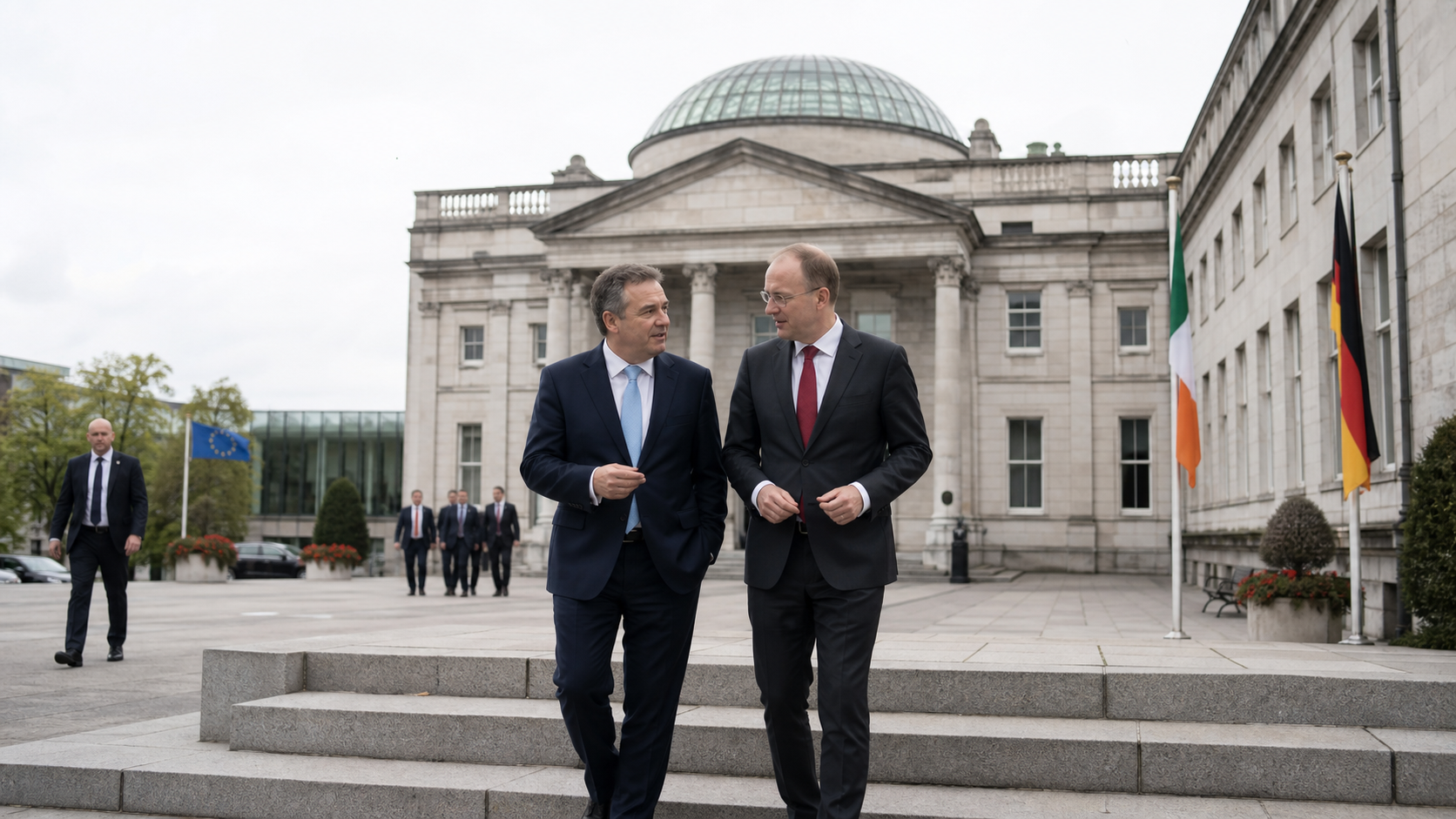
Taoiseach Martin Meets German Chancellor Merz in Dublin for EU Budget and Competitiveness Talks
Taoiseach Micheál Martin has hosted German Chancellor Friedrich Merz in Dublin for high-level talks covering the EU's proposed two-trillion-euro long-term budget, European competitiveness, and the bloc's enlargement agenda, as Ireland's six-month EU Council Presidency enters a critical phase. The meeting, held on 28 July 2026, also provided an opportunity for the Taoiseach to express the solidarity of the Irish people with the victims of the terror attack at the Berlin Pride festival, which killed one person and injured at least 29 others over the preceding weekend.
Background
Ireland assumed the rotating presidency of the Council of the European Union on 1 January 2026, taking over from Poland for a six-month term that runs until the end of June — though the practical work of the presidency continues into the second half of the year as legislative files are concluded and political priorities are advanced. The Irish presidency has identified competitiveness, the single market, climate and digital transitions, and EU enlargement as its key priorities, and Taoiseach Martin has been active in building the bilateral relationships with major EU member states that are essential to advancing those priorities.
Germany is the EU's largest economy and one of its most influential member states, and the relationship between Dublin and Berlin is central to Ireland's ability to shape the European agenda. Chancellor Merz, who took office in early 2025 following the collapse of the Scholz coalition, has brought a more fiscally conservative approach to German European policy, and his position on the EU's long-term budget — which he regards as too large — is one of the most significant obstacles to agreement on the multiannual financial framework that the Commission has proposed.
The two leaders had previously met in Berlin in April 2026 to prepare for Ireland's EU presidency, and the Dublin meeting represents a continuation of that dialogue at a moment when the budget negotiations are entering a particularly sensitive phase. The attack at the Berlin Pride festival, which occurred on the weekend of 25-26 July, added an additional dimension to the meeting, with the Taoiseach using the occasion to express solidarity with Germany and to reaffirm Ireland's commitment to the EU's core values of human dignity, equality, and minority rights.
Key Developments
The Taoiseach opened the meeting by expressing the solidarity of the Irish people with the victims of the Berlin Pride attack, in which a van was driven into a crowd of festival-goers near the Brandenburg Gate before the perpetrator used a machete to attack individuals. One person died and at least 29 were injured in the attack, which German authorities have categorised as an act of terrorism. The suspect, identified as 21-year-old Abdul Ballout, was killed by police following a 24-hour manhunt.
Martin stated that the attack stood in direct opposition to the EU's core values and represented an act that must not be normalised or tolerated. He emphasised that the European Union is a community built on values of human dignity, equality, and the rights of minorities, and that Ireland stands firmly with Germany in defending those values.
On the substantive policy agenda, the two leaders discussed the EU's proposed two-trillion-euro long-term budget, with Chancellor Merz reiterating Germany's position that the proposed spending level is too high and that a more modest financial settlement is required. Taoiseach Martin indicated that he intended to listen carefully to the Chancellor's position and to use Ireland's presidency role to help facilitate the compromises that will be necessary to reach agreement. The discussions also covered the Irish presidency's work on strengthening European competitiveness, including simplifying regulations, deepening the single market, expanding trading links, and managing energy costs.
EU enlargement — a priority for the Irish presidency — was also on the agenda, with the Taoiseach highlighting Ireland's strong support for the accession of Western Balkan countries and Ukraine to the EU. Chancellor Merz expressed Germany's support for the enlargement process, while noting the importance of ensuring that candidate countries meet the necessary reform criteria before accession.
Why It Matters
The Martin-Merz meeting matters because it illustrates the central role that Ireland is playing in the EU's political life during its presidency. The long-term budget negotiations are one of the most consequential decisions that the EU will make in the coming years, and Ireland's ability to broker a compromise between the Commission's ambitious proposals and the fiscal conservatism of member states like Germany will be a significant test of the presidency's effectiveness. The Taoiseach's expression of solidarity with Germany following the Berlin Pride attack also reflects Ireland's commitment to the EU's values at a moment when those values are under pressure from both external threats and internal political tensions. The meeting demonstrates that Ireland's EU presidency is not just a bureaucratic exercise — it is an opportunity to shape the direction of the European project at a critical moment in its history.
Local Impact
The outcome of the EU budget negotiations will have direct consequences for Ireland, which is a significant net beneficiary of EU structural and cohesion funds. The level of funding available for rural development, regional infrastructure, and research and innovation in Ireland will depend in part on the outcome of the multiannual financial framework negotiations, and the Taoiseach's engagement with Chancellor Merz is therefore directly relevant to the interests of Irish communities from Donegal to Kerry. The EU's competitiveness agenda, which is a central priority of the Irish presidency, is also of direct relevance to Ireland's export-oriented economy, which depends on a well-functioning single market and a competitive regulatory environment. The Department of Foreign Affairs and the Department of Enterprise are both closely engaged in the presidency's work on these issues.
What's Next
The EU budget negotiations are expected to intensify in the autumn, with a series of high-level meetings planned between member state leaders and the European Commission. Ireland's presidency will play a key role in facilitating those discussions, and the Taoiseach is expected to hold further bilateral meetings with other major member state leaders in the coming weeks. The European Council is scheduled to meet in October 2026, and the budget negotiations are expected to be a central item on the agenda. A final agreement on the multiannual financial framework is not expected before the end of 2026 at the earliest.