Stripe Young Scientist Exhibition 2027 Opens for Applications as Ireland's Brightest Young Minds Invited to Compete
Applications have opened for the 2027 Stripe Young Scientist and Technology Exhibition, with students aged 12 to 19 across Ireland invited to submit their projects by 5pm on Monday, 28 September 2026 — the latest edition of a competition that has been a cornerstone of Irish science education for more than six decades and which received 1,974 project entries for its 2026 edition.
Background
The Young Scientist and Technology Exhibition has been a fixture of Irish educational and cultural life since its establishment in 1965, when it was founded with the explicit aim of encouraging young Irish people to engage with science and technology at a time when the country was beginning to modernise its economy. In the intervening six decades, the competition has produced a remarkable array of alumni who have gone on to careers in science, medicine, engineering, and technology both in Ireland and internationally.
The competition was rebranded as the Stripe Young Scientist and Technology Exhibition in May 2025, when the Irish-American payments company Stripe assumed the role of title sponsor, succeeding BT Ireland. Stripe's involvement has brought additional resources and a stronger technology focus to the competition, reflecting the company's interest in supporting the development of the next generation of Irish technology talent.
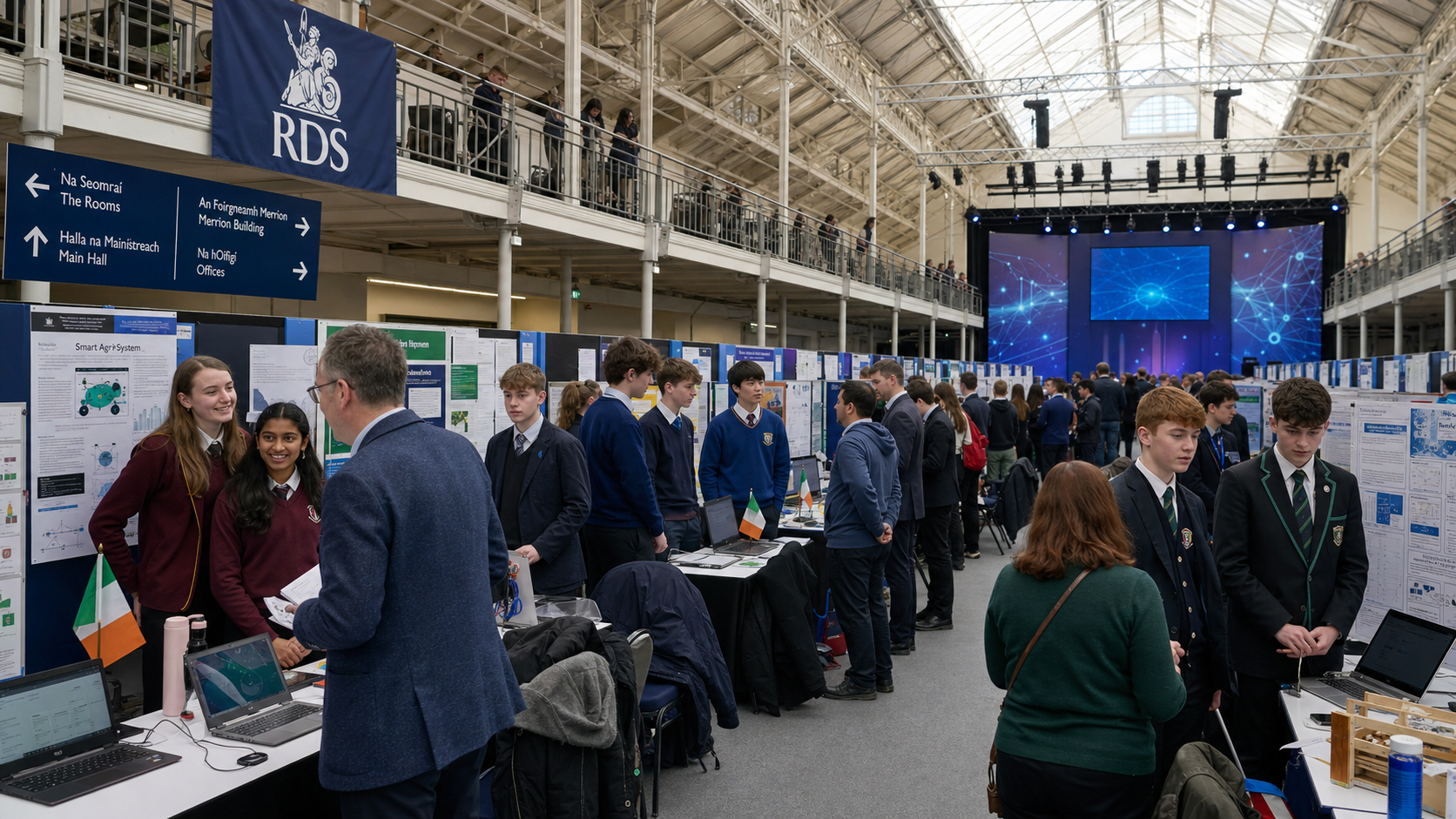
The 2026 edition of the exhibition, held at the RDS in Dublin in January, attracted 1,974 project entries, of which 550 were selected to participate in the four-day event. The competition awards prizes across five categories: Technology, Social and Behavioural Science, Biological and Ecological Science, Chemical, Physical and Mathematical Science, and Health and Wellbeing — a breadth of coverage that reflects the diverse interests and talents of Ireland's young scientists.
Key Developments
The 2027 exhibition will take place at the RDS in Dublin from 6 to 9 January 2027, with the application deadline set for 5pm on 28 September 2026. Students must be aged between 12 and 19 on 31 October 2026 and must reside in Ireland to be eligible. A non-refundable entry fee of €20 per student (£18 for students in Northern Ireland) is required, and all entries must be submitted through the official online registration system.
The competition is open to students from all types of schools across Ireland, including secondary schools, community colleges, vocational schools, and fee-paying schools. Projects can be submitted by individuals or by groups of up to three students, and the competition encourages projects that address real-world problems and have the potential for practical application.
Stripe has indicated that it will continue to invest in the competition's development, including initiatives to increase participation from schools in disadvantaged areas and to strengthen the competition's links with the technology industry. The company's co-founder and CEO Patrick Collison, who grew up in County Tipperary, has spoken publicly about the importance of science education in Ireland and the role that competitions like the Young Scientist can play in inspiring young people to pursue careers in STEM.
Why It Matters
The Young Scientist Exhibition matters because it works. The competition has a proven track record of identifying and nurturing exceptional young talent, and many of Ireland's leading scientists, engineers, and technology entrepreneurs cite their participation in the competition as a formative experience. The visibility that the exhibition provides — including significant media coverage and the opportunity to present work to industry professionals and academics — is genuinely valuable for young people at a critical stage of their educational development.
The competition also plays an important role in shaping attitudes towards science and technology among the broader student population. The knowledge that a peer has won a national science competition, or that a school has produced a Young Scientist finalist, can have a significant impact on the culture of a school and the aspirations of its students.
Ireland's technology sector, which employs hundreds of thousands of people and generates a significant proportion of the country's tax revenue, depends on a steady supply of talented graduates in science, technology, engineering, and mathematics. The Young Scientist Exhibition is one of the most effective tools available for inspiring young people to pursue these subjects and to see themselves as future contributors to Ireland's knowledge economy.
Local Impact
Schools across Ireland, from Donegal to Cork and from Galway to Wexford, have a tradition of participation in the Young Scientist Exhibition, and the competition has a genuinely national reach. In recent years, schools from smaller towns and rural areas have produced winning projects, demonstrating that scientific talent is not confined to the major urban centres.
The competition's impact is felt not just in the schools that participate but in the wider communities in which those schools are located. A Young Scientist finalist from a small town becomes a local hero, and the pride that communities take in the achievements of their young scientists is a powerful motivator for future generations.
What's Next
The application deadline is 28 September 2026, and students are encouraged to begin developing their project ideas now. The competition organisers will host a series of information events for teachers and students in the coming weeks, providing guidance on the application process and the judging criteria. The 550 projects selected to participate in the 2027 exhibition will be announced in November 2026, with the four-day event at the RDS taking place from 6 to 9 January 2027.