Ireland's Padel Court Boom in Full Swing as West Wood Opens Largest Indoor Facility at Leopardstown
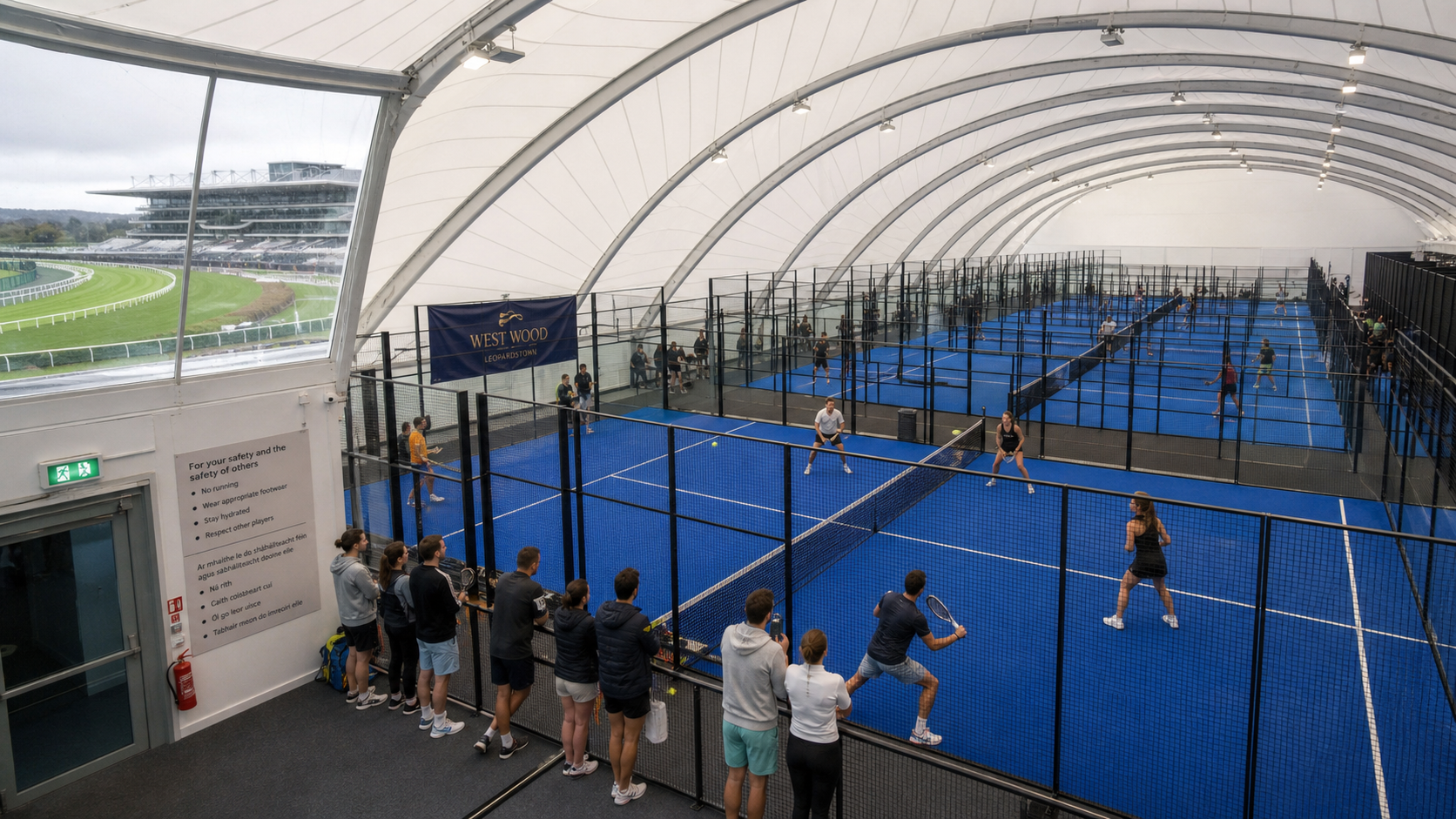
Ireland's padel court building boom is accelerating, with the West Wood Club opening the country's largest indoor padel facility at Leopardstown Racecourse in south Dublin this week — eight indoor courts and two pickleball courts housed under an air dome — as the sport that has taken Europe by storm continues its rapid expansion across the island, with over 120 locations now operational or announced.
Background
Padel, the racquet sport that combines elements of tennis and squash and is played on an enclosed court roughly a third the size of a tennis court, has experienced explosive growth across Europe over the past decade. Originating in Mexico in the 1960s and popularised in Spain, where it is now the second most played sport after football, padel has spread rapidly through continental Europe and has arrived in Ireland with a momentum that has surprised even its most enthusiastic advocates.
The sport's appeal is broad. It is easier to learn than tennis — the enclosed court means that balls remain in play longer, rallies are more sustained, and beginners can enjoy competitive games from an early stage — and it is highly social, typically played in doubles format with a strong emphasis on fun and community. These characteristics have made it particularly attractive to the 30-to-50 age group that forms the core of its Irish player base, though the sport is growing rapidly among younger players as well.
Ireland's padel market has been characterised by a transition from a "novelty" phase — in which a small number of facilities attracted curious early adopters — to a period of rapid, structural growth in which established sports and leisure operators are investing seriously in the sport. The West Wood Club, which operates six locations across Dublin and is one of the most established health and fitness operators in the country, is the latest and most significant example of this transition.
Key Developments
The West Wood Club's new facility at Leopardstown Racecourse represents the most significant single investment in padel infrastructure in Ireland to date. The eight indoor courts, housed under an air dome, feature MejorSet surfaces consistent with those used on the professional World Padel Tour, providing a playing experience that meets international standards. The addition of two dedicated pickleball courts reflects the growing interest in that sport, which shares some characteristics with padel and has been growing rapidly in Ireland alongside it.
The facility will be accessible to members across all six West Wood Club locations, with court-fee access also available to non-members — a model that is designed to maximise utilisation and introduce new players to the sport. The indoor format is particularly significant in the Irish context, where the weather is a persistent constraint on outdoor sports participation. An all-weather, indoor padel facility removes one of the primary barriers to year-round participation and is expected to drive a significant increase in player numbers.
Beyond the West Wood development, the broader padel market in Ireland is characterised by a mix of independent operators and larger organisations. Padel100, a key player in the market, has raised significant capital through the government's Employment and Investment Incentive scheme to fund its goal of opening 100 clubs with 230 courts by the end of 2027. A €2 million, six-court project at St Patrick's Woollen Mills in Douglas, Cork, received planning approval in May 2026 and is targeting completion by the end of the year.
Why It Matters
The padel boom matters for Irish sport and the Irish economy for several reasons. At the participation level, it is bringing a new sport to hundreds of thousands of Irish people who might not otherwise be engaged in regular physical activity — a significant public health benefit in a country where sedentary lifestyles and obesity are growing concerns. At the economic level, the investment in padel infrastructure is creating jobs in construction, facility management, coaching, and equipment retail, and is generating revenue for the hospitality and leisure sector.
The planning dimension of the padel boom is also significant. Local councils across Ireland are grappling with how to classify and regulate padel facilities, which occupy an ambiguous position between temporary sporting infrastructure and permanent commercial development. The refusal of planning permission for a 10-court development at Swords Pavilions in March 2026 — on grounds of scale and nature — illustrates the challenges that operators face in navigating the planning system, and the need for clearer national guidance on the planning treatment of padel facilities.
Local Impact
In south Dublin, the opening of the West Wood facility at Leopardstown will be welcomed by the large and growing padel community in the area. Leopardstown Racecourse, which is already a major leisure destination in south Dublin, provides an ideal location for a large-scale padel facility, with ample parking and good public transport connections. The facility is expected to attract players from across the greater Dublin area, including from Dún Laoghaire-Rathdown, South Dublin, and Wicklow. For the West Wood Club, the investment represents a significant diversification of its offering and a bet on the continued growth of padel as a mainstream sport in Ireland.
What's Next
The West Wood Leopardstown facility is expected to open to members and the public in late August 2026. The broader padel market in Ireland will continue to develop rapidly over the coming months, with a number of significant projects in the pipeline across Dublin, Cork, Galway, and Limerick. The Irish Padel Federation, which governs the sport in Ireland, is working to develop a national competition structure that will provide a pathway for players from beginner to elite level. The first Irish Padel Championships are expected to take place in 2027.