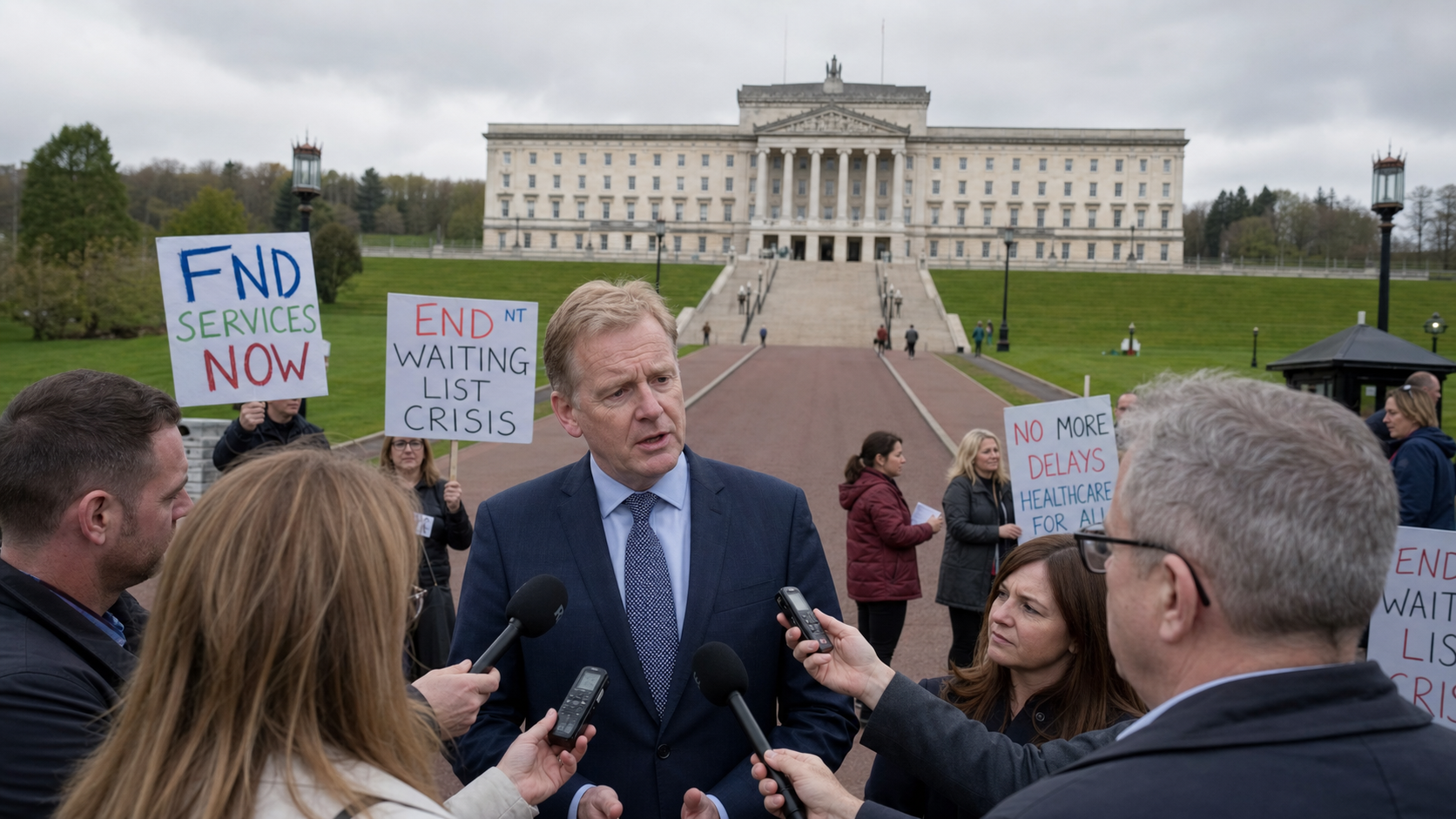
Stormont's New Health Minister Robbie Butler Faces Mounting Pressure Over FND Services and Waiting Lists
Northern Ireland's newly appointed Health Minister Robbie Butler is facing immediate and mounting pressure from patient advocates, opposition MLAs, and healthcare professionals over a range of urgent issues including the absence of dedicated services for Functional Neurological Disorder, record-breaking waiting lists, and the unresolved question of emergency surgery at Causeway Hospital — with Assembly elections due in May 2027 leaving a narrow window for meaningful reform.
Background
Robbie Butler MLA, the Lagan Valley representative and former firefighter, was formally appointed as Northern Ireland's Health Minister in August 2026, becoming the third person to hold the role in relatively quick succession. His appointment came after a period of ministerial instability in the Department of Health that has frustrated healthcare professionals and patient advocates who argue that the constant change of leadership has made it impossible to develop and implement a coherent long-term reform agenda.
The Northern Ireland health system is in a state of profound crisis. Waiting lists for outpatient appointments, diagnostic tests, and surgical procedures are among the longest in the United Kingdom, with hundreds of thousands of patients waiting for care. The staffing crisis, which has left the health service operating with thousands of vacancies across nursing, medicine, and allied health professions, has compounded the waiting list problem and placed enormous pressure on front-line staff. The new Health Minister has pledged to prioritise front-line care and has been given "no red lines" by his party leader, Jon Burrows of the Ulster Unionist Party.
The political context is also challenging. With Assembly elections due in May 2027, the window for meaningful legislative and policy reform is narrow. Political analysts have warned that the pattern of ministerial instability in the Department of Health is damaging public confidence in devolved government and that the incoming minister will need to demonstrate tangible progress quickly if he is to make a meaningful impact before the election campaign begins.
Key Developments
Within days of taking office, Butler has been confronted with a series of urgent issues that demand immediate attention. The case of Carmel McConnellogue, the Derry woman who was diagnosed with Functional Neurological Disorder while being treated for dehydration at Altnagelvin Hospital, has highlighted the complete absence of dedicated FND services in Northern Ireland — a gap that FND Matters NI estimates affects approximately 5,000 people in the region. The charity has formally requested a meeting with the new minister to discuss the development of dedicated services.
The waiting list situation, while showing some improvement in specific areas — with a 14% reduction in long-term outpatient waits and a 21% decrease in surgical waits exceeding four years reported in recent data — remains deeply problematic overall. Hundreds of thousands of patients are still waiting for care, and the pace of improvement is far too slow to address the backlog within any politically meaningful timeframe. Opposition MLAs from Sinn Féin, the SDLP, and the Alliance Party have all indicated that they will hold Butler to account on waiting list performance.
The unresolved question of emergency surgery at Causeway Hospital in Coleraine — where the future of the service has been uncertain for several years — is another immediate priority. Local communities in north Antrim and the Causeway Coast area have been campaigning vigorously for the retention of emergency surgical services at the hospital, and Butler will need to make a decision on the matter in the coming months.
Why It Matters
The performance of the Northern Ireland health system is not merely a policy issue — it is a matter of life and death for thousands of patients who are waiting for care that they urgently need. The waiting list crisis has been building for years, driven by a combination of chronic underfunding, staffing shortages, and the structural inefficiencies of a health system that was designed for a different era. The new Health Minister inherits a situation that will require not just political will but sustained investment and fundamental reform to address.
The broader political context — with elections due in May 2027 — means that Butler will be under pressure to demonstrate results quickly. The risk is that short-term political considerations will drive decisions that are not in the long-term interests of the health system, as has happened with previous ministers who have prioritised visible announcements over the harder work of systemic reform. Healthcare professionals and patient advocates are watching closely to see whether Butler will take a different approach.
Local Impact
Across Northern Ireland's five health and social care trusts — Belfast, South Eastern, Southern, Western, and Northern — the impact of the waiting list crisis is felt differently but acutely. In the Western Trust, which covers Derry/Londonderry, Strabane, and Omagh, waiting times for some specialties are among the longest in the region. In the Northern Trust, which covers Antrim, Ballymena, Coleraine, and the surrounding areas, the Causeway Hospital question is the most pressing immediate issue. In the Belfast Trust, which serves the largest population, the sheer volume of patients waiting for care makes the challenge of improvement particularly daunting.
What's Next
Butler is expected to publish a ministerial priorities statement in September, setting out his agenda for the Department of Health for the remainder of the Assembly term. He is also expected to meet with the chief executives of the five health trusts and with representatives of the main healthcare professional bodies in the coming weeks. The Assembly's health committee, chaired by an opposition MLA, will hold its first scrutiny session with the new minister in September, providing an early opportunity for MLAs to test his commitment to reform.