Stormont's Five Parties Unite to Condemn Belfast Disorder — But Executive Faces Criticism Over Handling
The five main parties at Stormont — Sinn Féin, the DUP, Alliance, the SDLP, and the UUP — have issued a joint statement condemning the anti-migrant violence that erupted in Belfast and other parts of Northern Ireland following a stabbing in North Belfast on June 8. The rare display of cross-community political unity has been broadly welcomed, but it has not shielded the Executive from criticism, with commentators and opposition voices arguing that the political environment at Stormont contributed to the conditions in which the disorder occurred.
Background
The joint statement from Stormont's five main parties was issued in the immediate aftermath of the disorder, which saw properties attacked, a Glider bus destroyed, and families from ethnic minority backgrounds forced to flee their homes. The statement condemned the violence in unequivocal terms, described it as an attack on the values of Northern Ireland, and called on the public to support the PSNI's investigation.
Joint statements from all five parties are relatively rare at Stormont, where the dynamics of power-sharing mean that political disagreement is the norm rather than the exception. The fact that parties as ideologically and constitutionally different as Sinn Féin and the DUP were able to agree on a common text was itself significant, and it was widely reported as evidence that the disorder had crossed a line that all parties recognised as unacceptable.
But the statement also raised questions. Critics noted that it came several days after the disorder had begun, and that the initial political response from some parties had been more muted than the situation warranted. There were also questions about whether the political debate at Stormont in the weeks and months before the disorder — particularly around immigration and the Common Travel Area — had contributed to a climate in which anti-migrant sentiment was able to take hold.
Key Developments
The joint statement was followed by a series of individual party responses that revealed the limits of the consensus. While all five parties condemned the violence, they differed significantly in their analysis of its causes and their prescriptions for preventing a recurrence. The DUP emphasised the need for tougher immigration enforcement and called for a review of the Common Travel Area, arguing that the border had become a security vulnerability. Sinn Féin focused on the need for community cohesion and investment in integration services. Alliance called for a cross-departmental strategy on racism and hate crime. The SDLP and UUP struck broadly similar notes, emphasising the importance of community relations and the rule of law.
The Belfast Telegraph reported that several commentators had criticised the Executive for its handling of immigration debates in the period before the disorder. Specifically, there were concerns that political rhetoric around immigration — including from some unionist politicians — had legitimised anti-migrant sentiment and created a permissive environment for those who were inclined towards violence. These criticisms were rejected by the parties concerned, who argued that legitimate debate about immigration policy was not the same as incitement to violence.
The rejection by a Stormont department of a £200 million PSNI recovery plan — reported in the days before the disorder — also attracted renewed attention, with critics arguing that the underfunding of the PSNI had left the service ill-equipped to respond to the scale of the disorder it faced.
Why It Matters
The Stormont response to the disorder matters because it reveals both the strengths and the limitations of Northern Ireland's power-sharing institutions. The ability of five parties with fundamentally different constitutional visions to agree on a common condemnation of violence is a genuine achievement — one that would have been unimaginable in the darkest days of the Troubles. But the speed and coherence of that response, and the willingness of the parties to engage in genuine self-reflection about their own role in creating the conditions for disorder, are more questionable.
The question of whether political rhetoric contributes to real-world violence is one that democracies across the world are grappling with. In Northern Ireland, where the relationship between political language and physical violence has a particularly fraught history, it is a question that demands particular care and honesty. The joint statement was a necessary first step, but it is not a sufficient response to the events of the past week.
The PSNI funding question is also significant. A police service that is chronically underfunded and understaffed cannot be expected to respond effectively to large-scale disorder. The rejection of the recovery plan — whatever the reasons behind it — has consequences that are now visible on the streets of Belfast.
Local Impact
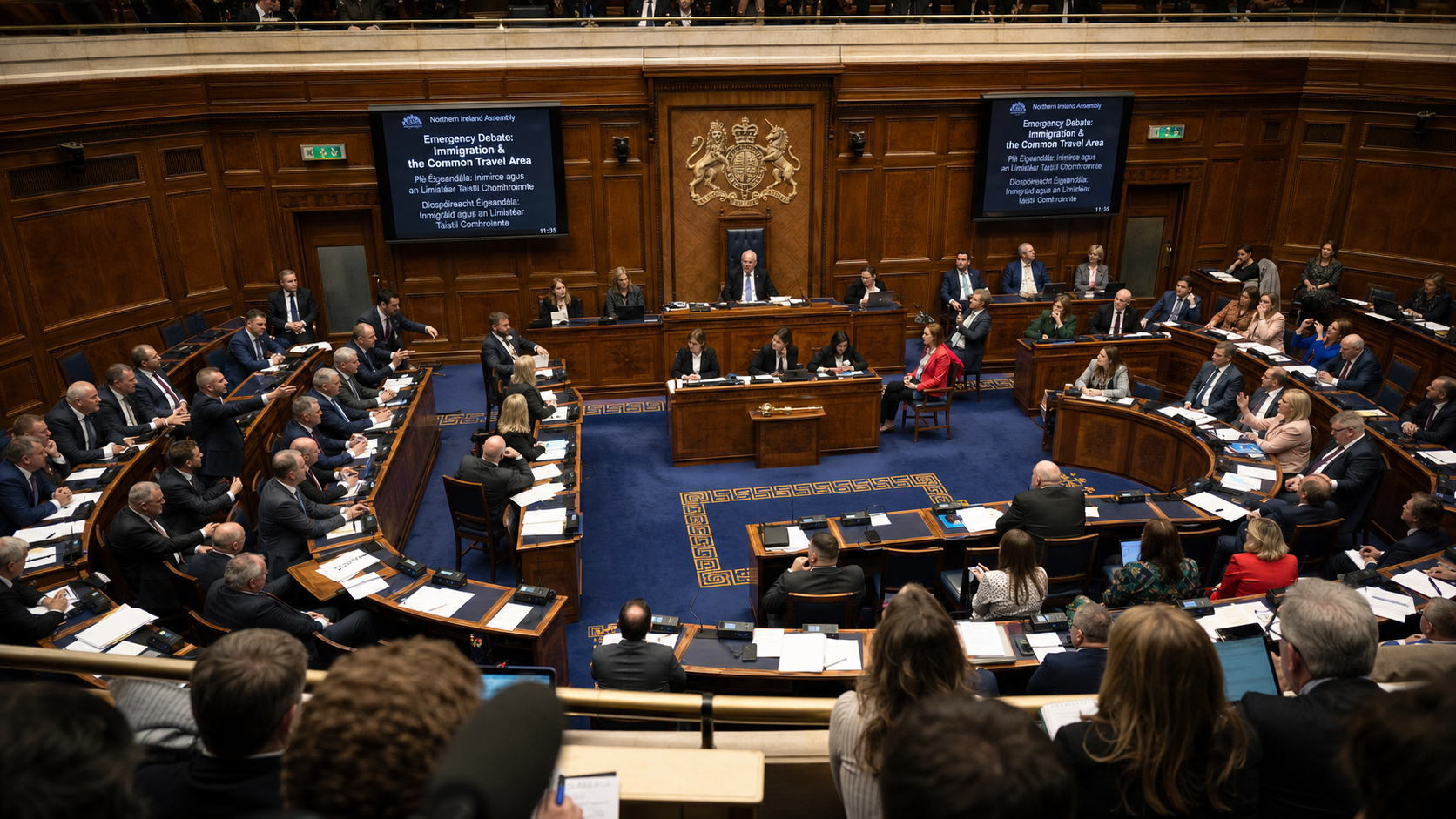
In the Assembly chamber, the disorder has prompted a series of emergency debates and urgent questions, with MLAs from all parties seeking to demonstrate their commitment to community safety and their condemnation of racism. The Executive Office has announced a review of the government's approach to community cohesion and integration, though the terms of reference and timeline for that review have not yet been published. The Communities Minister has indicated that additional funding will be made available for community relations work in the areas most affected by the disorder.
What's Next
The Assembly is expected to hold a full debate on the disorder and its aftermath before the summer recess, which begins in late June. The Executive is under pressure to publish a concrete action plan on community cohesion and integration within the next month. The PSNI's investigation into the disorder is ongoing, and the Policing Board is expected to hold a special meeting to scrutinise the service's response. The question of the PSNI recovery plan is likely to return to the political agenda in the autumn, when the Stormont budget process for 2027-28 begins in earnest.