Stormont Poised for Renewed Battle Over Fox Hunting Ban
A fresh legislative attempt to ban the hunting of wild mammals with dogs in Northern Ireland has been launched at Stormont, five years after a similar bill was narrowly defeated. Alliance Party MLA John Blair has reintroduced a Private Member's Bill — the Hunting of Wild Mammals Bill — reigniting a passionate and divisive debate that cuts to the heart of rural identity and animal welfare in the North. Northern Ireland remains the only part of the United Kingdom where hunting with dogs is still legal, a distinction that animal welfare advocates find increasingly untenable.
Background
The legislative history of fox hunting bans across the UK provides important context. England and Wales enacted the Hunting Act 2004, making it a criminal offence to hunt wild mammals with dogs. Scotland moved even earlier, with the Protection of Wild Mammals (Scotland) Act 2002, later strengthened by the Hunting with Dogs (Scotland) Act 2023. Northern Ireland has remained conspicuously absent from this legislative shift, leaving it as the last jurisdiction in the UK where the practice continues legally.
A previous attempt to change this in 2021 failed by a vote of 45 to 38 at Stormont, largely due to Sinn Féin's preference at the time for regulation over an outright ban. That defeat was a significant blow to animal welfare campaigners who had hoped to see Northern Ireland align with the rest of the UK. However, the political landscape has since shifted in a meaningful way.
Public opinion in Northern Ireland has long favoured a ban. A 2022 poll by the League Against Cruel Sports found that 73% of people in Northern Ireland believe fox hunting should be illegal, while a 2019 Red C poll found that 74% of people in rural areas are opposed to the practice. Strikingly, a majority of the public mistakenly believe a ban is already in place — a fact that underscores how out of step current law is with public sentiment.
Key Developments
The most significant development since the 2021 defeat has been Sinn Féin's policy reversal. At their recent Ard Fheis, party members narrowly voted to support a ban on fox hunting for leisure, a change from their previous stance. The party has stated it will "engage with rural communities to ensure that such a ban is introduced in a way that does not unduly impact rural life." This shift has given John Blair and his supporters renewed confidence that the numbers may finally be there to pass the legislation.
Blair's reintroduced bill is more comprehensive than its predecessor. It would make it a criminal offence to organise or participate in the hunting of wild mammals with dogs, and crucially, it specifically bans "trail hunting" — where dogs follow an artificially laid scent — to close a loophole that has been exploited in England and Wales. The bill also prohibits "terrier work," where terriers are used to flush animals from underground, a practice that frequently results in serious injury to the dogs involved. Exemptions are included for the hunting of rats and mice, and for land management purposes such as protecting livestock or biodiversity.
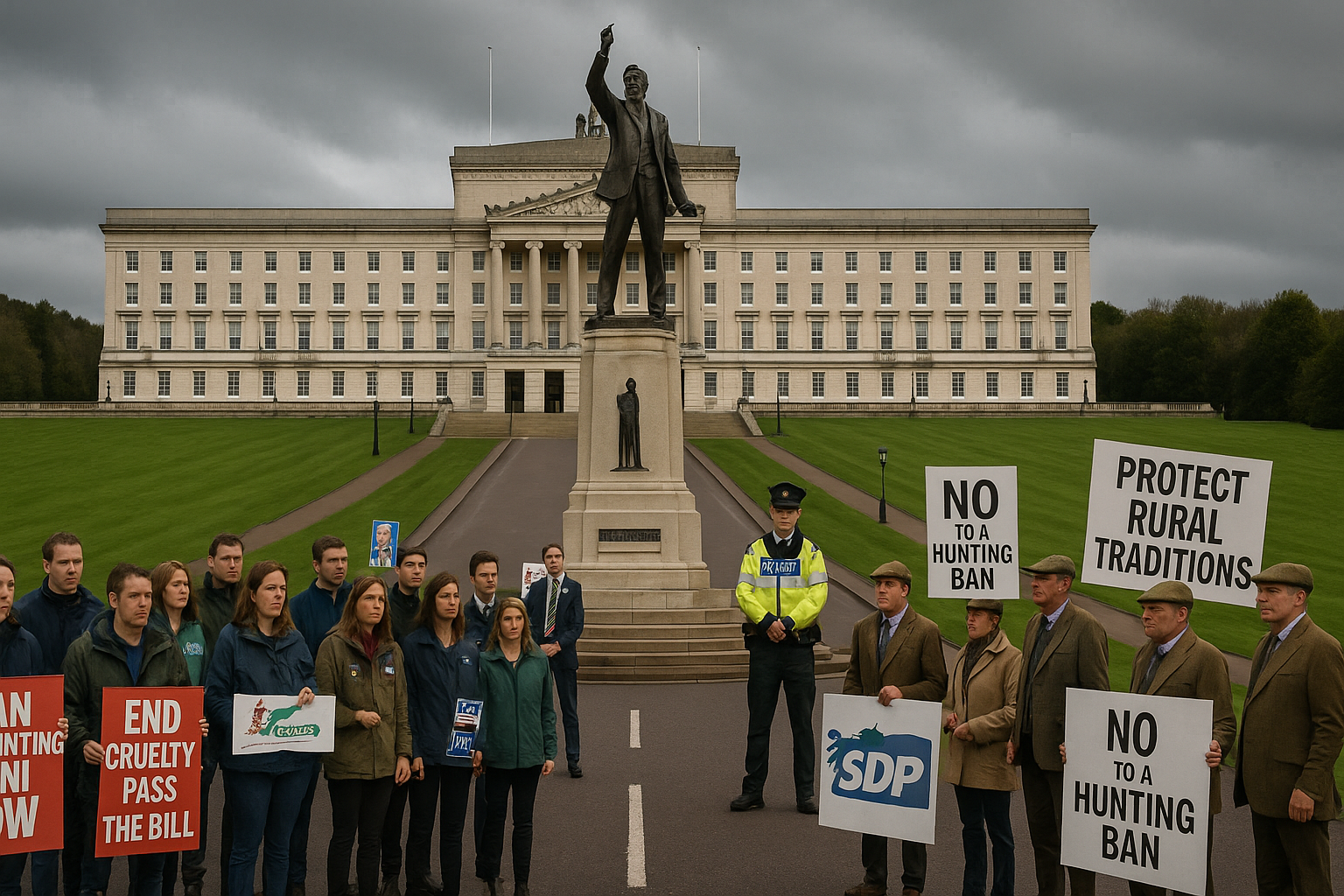
The Countryside Alliance Ireland has condemned the bill as "misguided and divisive" and a "fundamental attack on the rural way of life," arguing it is driven by "slogans rather than substance" and raises concerns about unintended consequences for other countryside pursuits. Animal welfare groups including the League Against Cruel Sports and the USPCA have welcomed the move, launching a joint petition in support of the ban.
Why It Matters
The fox hunting debate in Northern Ireland is about far more than the fate of foxes. It is a proxy battle over the relationship between rural tradition and modern animal welfare standards, and over whether Stormont is capable of legislating on contentious social issues. Northern Ireland's continued legal permission for hunting with dogs is an anomaly within the UK — one that sits uncomfortably alongside the devolved assembly's stated commitments to animal welfare and environmental protection.
The bill's passage would send a clear signal that Stormont can act decisively on issues where public opinion is clear and the evidence is compelling. Conversely, another defeat would reinforce perceptions that rural lobbying groups hold disproportionate sway over the assembly. With polling consistently showing strong public support for a ban — including among rural communities — the political risk of opposing the bill may now outweigh the risk of supporting it. The question is whether MLAs will follow the evidence or the lobbying.
Local Impact
For Northern Ireland, the stakes are both symbolic and practical. The bill's passage would end a practice that animal welfare organisations say causes unnecessary suffering to wild animals and working dogs alike. It would also bring the North into alignment with the rest of the UK, removing an anomaly that has long been a source of embarrassment for those who argue that Stormont should reflect modern values. Rural communities in counties like Antrim, Down, and Fermanagh, where fox hunting has deep cultural roots, will be watching closely. The bill's exemptions for livestock protection and biodiversity management are designed to reassure farmers that their legitimate land management needs will not be criminalised — a key concern that contributed to the 2021 defeat.
What's Next
The bill has passed its First Stage and is expected to proceed to its Second Stage in the coming weeks, after which it will be referred to a committee for detailed scrutiny before a final Assembly vote. John Blair has expressed confidence that there is sufficient time within the current mandate to see the legislation through. With Sinn Féin's policy shift and what Blair describes as growing support among some DUP members, the arithmetic at Stormont may finally be moving in the bill's favour. The second reading will be the first real test of whether this time, the Assembly is ready to act. Sources: NI Assembly — Hunting of Wild Mammals Bill; Belfast Live — MLA hopeful Stormont will back fox hunting ban.