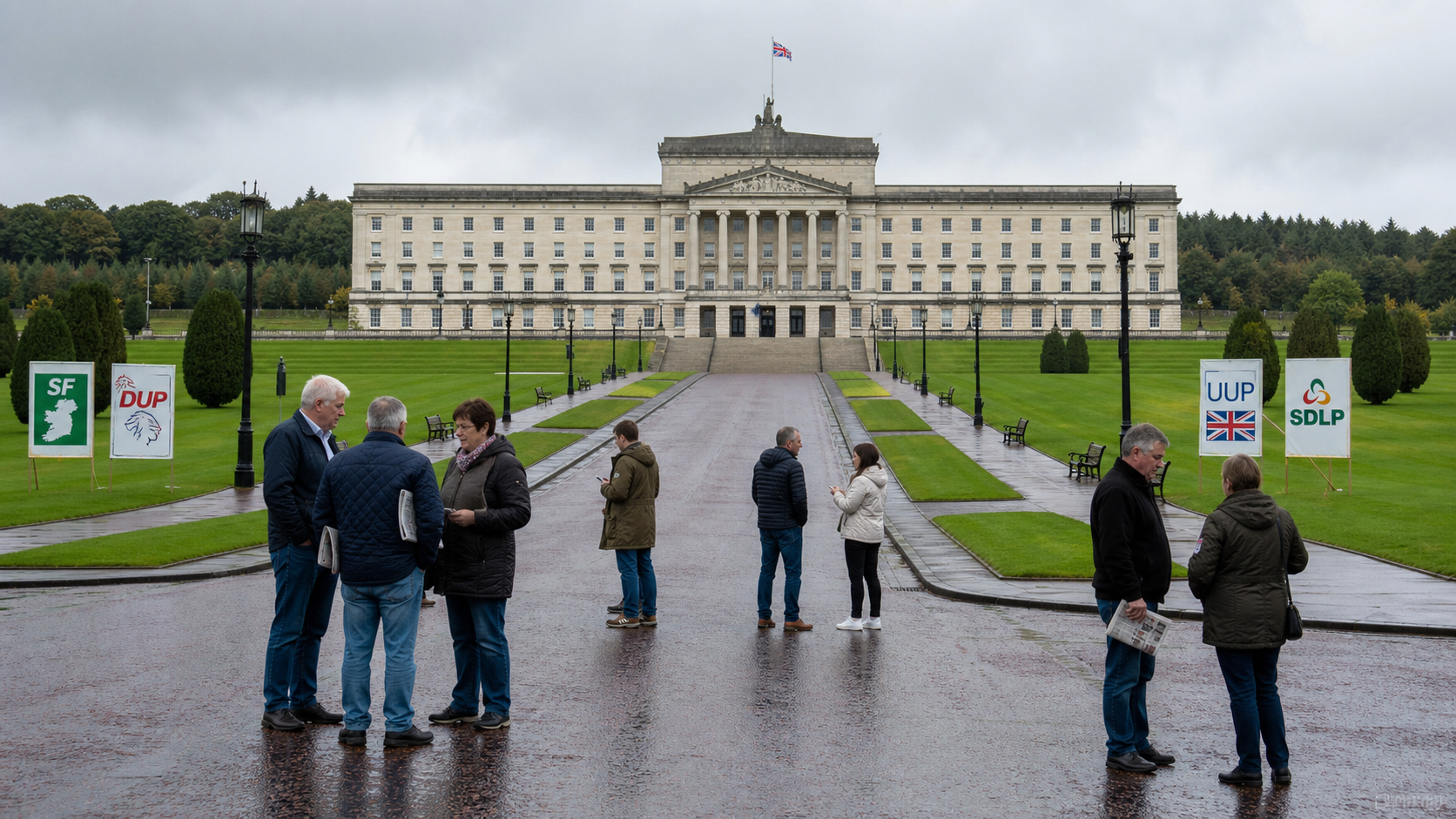
Stormont Faces Minority Government Scenario as New Poll Shows Sinn Féin and DUP at Five-Year Lows
A LucidTalk poll published in July 2026 has revealed a dramatic shift in Northern Ireland's political landscape, with Sinn Féin falling to 22%, the DUP to 15%, and the Alliance Party to 10% — all at five-year lows — while the Ulster Unionist Party has surged to 16% and the SDLP has risen to 13%, raising the prospect of a minority government scenario at Stormont that would be unprecedented in the Assembly's history and that could fundamentally reshape the dynamics of Northern Ireland politics ahead of the next election.
Background
The Northern Ireland Assembly operates under a mandatory coalition system, in which the largest party from the nationalist and unionist designations must share the First Minister and Deputy First Minister roles. This system, established under the Good Friday Agreement, was designed to ensure that neither community could dominate the executive, but it has also created a governance structure that is uniquely vulnerable to political deadlock — as demonstrated by the multiple periods of Assembly collapse over the past two decades.
The current mandate, which began following the 2022 Assembly election, has been characterised by a period of DUP-imposed collapse over the Northern Ireland Protocol, followed by a restoration of the Executive in February 2024 after the Windsor Framework negotiations. The restored Executive, led by Sinn Féin First Minister Michelle O'Neill and DUP Deputy First Minister Emma Little-Pengelly, has faced significant challenges including a severe budget shortfall, mounting public service waiting lists, and growing public frustration with the pace of delivery.
The next Assembly election must be held by May 2027. The polling trends suggest that the political landscape at that election could look very different from 2022, with the two dominant parties — Sinn Féin and the DUP — both facing significant challenges from resurgent rivals.
Key Developments
The LucidTalk poll, published in late July 2026, shows Sinn Féin at 22%, the UUP at 16%, the DUP at 15%, the SDLP at 13%, and the Alliance Party at 10%. Political analysts have noted that if these figures were replicated in an Assembly election, the resulting arithmetic could make it impossible to form a stable Executive under the current mandatory coalition rules, potentially triggering a period of political uncertainty or requiring a renegotiation of the governance arrangements.
The prospect of a minority government — a scenario unprecedented in Northern Ireland — has been raised by analysts at Slugger O'Toole and other political commentators. Such a scenario would give smaller parties, including the UUP, SDLP, and Alliance, increased leverage in opposition, as legislation would require negotiation on an individual basis rather than relying on a dominant two-party Executive. Secretary of State Sir Chris Bryant has reportedly engaged with local parties with a "checklist, not a chequebook," signalling that additional funding may be contingent on agreement to substantive institutional reforms.
Why It Matters
The polling shift reflects a broader dissatisfaction with the delivery of public services by the current Stormont Executive. Waiting lists for hospital treatment in Northern Ireland are among the longest in the United Kingdom. GP access is severely constrained. The education system is under significant financial pressure. For many voters, the question of who governs Northern Ireland matters less than whether the government can actually deliver improvements in their daily lives — and on that measure, the current Executive has struggled to make a compelling case.
The resurgence of the UUP and SDLP is particularly significant. Both parties had been in long-term decline, squeezed by the more assertive politics of the DUP and Sinn Féin respectively. Their recovery suggests that there is an appetite among Northern Ireland voters for a more moderate, service-delivery-focused politics — a message that both parties will be keen to amplify in the run-up to the next election.
Local Impact
For communities across Northern Ireland, the political uncertainty reflected in the polls translates into practical uncertainty about the future of public services. The Executive's budget negotiations with the UK government remain unresolved, with the lack of a finalised budget having tangible impacts on local community services, including summer schemes for children and youth programmes. In Belfast, Derry, and across the province's towns and rural areas, the question of whether Stormont can function effectively is not an abstract constitutional debate — it is a question about whether the health service will be adequately funded, whether schools will have the resources they need, and whether the infrastructure of daily life will be maintained.
What's Next
The next Assembly election must be held by May 2027. Party leaders are expected to begin positioning for that election in earnest in the autumn of 2026, following the summer recess. The UUP, under leader Jon Burrows, is expected to campaign heavily on public service delivery and institutional reform. Sinn Féin and the DUP will both be seeking to shore up their core vote while appealing to the middle ground that the polling suggests is increasingly up for grabs. The Secretary of State's engagement with the parties on institutional reform is expected to intensify in the coming months.