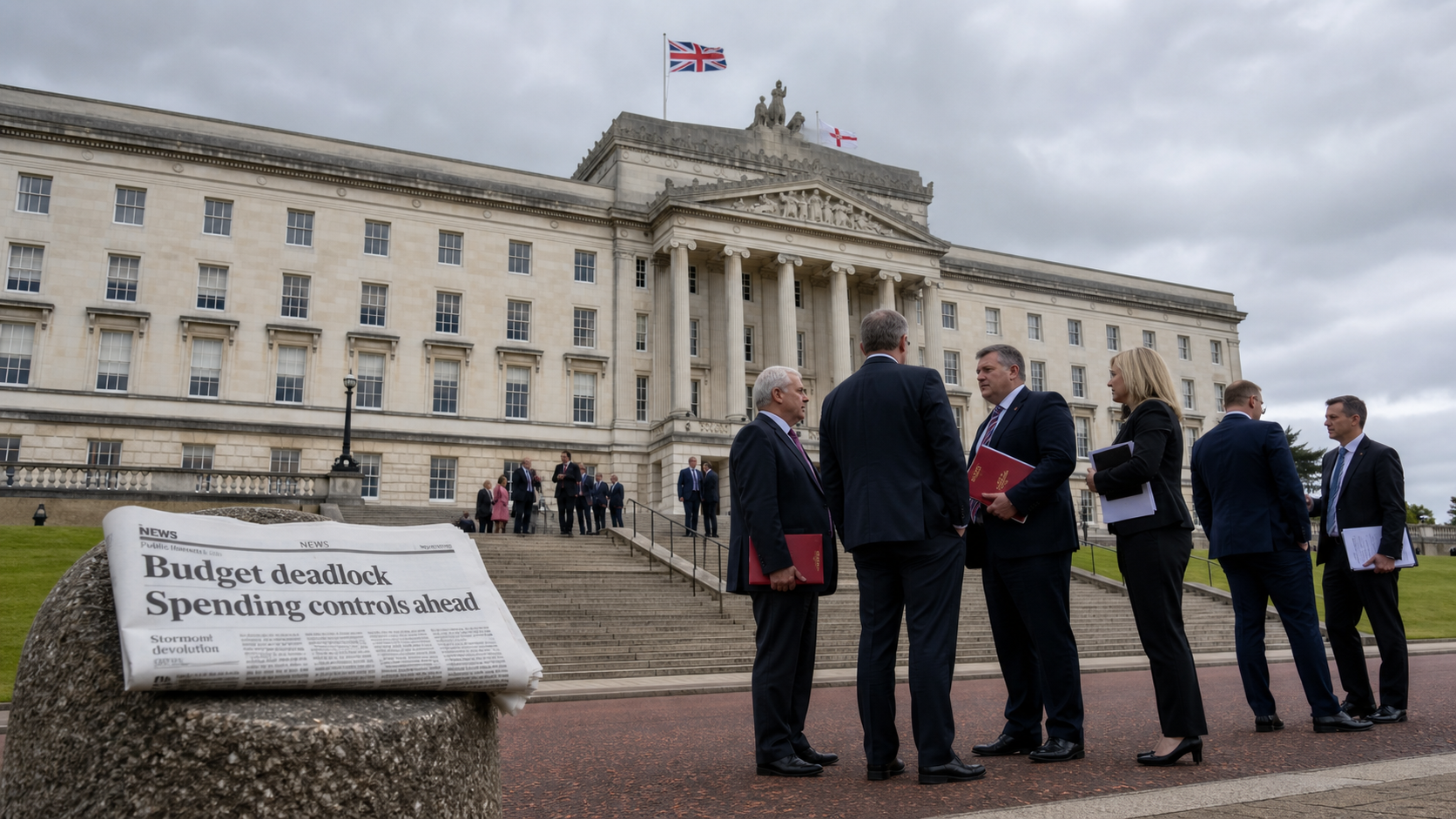
Stormont Assembly Faces Fresh Budget Crisis as Finance Minister Warns of Emergency Spending Controls
The Northern Ireland Executive faces the prospect of operating under emergency spending controls for the remainder of the financial year if a draft budget is not agreed before the Assembly returns from recess in September, with mounting pressure on the Finance Minister to bring forward a comprehensive spending plan that addresses the chronic underfunding of health, education, and infrastructure that has left public services across the six counties operating in a state of managed decline.
Background
Northern Ireland's budgetary situation has been in a state of near-permanent crisis for the better part of a decade. The combination of political instability at Stormont — which has seen the Assembly collapse and be restored multiple times since 2017 — and the structural underfunding of public services relative to need has created a situation in which departments are routinely asked to deliver more with less, and in which long-term planning is effectively impossible.
The UK Treasury provided a £400 million reserve claim in February 2026 to help the Northern Ireland Executive balance department budgets, but that funding is structured as a repayable loan rather than a grant, leading to concerns from political figures across the spectrum that it merely defers fiscal problems to future years rather than resolving the underlying structural issues. The allocation of that funding across departments has been contested, with health and education both claiming priority status.
The failure to agree a formal budget for 2026 has had cascading consequences across public services, from the summer schemes crisis affecting youth organisations in Coalisland and beyond, to delays in capital investment in roads, schools, and hospitals. The Northern Ireland Fiscal Council has repeatedly warned that the absence of multi-year budgeting is fundamentally incompatible with effective public service delivery.
Key Developments
The Finance Minister faces mounting pressure from all parties at Stormont to bring forward a draft budget before the Assembly returns from recess in September. If no budget is agreed by October, Northern Ireland faces the prospect of operating under emergency spending controls — a mechanism that limits departments to spending at the previous year's rate and prevents new commitments from being made. Emergency spending controls would effectively freeze public service delivery at current levels, preventing any new investment or service improvements for the remainder of the financial year.
The health service is particularly exposed. The five health trusts — Belfast, South Eastern, Southern, Western, and Northern — are all operating with significant deficits, and the absence of a confirmed budget makes it impossible to plan for winter pressures, which are expected to be severe given the ongoing backlog of elective procedures and the pressures on emergency departments. The Education Authority faces similar challenges, with school building programmes and special educational needs provision both dependent on capital funding that has not been confirmed.
Political parties at Stormont have been unable to agree on the priorities for the budget, with disputes over the allocation of funding between health, education, and infrastructure proving particularly intractable. The DUP and Sinn Féin, as the two largest parties in the Executive, bear the primary responsibility for reaching agreement, but both have been reluctant to make the difficult choices that a constrained budget requires.
Why It Matters
The budget crisis at Stormont is not an abstract political problem — it has direct and immediate consequences for the people of Northern Ireland. Waiting lists for elective surgery are among the longest in the United Kingdom. School buildings are in a state of disrepair. Roads and infrastructure are deteriorating. Youth services are being cut. Mental health provision is chronically underfunded. Each of these problems is made worse by the absence of a clear and agreed budget that allows departments to plan and invest with confidence. The political dysfunction that has produced this situation is a failure of governance that affects every citizen in Northern Ireland, regardless of their political affiliation or community background.
Local Impact
Across Northern Ireland, the budget impasse is felt most acutely in communities that depend most heavily on public services. In West Belfast, where the Belfast Health and Social Care Trust serves some of the most deprived communities in the United Kingdom, the absence of confirmed funding for mental health services, community health programmes, and social care is creating real hardship. In rural areas of Fermanagh, Tyrone, and Armagh, where public transport is limited and access to services depends on adequate funding for community transport schemes, the uncertainty is equally damaging. The five health trusts have all indicated that they are managing their finances on a month-by-month basis, a situation that is unsustainable and that risks compromising patient safety.
What's Next
The Assembly is due to return from recess in September, at which point the Finance Minister will be expected to present a draft budget for scrutiny by the relevant committee. If agreement cannot be reached within the Executive before that point, the Secretary of State for Northern Ireland may be required to intervene — a step that would represent a significant political embarrassment for the devolved institutions. The Northern Ireland Fiscal Council is expected to publish its assessment of the budget position in late August, providing an independent analysis of the gap between available resources and the cost of maintaining current service levels. That assessment is likely to make uncomfortable reading for all parties at Stormont.