Stormont Assembly Faces Democratic Consent Vote on Windsor Framework as New Trade Friction Emerges
The Stormont Assembly is preparing for a democratic consent vote on the continuation of the Windsor Framework's core articles at a moment when new EU General Product Safety Regulations are creating fresh and significant trade friction for businesses selling goods from Great Britain into Northern Ireland — with industry groups warning that many traders may simply stop serving the Northern Ireland market rather than navigate the new administrative requirements.
Background
The Windsor Framework, agreed between the UK government and the European Union in February 2023, was presented as a resolution to the problems created by the original Northern Ireland Protocol, which had established an effective customs and regulatory border in the Irish Sea following Brexit. The Framework sought to reduce the volume of checks on goods moving from Great Britain to Northern Ireland while maintaining Northern Ireland's alignment with the EU Single Market for goods — a status that allows it to trade freely with the Republic of Ireland and the rest of the EU.
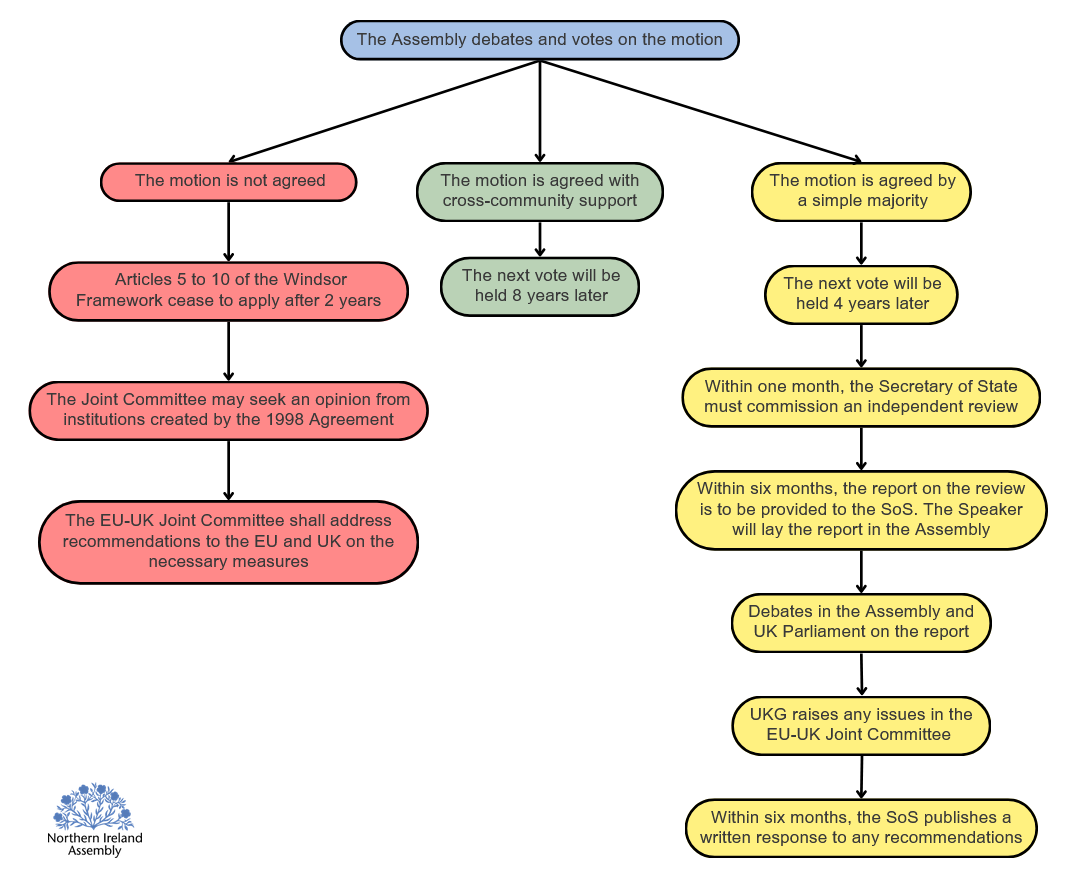
A key element of the Windsor Framework is the democratic consent mechanism, which requires the Stormont Assembly to vote periodically on whether to continue the arrangements. The first such vote is now approaching, and its outcome will determine whether the Framework's core articles remain in force. The mechanism was designed to give Northern Ireland's elected representatives a meaningful say in the post-Brexit arrangements that govern their region, but it has been criticised by unionists for requiring only a simple majority rather than the cross-community consent that is required for the most significant decisions at Stormont.
The political context for the vote is complex. The DUP, which boycotted Stormont for two years in protest at the original Protocol, has returned to the Executive but remains deeply sceptical of the Windsor Framework. The TUV, led by North Antrim MP Jim Allister, is implacably opposed to any arrangement that it believes maintains an Irish Sea border. Nationalist and Alliance parties broadly support the Framework as the best available settlement for Northern Ireland's unique post-Brexit position.
Key Developments
The immediate trigger for renewed controversy is the implementation of new EU General Product Safety Regulations (GPSR), which came into force in July 2026. Because Northern Ireland remains aligned with the EU Single Market for goods under the Windsor Framework, these regulations apply there. The GPSR requires businesses in Great Britain that sell products into Northern Ireland to appoint a "responsible person" based in either Northern Ireland or the EU — a requirement that creates a significant new administrative and cost burden, particularly for small and medium-sized enterprises.
Industry groups representing GB retailers and manufacturers have warned that many businesses will conclude that the cost and complexity of compliance is not justified by the size of the Northern Ireland market, and will simply cease selling there. This would effectively thin out the range of goods available to consumers in Northern Ireland compared to the rest of the UK — a tangible manifestation of the Irish Sea border that unionists have consistently argued the Windsor Framework failed to eliminate.
TUV leader Jim Allister has pointed to the GPSR as further evidence that his alternative proposal — a system of "mutual enforcement" in which the UK and EU would each enforce their own standards at the point of origin rather than at a geographical border — would have been a more effective solution. The UK government and nationalist parties have dismissed mutual enforcement as impractical, but the GPSR controversy has given the argument renewed currency.
Why It Matters
The Windsor Framework consent vote and the GPSR controversy matter because they go to the heart of Northern Ireland's unresolved post-Brexit constitutional and economic position. The Framework was presented as a durable settlement, but the emergence of new trade friction with each successive tranche of EU regulatory implementation suggests that the underlying tension between Northern Ireland's dual alignment — with both the UK internal market and the EU Single Market — has not been resolved, merely managed.
For businesses in Northern Ireland, the practical consequences are real and growing. The GPSR is not the first EU regulation to create friction since the Windsor Framework came into force, and it will not be the last. Each new regulation that applies in Northern Ireland but not in Great Britain adds to the administrative divergence between the two parts of the UK, reinforcing the sense among unionists that the Irish Sea border is a permanent and deepening reality rather than a temporary inconvenience.
Local Impact
For consumers and businesses in Northern Ireland, the GPSR creates immediate practical challenges. Retailers in Belfast, Derry/Londonderry, Newry, and Antrim who source products from GB suppliers may find their supply chains disrupted if those suppliers decide that Northern Ireland compliance is not worth the effort. The impact is likely to be felt most acutely in specialist retail sectors where the Northern Ireland market is served by a small number of GB-based suppliers. The Stormont Executive's Department for the Economy has indicated it is monitoring the situation and will provide guidance to affected businesses, but has stopped short of committing to any specific mitigation measures ahead of the consent vote.
What's Next
The Stormont Assembly democratic consent vote on the Windsor Framework is expected to take place before the end of July 2026. The outcome is widely expected to be a simple majority in favour of continuation, given the arithmetic of the Assembly, but the debate surrounding the vote will provide a significant platform for unionist opposition to the Framework. The UK government has indicated it will continue to engage with the EU on the implementation of the Framework, including on the specific issues raised by the GPSR. A further review of the Framework's operation is scheduled for 2027.