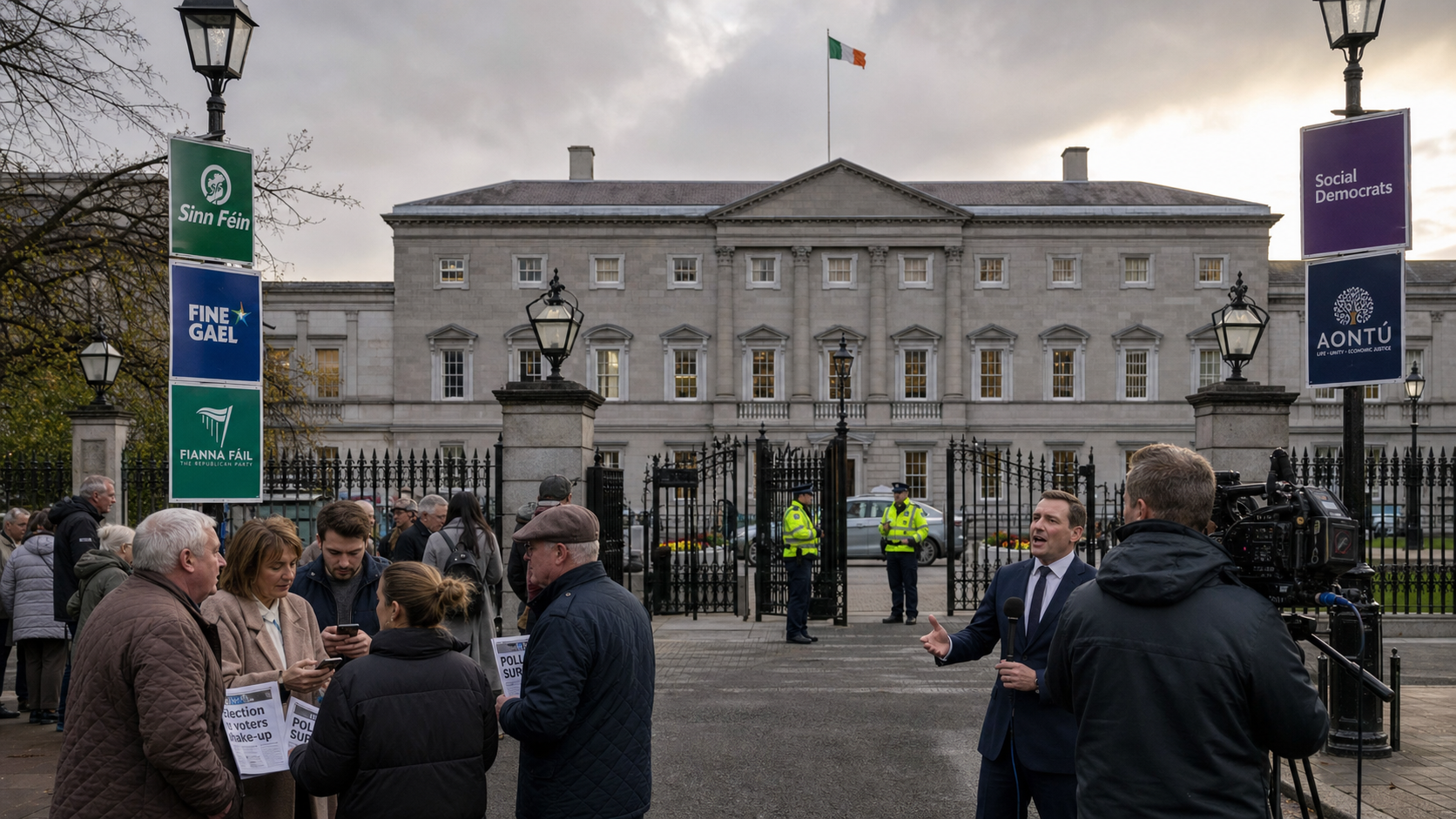
Sinn Féin and Fine Gael Level at 20% as Fianna Fáil Slumps to Two-Year Low in New Poll
Sinn Féin and Fine Gael are tied at 20% support each in the latest Sunday Independent/Ireland Thinks opinion poll, while Fianna Fáil has fallen to 16% — its lowest level in two years — in a set of figures that will cause significant concern within the junior coalition partner and raise questions about the durability of the current government's political standing heading into the autumn.
Background
The current coalition government, formed after the November 2025 general election, comprises Fine Gael, Fianna Fáil, and the Green Party, with Micheál Martin serving as Taoiseach and Simon Harris as Tánaiste. The government came to power on a platform that emphasised economic stability, housing delivery, and Ireland's role in the European Union, and has been managing a busy legislative agenda alongside the demands of the EU presidency that Ireland assumed in July 2026.
Opinion polling in Ireland has been volatile since the 2020 general election, when Sinn Féin's surge to first place in the popular vote transformed the political landscape. The party has remained a significant force in the polls since then, though its support has fluctuated as the novelty of its breakthrough has worn off and as it has faced scrutiny of its policy positions and its record in government in Northern Ireland.
Fine Gael's recovery from the lows of the 2020 election has been one of the more notable features of the polling landscape in recent years, driven in part by the personal popularity of Taoiseach Martin and in part by the perception that the party has managed the economy competently. Fianna Fáil, by contrast, has struggled to establish a distinctive identity within the coalition, and its polling numbers have reflected that difficulty.
Key Developments
The Ireland Thinks poll, conducted for the Sunday Independent, found Sinn Féin at 20% — up one percentage point from the previous survey — and Fine Gael also at 20%, unchanged from the previous poll. Fianna Fáil fell one point to 16%, its lowest level since May 2024. The Social Democrats dropped two points to 10%, while Aontú rose one point to 7% and Independent Ireland remained unchanged at 7%.
The figures represent a continuation of a trend that has seen Fine Gael gradually close the gap on Sinn Féin since the spring of 2026, when the party stood at 17% compared to Sinn Féin's 19%. The convergence of the two parties at 20% is a significant moment, suggesting that the political landscape is more competitive than it has been at any point since the 2025 election.
For Fianna Fáil, the fall to 16% is a cause for genuine concern. The party's strategists will be aware that its current polling level is below the vote share it achieved in the 2025 election, and that the gap between it and its coalition partner Fine Gael — now four percentage points — is wider than at any point in recent memory. The question of whether Fianna Fáil can recover its position before the next election, which is not due until 2030, will be a central preoccupation for the party's leadership in the months ahead.
Why It Matters
The polling figures matter not just as a snapshot of current political opinion but as an indicator of the underlying dynamics that will shape Irish politics over the next several years. The convergence of Sinn Féin and Fine Gael at 20% suggests that the two parties are competing for a similar pool of voters — broadly, those who are dissatisfied with the status quo but who are not committed to either the traditional centre-right or the republican left. How that competition plays out will be a defining feature of Irish politics in the run-up to the next election.
Fianna Fáil's difficulties are partly structural — the party occupies a centre-right space that is increasingly crowded — and partly a reflection of the specific challenges of being the junior partner in a coalition led by a more popular party. The experience of the Green Party in the 2020-2025 government, which saw its support collapse during its time in office, is a cautionary tale that Fianna Fáil's strategists will be acutely aware of.
The rise of Aontú to 7% is also worth noting. The party, which was founded in 2019 by former Sinn Féin TD Peadar Tóibín, has been steadily building its support base, particularly among socially conservative voters who are uncomfortable with Sinn Féin's positions on issues such as abortion. Its continued growth represents a potential threat to Sinn Féin's left flank in certain constituencies.
Local Impact
The polling figures will be closely watched by TDs and senators across all parties as they assess their own electoral prospects. For Fianna Fáil backbenchers in particular, the fall to 16% will prompt difficult conversations about the party's strategy and messaging. The party's performance in the local elections of 2024 — where it held its ground better than the national polls suggested — provides some comfort, but the trend in the national figures is not one that can be ignored.
What's Next
The next major test of the parties' relative strengths will come in the form of any by-elections that arise during the current Dáil term, which is not due to end until 2030. The government's performance on key issues — housing, health, and the cost of living — will be the primary determinant of how the polling figures evolve over the coming months. The autumn budget, expected in October, will be a particularly significant moment, with all parties positioning themselves to maximise their political advantage from the fiscal decisions that are made.