Sinn Féin Stormont Reform Proposals Spark Assembly Debate as DUP Demands 'Reform of the Heart'
Sinn Féin's proposals for reforming the Stormont Assembly and Executive — published on 1 June and now the subject of live debate in the Assembly chamber — would end executive vetoes, change the Speaker election rules, and appoint the Justice Minister through the D'Hondt system, but have been rejected by DUP leader Gavin Robinson, who has called instead for 'reform of the heart' rather than structural change to the institutions.
Background
The question of how to reform Northern Ireland's power-sharing institutions has been a recurring feature of political life since the Good Friday Agreement was signed in 1998. The Assembly and Executive operate on a consociational model — one designed to ensure that both unionist and nationalist communities have a share of power — but the mechanisms that make this possible have also, on several occasions, been used to collapse the institutions entirely. The DUP's boycott of the Assembly from February 2022 to February 2024, which left Northern Ireland without a functioning government for two years, is the most recent and most damaging example.
Sinn Féin's reform proposals, published on 1 June 2026, represent the party's most comprehensive attempt yet to address the structural vulnerabilities that have allowed the institutions to be brought down by a single party's withdrawal. The proposals draw on the experience of the 2022-2024 collapse and on the recommendations of various academic and civil society bodies that have examined the functioning of the Agreement's institutions.
The timing of the proposals — with the next Assembly election required by 6 May 2027 — is not coincidental. Sinn Féin is seeking to shape the political agenda in the run-up to an election in which it is expected to remain the largest party, and the reform proposals serve both a substantive purpose (addressing genuine institutional weaknesses) and a political one (positioning the party as the driver of progress).
Key Developments
The core of Sinn Féin's proposals is a set of changes designed to prevent any single party from collapsing the institutions. The most significant proposal would end the executive veto mechanism, under which the largest unionist or nationalist party can block the nomination of a First or Deputy First Minister, effectively bringing down the Executive. Under Sinn Féin's proposal, if the largest party in either designation refuses to nominate, the nomination would pass to the next party in that designation.
A second key proposal would change the rules for electing the Assembly Speaker, removing the cross-community veto that the DUP used in 2022 to prevent the Assembly from functioning. Sinn Féin also proposes that the Justice Minister be appointed through the D'Hondt system — the proportional mechanism used to allocate ministerial portfolios — rather than through the current cross-community vote, which has historically been a source of contention.
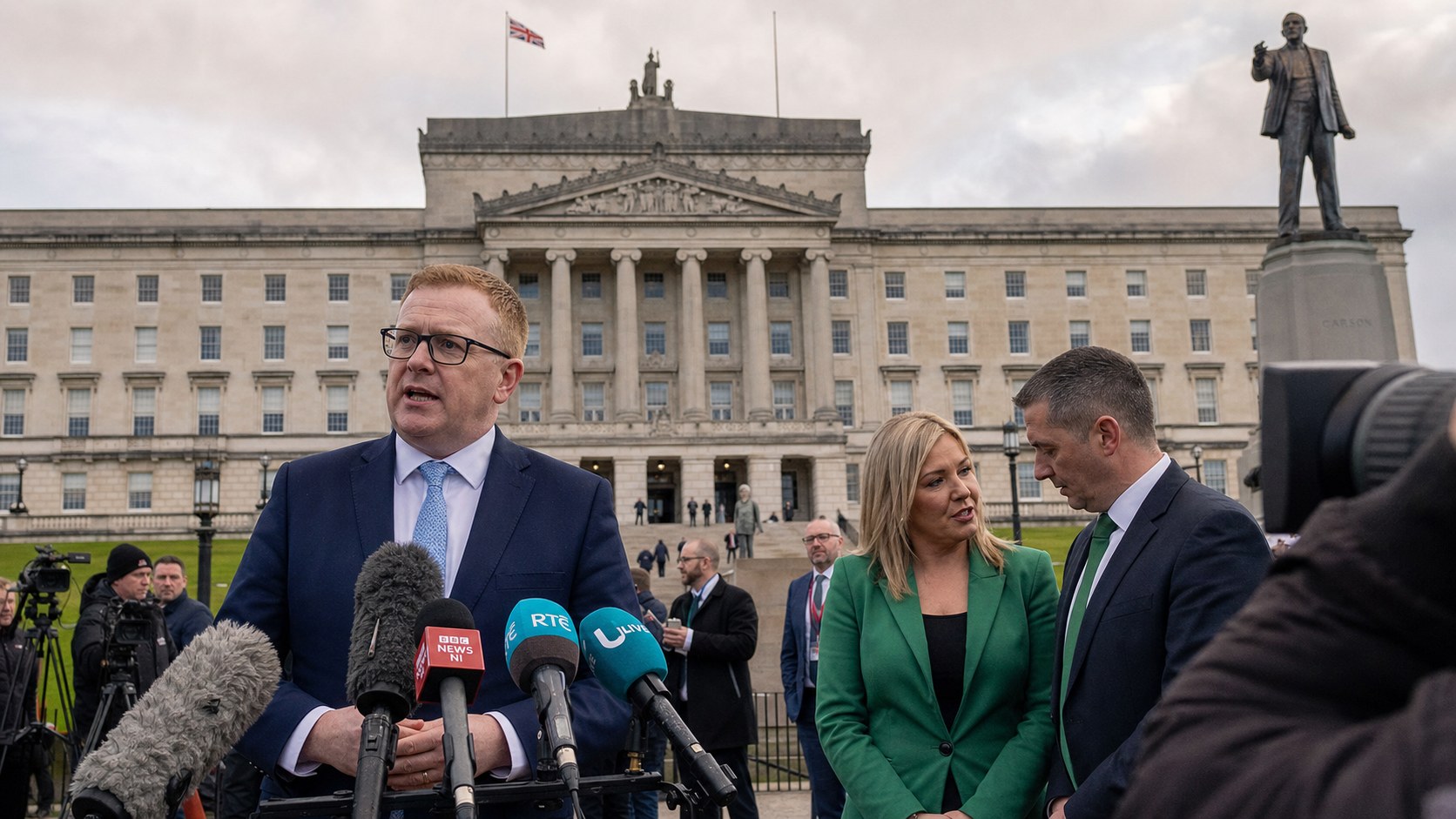
DUP leader Gavin Robinson has rejected the proposals, arguing that the problem with Stormont is not structural but cultural. His call for "reform of the heart" reflects the DUP's longstanding position that the institutions can only function if there is genuine goodwill between the parties, and that structural changes cannot substitute for that goodwill. DUP Education Minister Paul Givan has accused Sinn Féin of using the reform proposals to "block" legislation that the DUP supports.
SDLP leader Claire Hanna has taken a different approach, calling for a formal UK-Irish negotiation process to examine the reform proposals. This reflects the SDLP's traditional emphasis on the intergovernmental dimension of the Good Friday Agreement and its view that changes to the institutions should be agreed between the two governments rather than imposed by one party.
Why It Matters
The debate over Stormont reform is not merely academic. Northern Ireland has now experienced two prolonged periods without a functioning Executive in the past decade — the 2017-2020 collapse and the 2022-2024 boycott — and the cumulative damage to public services, infrastructure investment, and political trust has been severe. The five Health and Social Care Trust chairs' warning this week about "catastrophic" budget cuts is a direct consequence of the institutional dysfunction that has characterised Stormont's recent history.
The reform debate also has implications for the relationship between Northern Ireland and the two governments. The Irish government, as a co-guarantor of the Good Friday Agreement, has a direct interest in the stability of the institutions, and Taoiseach Micheál Martin has indicated that Dublin is watching the reform debate closely. The British government, for its part, has been reluctant to intervene in what it regards as a matter for the parties at Stormont, but the 2022-2024 collapse demonstrated that this hands-off approach has limits.
Local Impact
For communities across Northern Ireland, the reform debate is a reminder of the fragility of the institutions that govern their daily lives. In Belfast, Derry, Newry, and the rural areas of Tyrone, Fermanagh, and Armagh, the consequences of institutional collapse are felt in delayed planning decisions, underfunded public services, and a political vacuum that allows problems to fester. The current budget crisis — with the Trust chairs warning of potential hospital bed closures and reduced domiciliary care — is a direct product of the dysfunction that Sinn Féin's proposals are designed to address.
What's Next
The Assembly debate on Sinn Féin's reform proposals is expected to continue over the coming weeks, with a formal vote on whether to establish a committee to examine the proposals likely before the summer recess. The British and Irish governments are expected to hold bilateral discussions on the reform agenda in the margins of the next British-Irish Intergovernmental Conference, scheduled for later in the summer. The next Assembly election must take place by 6 May 2027, and the reform debate is expected to be a significant feature of the campaign.