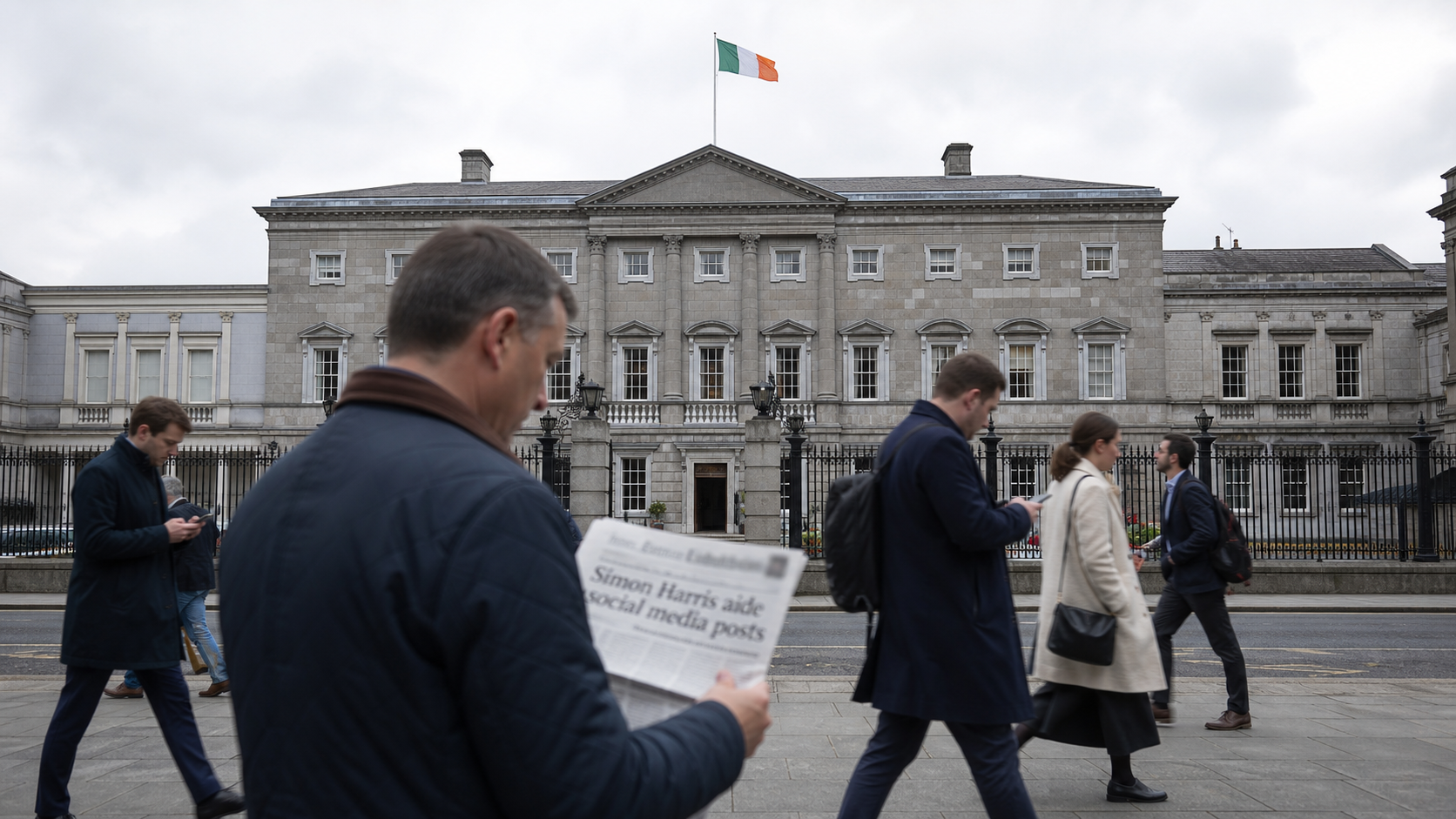
Simon Harris Aide Mocked Teachers as 'Work-Shy' and Public as 'Racist' in Social Media Posts
A constituency aide to Taoiseach Simon Harris has been revealed to have posted social media content mocking teachers as "work-shy" and describing the public as "racist" — a disclosure that has placed the Taoiseach in an uncomfortable political position and reignited debate about the standards expected of those who work in close proximity to senior government figures.
Background
The relationship between politicians and their staff has always been a sensitive one. Constituency aides, special advisers, and parliamentary assistants operate in a grey zone — they are not elected, they are not civil servants, and they are not subject to the same codes of conduct that govern either category. They are, in effect, political appointees whose primary loyalty is to the politician who employs them, and whose conduct reflects, for better or worse, on that politician's judgement and values.
Simon Harris has been Taoiseach since early 2024, having succeeded Leo Varadkar in the Fine Gael leadership. His tenure has been marked by a series of political controversies, including the fallout from the M9 motorway crash and the ongoing debate about the government's response to the housing crisis. He has cultivated a public image as an accessible, media-savvy politician who is comfortable with social media and direct communication — an image that makes the revelation about his aide's online conduct particularly awkward.
The aide in question, identified in The Irish Times report as John Kelly, is a constituency aide rather than a special adviser — a distinction that matters in terms of the formal accountability structures that apply to his role. Constituency aides are employed to support the political work of their TD or minister in their local constituency, and they are paid from public funds. Their conduct is therefore a matter of legitimate public interest.
Key Developments
The Irish Times reported on Thursday that Kelly had used social media to mock teachers as "work-shy" — a characterisation that echoes the controversy generated by Ryanair CEO Michael O'Leary's comments about teachers at a Fine Gael event in 2024, which Harris himself described as "crass and ill-informed." The report also revealed that Kelly had described the public as "racist" and had referred to Donald Trump as a "moron" and Prince Harry as a "snowflake" in his online posts.
The disclosure has prompted immediate calls from opposition parties for Kelly's dismissal. Labour leader Ivana Bacik described the posts as "deeply disrespectful" to teachers and to the public, and called on Harris to take immediate action. Sinn Féin's Mary Lou McDonald said the episode raised questions about the judgement of those around the Taoiseach. Social Democrats co-leader Holly Cairns described the posts as "embarrassing" for the government.
Harris's office has not yet issued a formal statement on the matter, though sources close to the Taoiseach indicated that he was "not happy" with the posts and that the situation was being reviewed. The Irish National Teachers' Organisation and the Teachers' Union of Ireland both issued statements expressing disappointment and calling for an apology.
Why It Matters
The episode matters for several reasons. First, it is a reminder that the social media footprints of political staff are a legitimate area of public scrutiny. In an era when politicians are held accountable for their online conduct, it is reasonable to expect that those who work for them are held to similar standards. The posts attributed to Kelly are not merely embarrassing; they reflect a contempt for teachers and for the public that is incompatible with the role of someone employed to serve a senior government figure.
Second, the timing is particularly unfortunate for Harris. The government is currently engaged in sensitive negotiations with teacher unions over pay and conditions, and the revelation that a member of the Taoiseach's staff holds teachers in contempt will not help those negotiations. The INTO and TUI have both been vocal in their criticism, and the episode risks hardening attitudes at a moment when the government needs goodwill from the teaching profession.
Third, the episode raises questions about the vetting and oversight of political staff. There is no formal requirement for constituency aides to undergo social media audits before appointment, and the informal networks through which such appointments are typically made do not always surface the kind of information that would flag potential problems. The Kelly case may prompt a review of those processes.
Local Impact
In Harris's Wicklow constituency, the revelation has generated local media coverage and some discomfort among Fine Gael supporters who are proud of their TD's national profile. Teachers in the constituency — a significant professional group in any Irish community — have been particularly vocal in their criticism, with several posting on social media to express their disappointment.
More broadly, the episode is a reminder that the conduct of political staff has real consequences for the politicians they serve. Harris has built his political brand on a reputation for accessibility and directness; the revelation that someone in his employ holds the public in contempt undermines that brand in ways that are difficult to repair quickly.
What's Next
Harris is expected to address the matter publicly on Thursday, either through a formal statement or at a press conference. The key question is whether Kelly will be dismissed or whether Harris will opt for a lesser sanction — an apology, a period of suspension, or a commitment to review the aide's social media conduct. Opposition parties have made clear that they will not be satisfied with anything short of dismissal, and the political pressure on Harris to act decisively is considerable. The INTO and TUI have indicated they will seek a meeting with the Taoiseach to discuss the matter directly.