School Device Costs Leave Parents Feeling 'Press-Ganged' as Education Department Launches Review
Parents across Ireland are expressing growing frustration at the cost of school-mandated digital devices, with many describing themselves as feeling "press-ganged" into purchasing expensive tablets and laptops they cannot afford, as the Department of Education launches a review of back-to-school costs after the Minister raised concerns directly with schools about the practice of specifying particular devices without adequate consideration of affordability.
Background
The integration of digital technology into Irish classrooms has accelerated significantly over the past five years, driven by the pandemic-era shift to remote learning and by a broader government commitment to digital education that has seen substantial investment in school broadband, interactive whiteboards, and teacher training. The benefits of this investment are real — students who have access to quality digital tools are better prepared for a workforce that is increasingly technology-dependent — but the costs have not been distributed equitably.
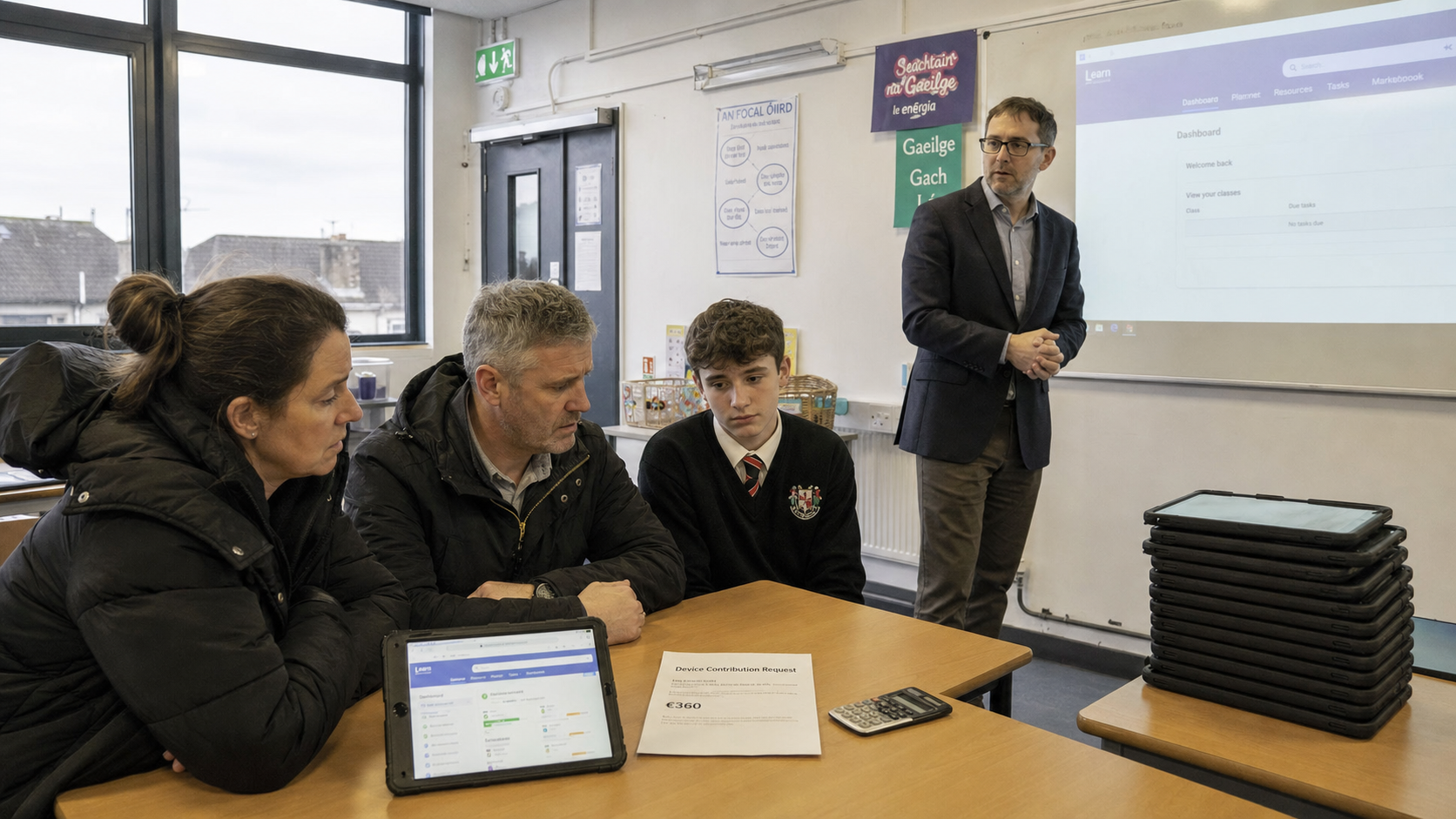
The problem is straightforward: many schools, in specifying the digital devices that students are required to bring to class, are effectively mandating purchases that can cost between €300 and €800 per device, without adequate consideration of the financial circumstances of the families they serve. In some cases, schools have specified particular brands or models — Apple iPads and MacBooks are frequently cited — that are significantly more expensive than functionally equivalent alternatives. Parents who cannot afford the specified device are left in an impossible position: purchase something they cannot afford, or send their child to school without the tools they need to participate fully in class.
The issue has been building for several years, but it has come to a head in the 2026 back-to-school season, when a combination of rising device prices, the end of pandemic-era government supports, and the general cost-of-living squeeze has made the financial burden particularly acute for many families.
Key Developments
The Department of Education has confirmed that it has launched a review of back-to-school costs, with a particular focus on the practice of schools specifying particular digital devices. The Minister raised concerns directly with school principals and boards of management in recent weeks, and the department has written to all schools reminding them of their obligations under the free education scheme and the requirement to consider the financial circumstances of all families when making decisions about school costs.
The review is expected to produce recommendations before the end of the year, with a view to introducing new guidelines for the 2027/28 school year. Options under consideration include a requirement for schools to offer a range of device options at different price points, a national device procurement scheme that would allow schools to purchase devices in bulk at reduced cost, and an expansion of the existing school book rental scheme to cover digital devices.
Parents who spoke to the Irish Times described their frustration in vivid terms. "We were told our child needed a specific iPad model," said one parent from County Kildare. "When I asked if a cheaper tablet would do, I was told it wouldn't be compatible with the school's systems. I felt completely press-ganged into something I couldn't afford and didn't want."
Why It Matters
The school device issue is a microcosm of a broader challenge facing Irish education: how to ensure that the benefits of digital technology are accessible to all students, regardless of their family's financial circumstances. Ireland has made significant progress in reducing educational disadvantage over the past two decades, but the rapid digitalisation of the classroom risks creating a new form of inequality — a "digital divide" within schools that mirrors the broader socio-economic divide in Irish society.
The cost-of-living context is also important. Irish families are already under significant financial pressure from rising housing costs, energy bills, and food prices, and the addition of a €500 device purchase to the back-to-school bill is a serious burden for many. The government's decision to review the situation is welcome, but parents and advocacy groups are calling for action rather than review, arguing that the problem is well understood and that what is needed is a clear policy response.
Local Impact
The issue is felt most acutely in schools serving disadvantaged communities, where the proportion of families who cannot afford the specified devices is highest. DEIS schools — those designated as serving areas of educational disadvantage — have access to additional funding that can be used to support families with school costs, but the amounts available are insufficient to cover the full cost of digital devices for all students who need support. In Dublin's north inner city, Cork's northside, and Limerick's regeneration areas, school principals have described the device cost issue as one of the most significant barriers to educational participation they currently face.
What's Next
The Department of Education's review is expected to be completed by November 2026, with recommendations published before the end of the year. The Minister has indicated that she is open to legislative action if the review finds that voluntary guidelines are insufficient to address the problem. Parent advocacy groups have called for the review to include direct consultation with families, and have warned that any solution that does not address the fundamental affordability issue will be inadequate.