Rotunda Hospital Agrees to Align with Public-Only Consultant Contracts After Government Standoff
The Rotunda Hospital in Dublin has agreed to align with the government's public-only consultant contract policy, ending a prolonged standoff that had become one of the most significant tests of the government's resolve to implement Sláintecare reforms — a resolution that came only after the government applied significant pressure, including reported threats to withhold state funding from one of Ireland's most historic maternity hospitals.
Background
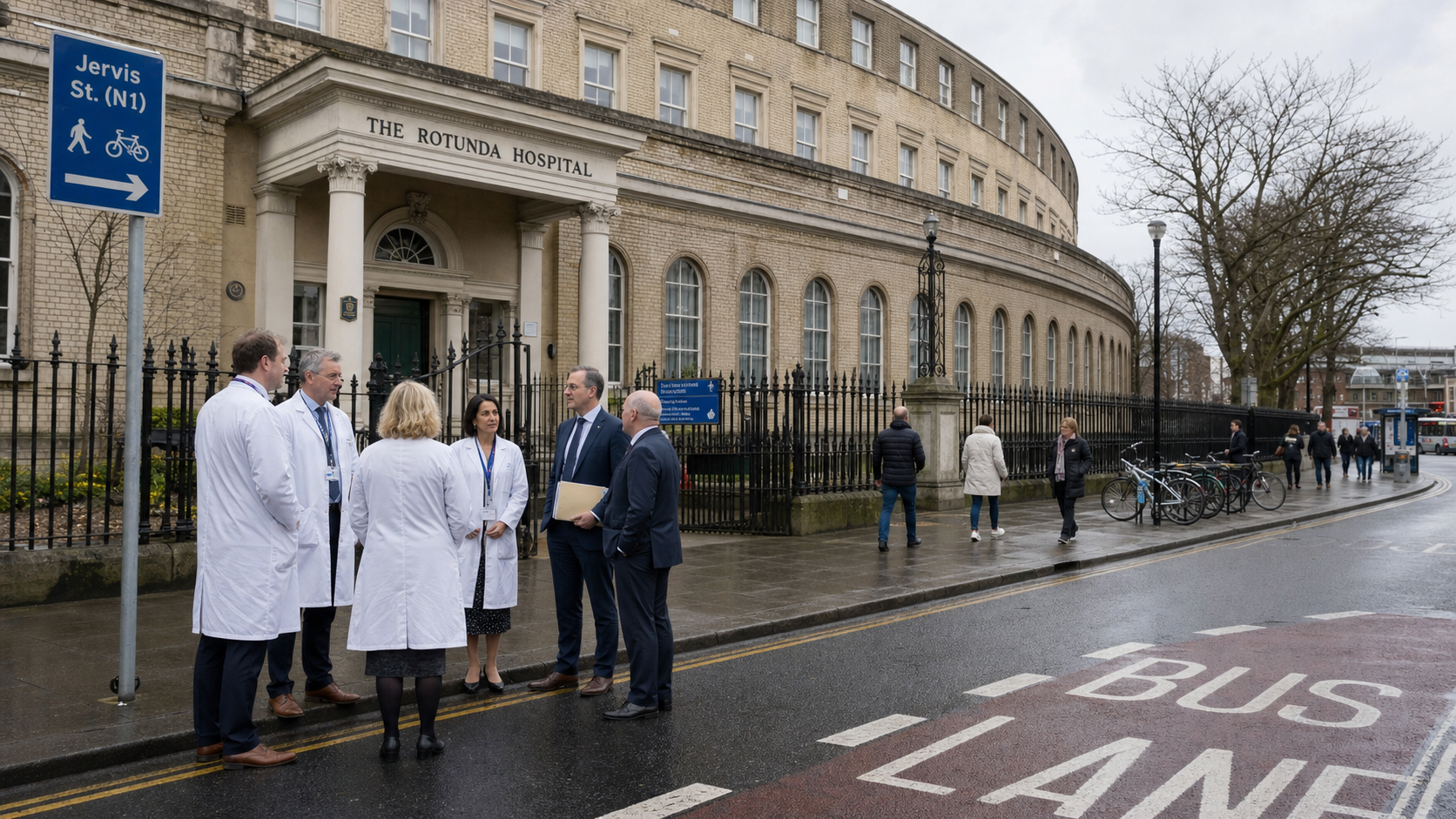
The Rotunda Hospital, founded in 1745, is the oldest continuously operating maternity hospital in the world and one of the most significant institutions in Irish healthcare. Located on Parnell Square in Dublin city centre, it delivers approximately 8,000 babies per year and provides a full range of maternity, gynaecological, and neonatal services. Its consultants are among the most experienced and respected in their fields, and the hospital has a long tradition of clinical excellence and medical education.
The introduction of the new public-only consultant contract in 2023 created a significant challenge for the Rotunda, as it did for other voluntary hospitals that had operated under a model in which consultants combined public and private practice. The hospital's board had been resistant to the full implementation of the public-only contract, arguing that the transition needed to be managed carefully to avoid disrupting services and to protect the hospital's ability to attract and retain the best consultants.
The government's position was that the public-only contract was non-negotiable — that all consultants in publicly funded hospitals must commit to working exclusively in the public system, and that hospitals that failed to implement this requirement would face consequences. The standoff between the Rotunda board and the government had been one of the most visible flashpoints in the broader debate about Sláintecare implementation.
Key Developments
The Rotunda Hospital board has now agreed to align with the government's public-only contract policy, ending the standoff. The resolution came after the government applied significant pressure, including reported threats to withhold state funding — a step that would have had serious consequences for a hospital that is almost entirely dependent on public funding for its operations.
The agreement means that all new consultant appointments at the Rotunda will be on public-only contracts, and that existing consultants on older contracts will be encouraged to transition to the new model. The hospital has indicated that it will work with the HSE and the Department of Health to manage the transition in a way that minimises disruption to services.
Health Minister Jennifer Carroll MacNeill, who has been one of the most assertive advocates for the public-only contract policy, welcomed the Rotunda's decision while also issuing a broader warning about hospital finances. The minister stated that recent large increases in hospital budgets are "not fiscally sustainable," citing over-recruitment of staff as a key driver of financial pressures. The comments signal a tougher stance on health spending and financial oversight in the period ahead.
Why It Matters
The Rotunda's agreement to align with the public-only contract policy matters because it removes one of the most significant obstacles to the implementation of Sláintecare's core principle — that access to healthcare should be based on need rather than ability to pay. The Rotunda is one of the most high-profile voluntary hospitals in Ireland, and its compliance with the new contract model sends a signal to other hospitals that the government's position is firm.
The minister's warning about fiscal sustainability is also significant. The health budget has been growing rapidly in recent years, driven by a combination of demographic pressures, the costs of Sláintecare implementation, and the legacy of the Covid-19 pandemic. The suggestion that over-recruitment has been a factor in driving costs upward will be closely watched by hospital managers and by the HSE, which has been under pressure to demonstrate that it can manage its resources effectively.
For patients at the Rotunda — the women and families who depend on the hospital for maternity care — the resolution of the standoff provides reassurance that the hospital's services will continue without disruption. The uncertainty created by the dispute had been a source of concern for some patients, and its resolution is welcome.
Local Impact
The Rotunda serves patients from across Dublin and from a wide catchment area that extends into the surrounding counties. Its location on Parnell Square, in the heart of the city, makes it accessible by public transport from across the greater Dublin area, and it serves a diverse patient population that includes women from all socioeconomic backgrounds. The implementation of the public-only contract model will, over time, mean that all patients at the Rotunda receive the same standard of care regardless of their ability to pay — a change that is consistent with the Sláintecare vision.
For the hospital's staff — consultants, midwives, nurses, and support workers — the resolution of the standoff provides a degree of certainty about the future direction of the institution. The transition to the public-only model will require adjustments, but the hospital's management has indicated that it is committed to managing the process in a way that supports staff and maintains the quality of care.
What's Next
The Rotunda will publish an implementation plan for the transition to the public-only contract model in the coming months, setting out the timeline and the specific measures that will be taken to manage the process. The Department of Health will monitor the implementation closely and has indicated that it will provide support to the hospital as needed. The minister's warning about fiscal sustainability suggests that a broader review of hospital budgets and staffing levels is likely in the autumn, with the Rotunda's experience likely to be a reference point in that process.