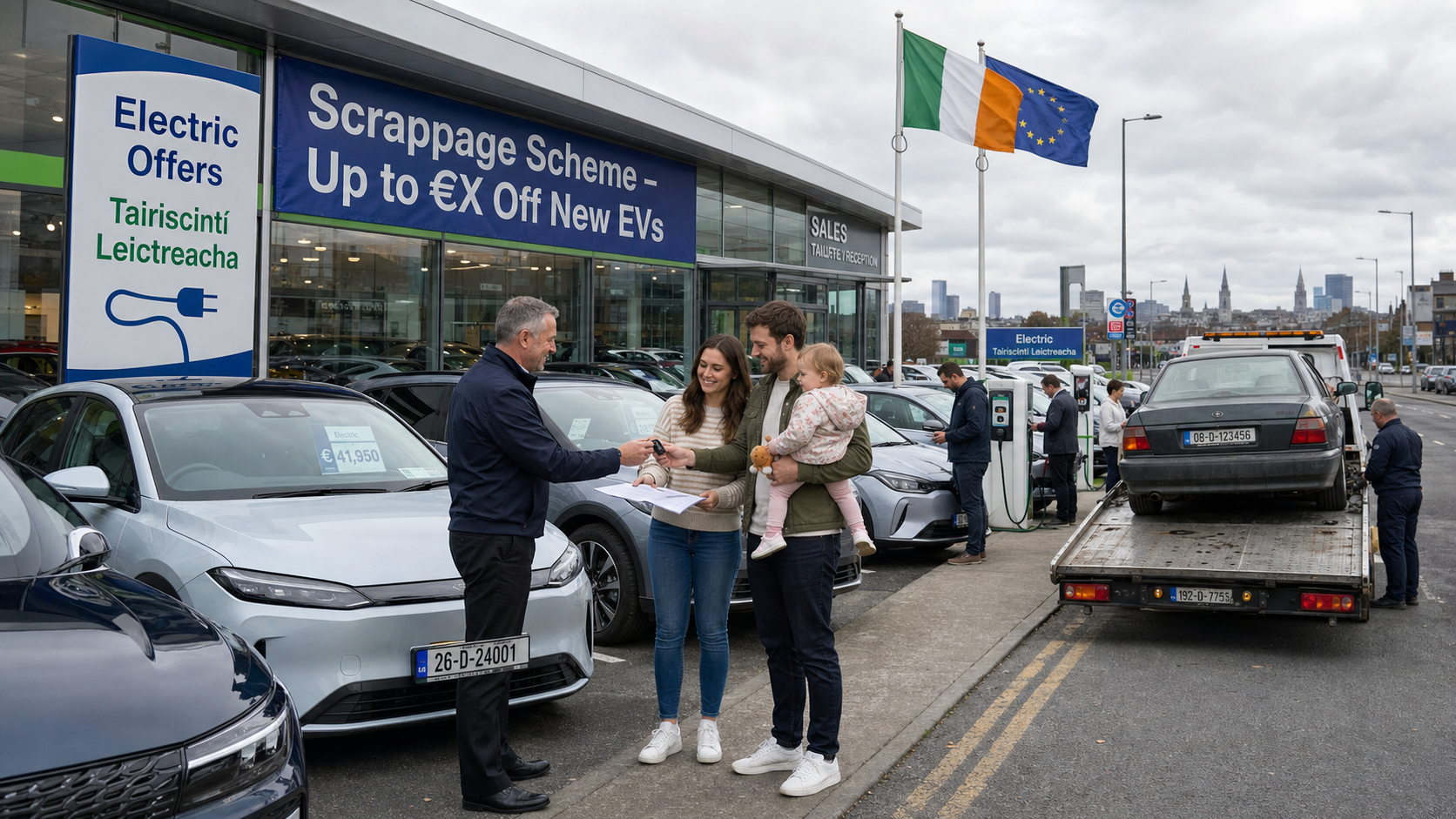
Record EV Sales Drive Irish Car Market Transformation as Scrappage Scheme Accelerates Uptake
Ireland's new car market has undergone a historic transformation in July 2026, with battery electric vehicles accounting for 26 per cent of new registrations — the first time EVs have topped the market — as the government's pilot scrappage scheme and existing grant incentives combine to drive a 98 per cent year-on-year surge in BEV sales that the Society of the Irish Motor Industry says marks a genuine tipping point in the country's transition to electric transport.
Background
Ireland's transition to electric vehicles has been one of the more closely watched aspects of the country's broader climate action agenda. The government's Climate Action Plan set an ambitious target of one million electric vehicles on Irish roads by 2030 — a goal that, until recently, appeared challenging given the relatively slow pace of uptake in the early years of the decade. The July 2026 figures suggest that the transition is now accelerating significantly, driven by a combination of government incentives, falling vehicle prices, and improving charging infrastructure.
The Irish motor market has historically been dominated by petrol and diesel vehicles, with the shift to electrification proceeding more slowly than in some comparable European countries. Norway achieved its first month of majority EV sales in 2019 — Ireland is following a similar trajectory, albeit several years later. The July 2026 figures represent a genuine inflection point, suggesting that the tipping point for mass EV adoption in Ireland may be closer than previously anticipated.
The government's pilot scrappage scheme, introduced in July 2026, has been identified by the Society of the Irish Motor Industry as a significant driver of the surge in sales. The scheme provides financial incentives for motorists to trade in older, higher-emission vehicles for new electric cars, reducing the upfront cost barrier that has been one of the primary obstacles to EV adoption among middle-income households.
Key Developments
The 9,682 BEVs registered in July 2026 represent the highest monthly sales ever recorded for the segment in Ireland — a 98 per cent increase on July 2025. Year-to-date, total BEV registrations for the first seven months of 2026 reached 29,840, a 61 per cent increase over the same period in 2025. The overall new car market also performed strongly, with 29,046 new cars registered in July, an increase of 8.63 per cent on July 2025.
The top-selling EV brands in 2026 have been Volkswagen, Kia, Hyundai, Skoda, and Tesla, with the Volkswagen ID.4 identified as the top-selling individual model for July. Crucially, the data indicates that EV adoption has expanded beyond urban centres, with growth recorded in every county across Ireland — a significant development that suggests the charging infrastructure concerns that previously deterred rural motorists are beginning to be addressed.
The SIMI has noted that the growth in EV sales is being driven not just by the scrappage scheme but by a broader shift in consumer attitudes, with increasing numbers of motorists citing environmental concerns and lower running costs as primary motivations for choosing electric vehicles. The total cost of ownership argument for EVs — which takes into account lower fuel and maintenance costs over the lifetime of the vehicle — is becoming increasingly compelling as electricity prices stabilise and petrol prices remain elevated.
Why It Matters
The milestone of EVs topping the Irish car market is significant for several reasons. It demonstrates that the government's policy mix — grants, scrappage schemes, and investment in charging infrastructure — is beginning to produce results at scale. It also suggests that the economic case for electric vehicles is becoming compelling enough to drive adoption without the need for the kind of regulatory mandates that some other countries have introduced.
Transport is one of Ireland's largest sources of greenhouse gas emissions, and the electrification of the car fleet is a critical component of the country's pathway to its 2030 climate targets. The July figures suggest that Ireland is on track to make meaningful progress on transport emissions, though the pace of the transition will need to be sustained and accelerated if the 2030 targets are to be met. The government's target of one million EVs on Irish roads by 2030 remains ambitious, but the July data provides genuine grounds for optimism.
Local Impact
The surge in EV sales is having tangible effects on communities across Ireland. In Dublin, the expansion of the public charging network — including rapid chargers at Liffey Valley, Dundrum, and the IFSC — has made EV ownership more practical for city dwellers without off-street parking. In rural counties including Mayo, Donegal, and Kerry, the installation of charging points at service stations and public car parks has begun to address the range anxiety that previously deterred rural motorists. ESB ecars, which operates the national public charging network, has reported a significant increase in the utilisation of its chargers, with demand growing particularly strongly in provincial towns and rural areas. The motor trade has also benefited, with dealerships reporting strong footfall and a significant increase in test drive requests for EV models.
What's Next
The government is expected to review the pilot scrappage scheme in the autumn, with a view to extending it if the July sales figures are sustained. The SIMI has called for the scheme to be made permanent and expanded to include commercial vehicles. The Department of Transport is also expected to publish an updated EV infrastructure strategy before the end of the year, setting out plans for the expansion of the public charging network to meet the anticipated growth in demand. The Climate Action Plan's 2030 target of one million EVs on Irish roads will be reviewed in light of the July data, with some analysts suggesting the target may need to be revised upwards given the pace of the current transition.