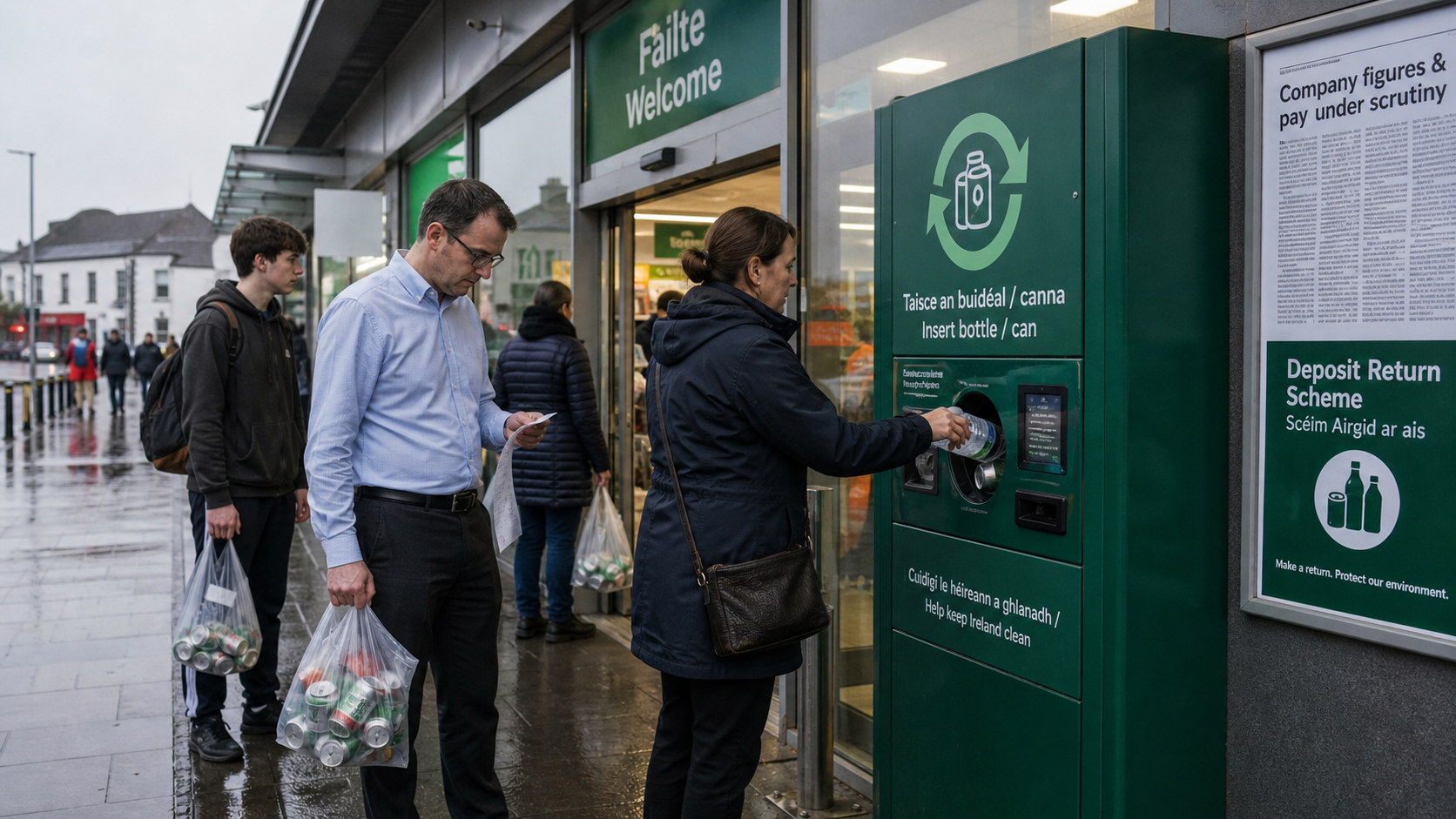
Re-turn Deposit Return Scheme Disputes Its Own Figures as Questions Over Executive Pay Emerge
Re-turn, the company responsible for operating Ireland's deposit return scheme for plastic bottles and aluminium cans, is facing a period of uncomfortable scrutiny after disputing its own published figures on container return rates, while separate questions have emerged about the level of executive pay at the organisation — a combination of controversies that has drawn attention to the governance of one of Ireland's most significant recent environmental policy initiatives.
Background
Ireland's deposit return scheme, operated by Re-turn, launched in February 2024 after years of planning and preparation. The scheme requires consumers to pay a deposit — 15 cent for containers under 500ml and 25 cent for larger containers — when purchasing drinks in plastic bottles or aluminium cans, with the deposit refunded when the empty container is returned to a designated reverse vending machine at a participating retailer. The scheme covers a wide range of beverages, from water and soft drinks to beer and cider, and has been rolled out across thousands of retail locations across the country.
The environmental rationale for the scheme is well-established. Deposit return schemes have been shown in other countries — including Germany, Norway, and Sweden — to dramatically increase recycling rates for the covered containers, reducing litter and improving the quality of recyclable material collected. Ireland's scheme was designed with these international models in mind, and the government set ambitious targets for container return rates in the years following the launch.
Re-turn is a not-for-profit company established by the drinks industry to operate the scheme on behalf of the state. It is funded through a combination of producer fees and the unredeemed deposits on containers that are not returned — a revenue stream that has proven to be significant given the scale of the scheme's operation.
Key Developments
The controversy over Re-turn's figures centres on a discrepancy between the return rate statistics published by the organisation and the figures that independent analysts have calculated from the underlying data. Re-turn has disputed the published figures, suggesting that the methodology used to calculate return rates may not accurately reflect the scheme's actual performance. The dispute has raised questions about the transparency of Re-turn's reporting and about the robustness of the data collection systems underpinning the scheme.
Separately, questions have emerged about the level of executive pay at Re-turn, with reports suggesting that senior management salaries are significantly higher than might be expected for a not-for-profit organisation operating a state-mandated scheme. Re-turn has not commented publicly on the specific figures cited in reports, but the issue has attracted attention from politicians and consumer advocates who argue that the organisation's governance should be subject to greater scrutiny given its quasi-public function.
Why It Matters
The deposit return scheme is one of the most significant environmental policy initiatives introduced in Ireland in recent years, and its success or failure will have implications for Ireland's ability to meet its recycling targets under EU legislation. The EU's Single-Use Plastics Directive and the Packaging and Packaging Waste Regulation set demanding targets for the collection and recycling of plastic bottles and aluminium cans, and Ireland's deposit return scheme is the primary mechanism for meeting those targets. If the scheme is not performing as well as its published figures suggest, that is a matter of genuine public concern — not just for environmental reasons, but because the scheme imposes costs on consumers and retailers that are justified by the environmental benefits it is supposed to deliver.
The executive pay question is also significant in the context of public trust. Re-turn operates a scheme that is effectively mandated by the state and funded in part by consumer deposits. The expectation that such an organisation would be run with the same level of pay restraint and transparency as a public body is reasonable, and the emergence of questions about executive compensation is likely to prompt calls for greater oversight of Re-turn's governance arrangements.
Local Impact
For consumers across Ireland — from Dublin's supermarkets to corner shops in rural Connacht — the deposit return scheme has become a familiar part of daily life. The reverse vending machines at Tesco, Lidl, Aldi, SuperValu, and other retailers have been widely adopted, and the scheme has generated a significant change in consumer behaviour around the disposal of plastic bottles and cans. The controversy over Re-turn's figures and executive pay is unlikely to affect consumers' day-to-day experience of the scheme, but it may affect public confidence in the organisation and in the scheme's governance. The Department of the Environment, which has policy responsibility for the scheme, is expected to seek clarification from Re-turn on the disputed figures and on the executive pay question.
What's Next
Re-turn is expected to publish a clarification of its return rate figures in the coming weeks, along with a response to the questions about executive pay. The Department of the Environment has indicated it is monitoring the situation and will engage with Re-turn's board on the governance questions that have been raised. The Oireachtas Environment Committee is expected to invite Re-turn's management to appear before it in the autumn session to address the controversies. The scheme's performance will also be assessed as part of the government's mid-term review of Ireland's National Waste Management Plan, which is scheduled for later in 2026.