President Connolly to Meet Ann Travers Over Mary McArdle Photo Controversy as Backlash Intensifies
President Seán Connolly has offered to meet Ann Travers, the sister of Mary Travers who was murdered by the IRA in 1984, following a controversy over a photograph featuring Mary McArdle — a convicted IRA member who served time for her role in the murder — with the offer coming as political pressure on the President's office intensifies and commentators question the judgement that led to the original incident.
Background
The murder of Mary Travers on 8 April 1984 remains one of the most painful episodes of the Troubles for the Travers family and for many who lived through that period. Mary, aged 22, was shot dead by IRA members as she walked from Sunday Mass at St Brigid's Church in Derryvolgie Avenue, south Belfast, alongside her father Tom Travers, a magistrate who was the intended target of the attack. Tom Travers survived, though he was seriously wounded. Mary McArdle was convicted of the murder and served a prison sentence before her release under the terms of the Good Friday Agreement.
Ann Travers, Mary's sister, has spent decades campaigning for victims' rights and for greater accountability in how the state and political parties engage with those convicted of Troubles-era violence. Her advocacy has been consistent and principled, and she has been a vocal critic of what she regards as the normalisation of former IRA members in public life without adequate acknowledgement of the harm they caused.
The controversy that prompted the President's offer to meet her centres on a photograph in which a convicted IRA member appeared alongside the President at a public event. The precise circumstances of the photograph and the President's awareness of the individual's background have been the subject of conflicting accounts, but the image's circulation caused significant distress to Ann Travers and to other victims' families.
Key Developments
RTÉ reported that President Connolly has offered to meet Ann Travers personally to discuss the controversy and to hear her concerns directly. The offer was welcomed cautiously by Travers, who indicated through a spokesperson that she would consider the invitation but that any meeting would need to be substantive rather than merely symbolic.
The Irish News columnist Máiría Cahill, herself a survivor of IRA abuse and a prominent victims' advocate, questioned whether the President would "do the decent thing" and engage meaningfully with Travers' concerns. Cahill's column reflected a broader frustration among victims' advocates that expressions of regret from political figures are often followed by a return to business as usual rather than genuine change in how former paramilitaries are treated in public life.
The controversy has also drawn comment from across the political spectrum. Fine Gael and Fianna Fáil representatives have called for clarity from the President's office about the circumstances of the photograph, while Sinn Féin has declined to comment on the specific incident.
Why It Matters
The McArdle photograph controversy touches on one of the most sensitive fault lines in Irish political life: the tension between the peace process imperative of moving forward and the victims' imperative of not forgetting. The Good Friday Agreement's prisoner release provisions were a necessary element of the peace settlement, but they did not — and could not — resolve the grief and anger of those who lost family members to political violence.
For the President's office, the episode is a reminder that the symbolic dimensions of the presidency carry real weight. The President of Ireland is not merely a constitutional figurehead but a representative of the state's values and its relationship with its history. Photographs matter. Associations matter. The judgement exercised in managing those associations is part of the job.
The broader question — how Irish public life should engage with former paramilitaries who have served their sentences and re-entered society — does not have a simple answer. But the minimum that victims' families are entitled to expect is that their pain is not compounded by carelessness or indifference at the highest levels of the state.
Local Impact
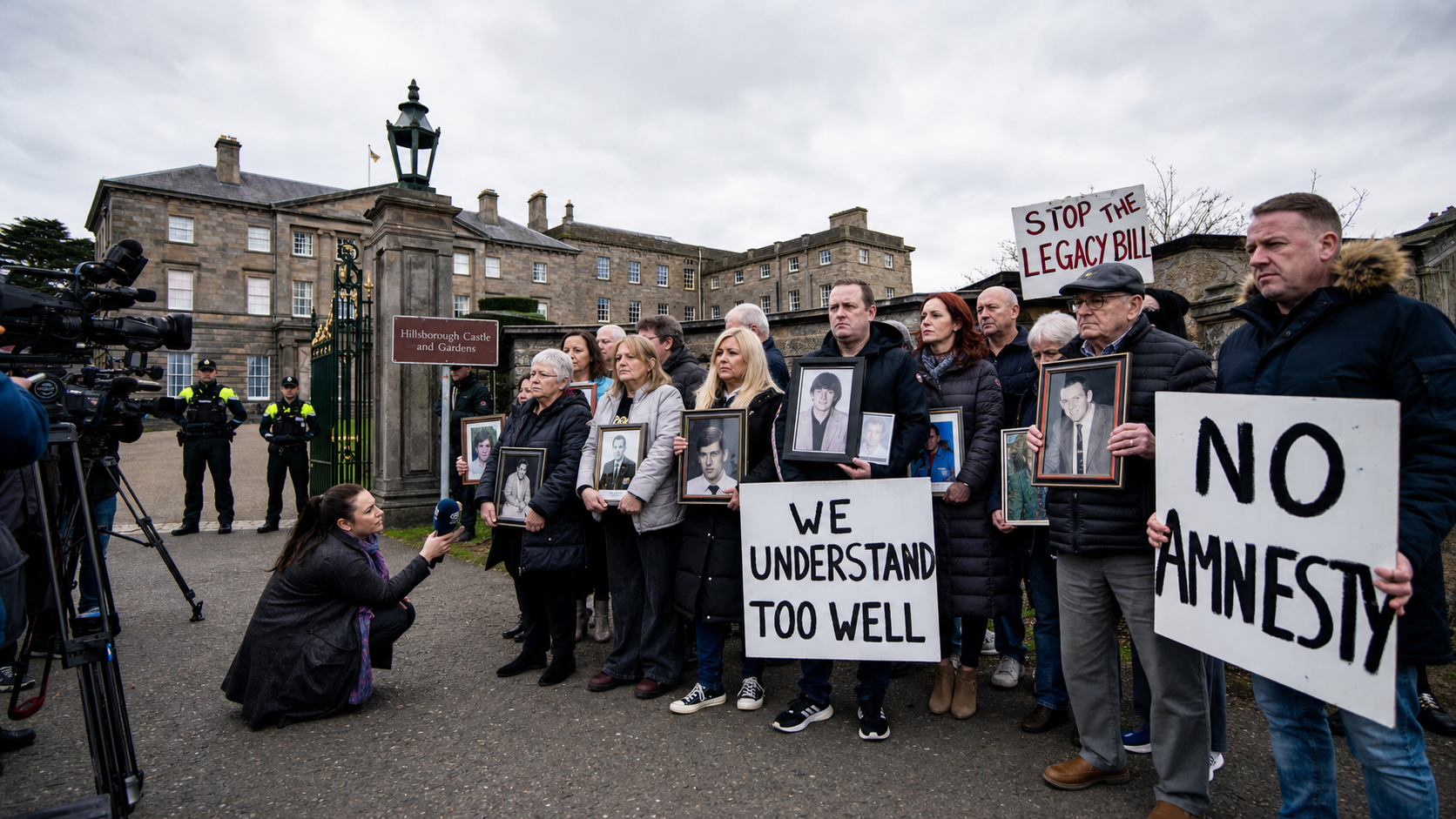
For victims' families across Ireland and Northern Ireland, the controversy has reopened wounds that never fully heal. The Troubles claimed more than 3,500 lives, and the families of those killed continue to live with the consequences of that violence every day. The President's offer to meet Ann Travers is a step toward acknowledging that reality, but its significance will depend entirely on what follows from the meeting.
In south Belfast, where the Travers family has deep roots, the controversy has been followed closely by communities that remember the 1984 murder and its aftermath. The area's mixed residential character — nationalist and unionist communities living in close proximity — means that Troubles-era incidents retain a particular resonance that does not diminish with time.
What's Next
Ann Travers is expected to respond formally to the President's invitation in the coming days. If a meeting takes place, it will be closely watched by victims' advocates and political commentators as an indicator of how the President's office intends to handle similar situations in the future. The broader policy question — about the protocols governing the President's public engagements — is likely to be reviewed internally following the controversy.